
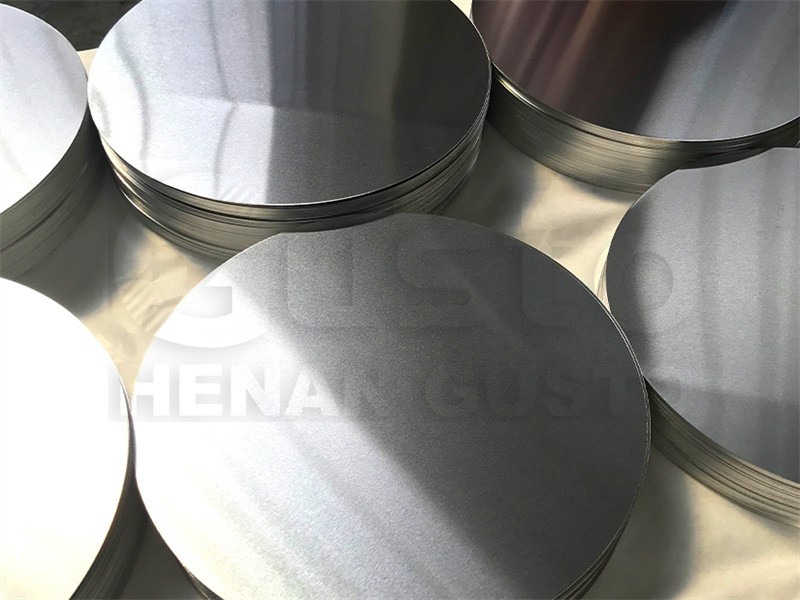
Buying aluminum disc in bulk is not complicated — once you know the key variables. The wrong alloy grade, temper, or surface finish can cause production failures downstream. This buyer’s guide breaks down everything you need before placing an order: alloy selection, size tolerances, surface options, pricing logic, and supplier evaluation tips.
Whether you need a 1050 aluminum disc for cookware spinning, a colored aluminum disc for decorative panels, or a round aluminum disc for machining blanks, this guide helps you buy smart and avoid common sourcing mistakes.

Why Alloy Grade Is the First Decision
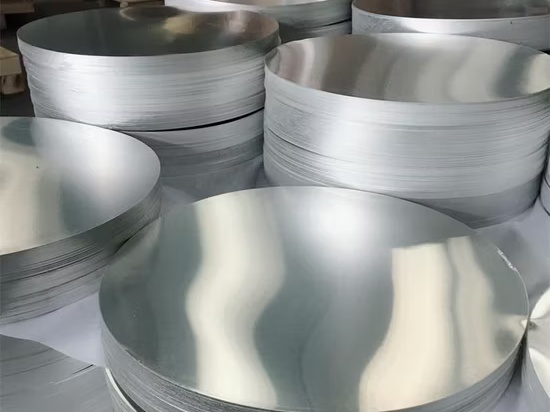
Many buyers focus on price first. Experienced buyers focus on alloy first. Choosing the wrong alloy costs far more in rework and scrap than any savings on the unit price.
Here is a practical alloy selector:
| Your Application | Recommended Alloy | Why |
|---|---|---|
| Deep-draw cookware (pots, pans) | 1050 / 1060 | Maximum ductility, food-safe, easy to spin |
| Pressure cooker lids | 3003-O | Better strength than 1-series, still deep-drawable |
| Road & traffic sign blanks | 1060 / 5052 | Weather resistance, lightweight, flat surface |
| LED reflectors & lighting | 1050 / 1060 | Highest reflectivity in pure aluminum series |
| Anodized decorative parts | 1050 / 5052 | Clean anodize response, consistent surface |
| Precision machining blanks | 6061-T6 | High strength, good machinability, tight tolerances |
| Marine / outdoor structural | 5052-H32 | Superior saltwater corrosion resistance |
| PCB heat spreader / LED base | 1060 / 3003 | Good thermal conductivity, flat surface |
| Dye sublimation blanks | 1100-O | Smooth surface accepts coating evenly |
Key rule: 1-series alloys (1050, 1060, 1100) are the softest and most formable. They anodize cleanly but have lower strength. 3003 adds strength. 5052 adds marine-grade corrosion resistance. 6061-T6 is the strongest but least formable.
Understanding Temper: O, H14, H18, T6
After alloy, temper is the second most important variable. Many buyers overlook this and receive material that cracks during forming.
| Temper | Description | Best For |
|---|---|---|
| O (annealed) | Fully soft, maximum ductility | Deep drawing, spinning, stamping |
| H12 | Strain-hardened, 1/4 hard | Light forming, moderate strength needed |
| H14 | 1/2 hard | Flat parts, signs, panels |
| H18 | Full hard | Stiffness required, no forming |
| T6 | Solution heat-treated + aged | Machining, structural, high-load parts |
For cookware: always specify O temper. A disc that arrives in H14 will crack during deep drawing — this is one of the most common sourcing errors.
For machined parts: always specify T6. O-temper 6061 is too soft for precision work.
Aluminum Disc Size Tolerances: What to Specify
A professional purchase order for aluminum disc should include the following dimensions with tolerances:
| Parameter | Typical Tolerance | Notes |
|---|---|---|
| Diameter | ±0.5 mm (standard) / ±0.2 mm (precision) | Specify which when ordering |
| Thickness | ±0.05 mm – ±0.1 mm | Depends on alloy and thickness |
| Flatness | ≤1.5 mm per 1,000 mm | Critical for sign blanks and PCB substrates |
| Edge condition | Sheared / milled / deburred | Milled edge = cleaner, safer for operators |
| Surface roughness | Ra ≤ 0.4 µm (mirror) / Ra ≤ 1.6 µm (mill) | Specify for anodized or coated discs |
Common Diameter Reference Table
| Diameter | Inch Equivalent | Typical Use |
|---|---|---|
| 80 mm | ~3.1 in | Small cookware base, instrument parts |
| 100 mm | ~4 in | 4 inch aluminum disc — lids, flanges |
| 150 mm | ~6 in | Medium cookware, sign components |
| 200 mm | ~8 in | Wok bases, industrial blanks |
| 300 mm | ~12 in | 12 inch aluminum disc — large cookware, sign blanks |
| 500 mm | ~20 in | Large sign blanks, industrial discs |
| 600 mm | ~24 in | 24 aluminum disc — industrial reflectors, large flanges |
| 1,000 mm+ | 39 in+ | Custom industrial / architectural applications |
Surface Finish Options and What They Affect
The surface finish affects both function and downstream processing. Here is a breakdown of common surface options for aluminum disc:
Mill Finish
The standard as-produced surface. Slight rolling lines may be visible. Suitable for parts that will be formed, painted, or coated after receipt. This is the lowest-cost option.
Bright / Mirror Finish
Mechanically or chemically polished to a reflective surface. Used for LED aluminum disc reflectors, decorative items, and cosmetic components. Specify Ra value and minimum reflectivity (e.g., ≥86%).
Anodized Finish
An electrochemical oxide layer applied after machining or forming. Anodized aluminum disc options include:
| Anodize Type | Thickness | Color Options | Use |
|---|---|---|---|
| Type II (standard) | 5–25 µm | Clear, black, gold, red, blue | Decorative, consumer products |
| Type III (hard anodize) | 25–75 µm | Black, dark gray | Industrial, wear surfaces |
| Color anodized | 5–20 µm | Custom RAL colors | Architectural, branded parts |
Colored aluminum disc products are popular in the promotional products industry, electronics accessories, and architectural trim. Ensure the supplier anodizes after cutting, not before — cutting after anodizing damages the oxide layer at the edge.
Pre-painted / PVDF Coated
Used for architectural and decorative applications. A coated aluminum circle plate can be directly fabricated into finished panels.
Aluminum Disc for Abrasive & Grinding Use
A separate product category also carries the name “aluminum disc.” These are abrasive discs used on angle grinders and power tools:
| Product | Description | Use Case |
|---|---|---|
| Aluminum cutting disc | Thin (1.0–1.6 mm) reinforced abrasive disc | Cutting aluminum sections and pipes |
| Aluminum grinding disc | Thicker (4–8 mm) depressed-center disc | Grinding welds and edges on aluminum |
| Aluminum sanding disc | Hook-and-loop or PSA backed abrasive | Surface preparation and paint removal |
| Aluminum flap disc | Overlapping abrasive flap segments | Blending, deburring, light grinding |
| Aluminum oxide disc | Aluminum oxide abrasive on fiber or cloth backing | General metal finishing |
| Aluminum oxide grinding disc | Bonded aluminum oxide wheel | Bench grinders, precision grinding |
Important: Standard ferrous-metal discs clog immediately on aluminum due to chip loading. Always use discs specifically designed for non-ferrous metals when working with aluminum. Look for products labeled “for aluminum” or “non-ferrous” — they use open-coat abrasives or special bond systems that resist loading.
For angle grinder aluminum disc applications, the most common sizes are 4.5 inch (115 mm) and 5 inch (125 mm) with M14 or 5/8″-11 arbor holes.
How Aluminum Disc Is Priced
Understanding pricing logic helps you negotiate better and avoid overpaying.
Price Components
Final price (USD/ton) =
  LME aluminum spot price
  + processing premium (alloy + temper)
  + size premium (custom diameter or tight tolerance)
  + surface finish premium
  + freight & packaging
Typical Processing Premiums Over LME (indicative)
| Item | Premium (USD/ton, indicative) |
|---|---|
| 1060-O, standard size, mill finish | Base (lowest) |
| 1100-O, standard size | +$50–$100 |
| 3003-O | +$80–$150 |
| 5052-H32 | +$150–$250 |
| 6061-T6 | +$200–$400 |
| Mirror / bright finish | +$100–$200 |
| Type II anodized | +$200–$500 |
| Custom diameter (non-standard) | +$50–$150 |
Prices fluctuate with the LME aluminum index. Always request a price valid for a specific number of days (typically 7–15 business days) when requesting quotations.
MOQ and Order Quantity Impact
| Order Size | Price Impact |
|---|---|
| Under 500 kg | Usually not accepted or carries surcharge |
| 500 kg – 2 MT | Standard MOQ pricing |
| 2 MT – 5 MT | Small discount, more alloy/size flexibility |
| 5 MT – 20 MT | Better pricing, priority scheduling |
| 20 MT+ | Best pricing, custom packing, dedicated service |
What to Check Before Ordering from a Supplier
Use this checklist when evaluating an aluminum disc supplier:
Product Capability
- Can they produce your exact alloy and temper?
- Do they have in-house rolling and annealing, or are they a trader?
- What is their diameter range and minimum/maximum thickness?
- Can they provide material test reports (MTR) with chemical and mechanical data?
Quality Control
- Do they perform 100% dimensional inspection or statistical sampling?
- Is surface quality inspection done under standard lighting conditions?
- Can they provide flatness certificates for sign-grade discs?
Certifications
- ISO 9001 quality management system
- SGS or Bureau Veritas third-party inspection
- REACH / RoHS compliance for EU market
- Food-contact safety certificates for cookware discs (FDA, LFGB, etc.)
Logistics
- What is the standard packing method? (interleaved with paper, palletized, wooden case)
- Do they have experience exporting to your country?
- Can they provide a full set of shipping documents: commercial invoice, packing list, bill of lading, certificate of origin, Form E (ASEAN), EUR.1 (EU)?
Packing Standards for Aluminum Disc Export
Poor packing is a hidden cost. Disc-on-disc contact without interleaving causes surface scratches. Here are the standard packing options:
| Packing Type | Description | Best For |
|---|---|---|
| Interleaved with paper | Kraft or PE film between each disc | Mirror finish, anodized, any cosmetic surface |
| Polybag per disc | Individual plastic sleeve | Premium / high-value discs |
| Pallet + stretch wrap | Stacked on pallet, stretch-wrapped | Large diameter (300mm+), bulk orders |
| Wooden case | Full wooden case export packing | Long sea freight, sensitive surfaces |
| Wooden pallet (ISPM 15) | Heat-treated timber, export compliant | All sea freight destinations |
Always specify “interleaved with PE film or kraft paper” for any disc that will not undergo further surface treatment. Confirm the supplier marks each bundle with alloy, temper, diameter, thickness, batch/lot number, and net weight.
Top Buyer Questions Answered
Q: What is the difference between aluminum disc and aluminum circle? In manufacturing, “aluminum circle” is the industry-standard term used by producers and in technical standards. “Aluminum disc” is the term most commonly used by English-speaking buyers, engineers, and online searchers. They refer to exactly the same product.
Q: Can I order a 3 inch aluminum disc or 4 inch aluminum disc in small quantities? Factories typically have a minimum order of 500 kg. For small quantities of small discs (3 inch, 4 inch), you can often meet the MOQ by ordering multiple thicknesses or alloys. Some distributors stock standard sizes in smaller quantities.
Q: Is a colored aluminum disc food-safe? It depends on the coloring method. Anodized colored discs (Type II anodize) that are sealed are generally food-safe. Dye-impregnated anodize should be verified against LFGB or FDA standards. Always request a food-contact compliance statement if the disc will be used in cookware.
Q: What is the lead time for custom-size aluminum discs? Standard sizes (common diameters, standard alloys) ship in 7–15 days from a stocked factory. Custom diameters or non-standard alloys typically require 20–35 days, including rolling, annealing, blanking, and quality inspection.
Q: How do I calculate the weight of an aluminum disc? Use this formula:
Weight (kg) = π × (D/2)² × T × 2.71 / 1,000,000
Where D = diameter in mm, T = thickness in mm, and 2.71 = aluminum density (g/cm³).
Example: A 300 mm diameter × 3 mm thick 1060 disc: = 3.1416 × 150² × 3 × 2.71 / 1,000,000 = 0.576 kg per disc
Aluminum Disc Export: Key Markets
As a manufacturer, we supply aluminum discs to buyers in more than 60 countries. Major markets include:
Americas USA, Canada, Mexico, Brazil, Colombia, Peru, Chile
Europe Germany, Italy, France, Spain, Turkey, Poland, Netherlands, Portugal
Middle East & Africa UAE, Saudi Arabia, Egypt, Iran, Nigeria, South Africa, Kenya, Morocco, Ethiopia
Asia Pacific Vietnam, Indonesia, Malaysia, Thailand, South Korea, Bangladesh, Pakistan, Australia
Popular products by region:
- Cookware disc (1050/1060-O): Middle East, Southeast Asia, Africa, South America
- Sign blank disc (5052/1060-H14): USA, Europe, Australia
- Anodized colored disc: Europe, USA, Japan, South Korea
- Machining blank (6061-T6): USA, Germany, Japan
Request a Quote
Ready to source aluminum disc for your production line?
Provide the following details for a fast, accurate quotation:
- Alloy grade and temper (e.g., 1060-O, 3003-O, 6061-T6)
- Diameter (mm or inches) and thickness (mm)
- Surface finish (mill finish / anodized / mirror / painted)
- Quantity (kg or number of pieces)
- Destination port and required Incoterms
Response within 24 hours. Sample orders accepted.