
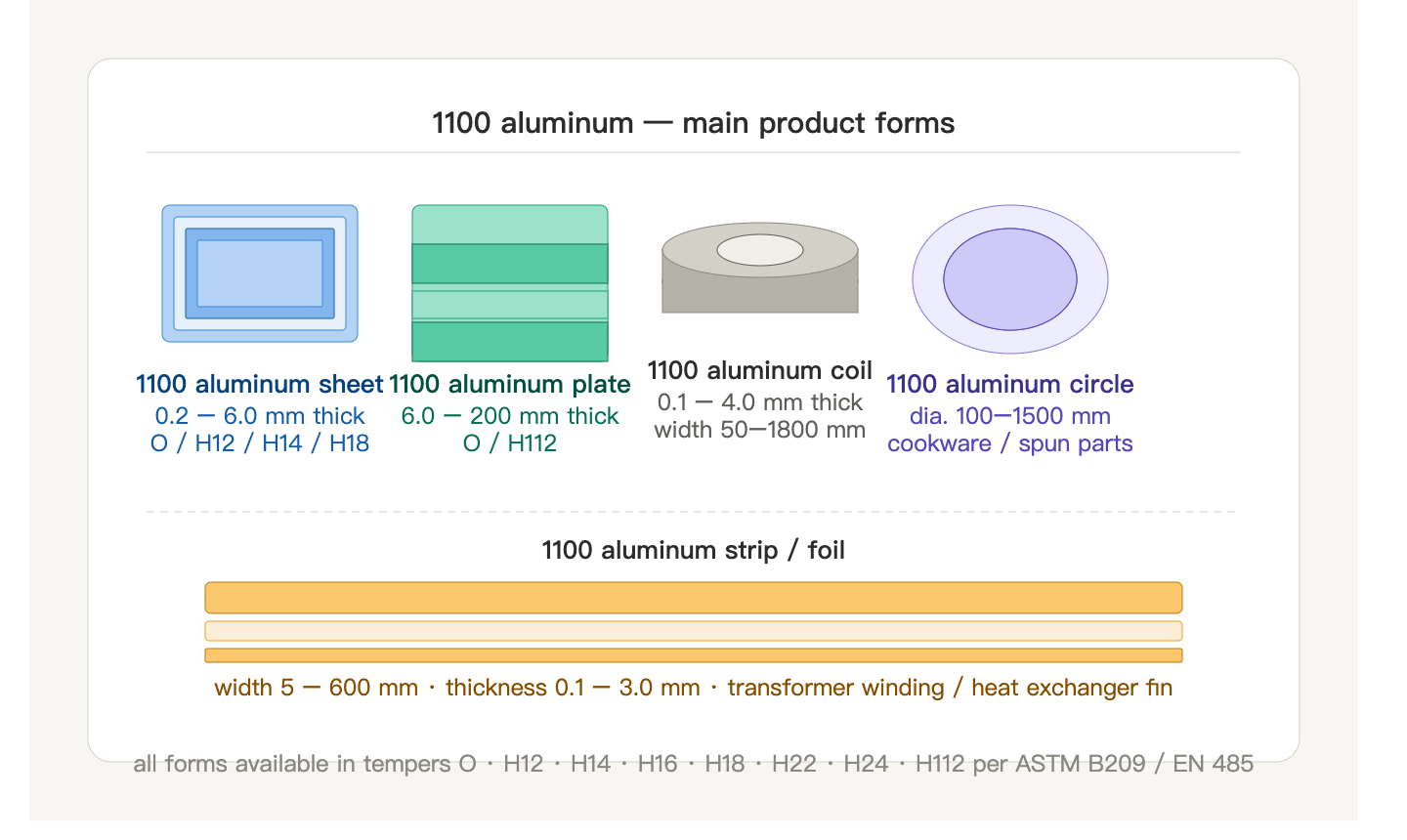
1100 aluminum is one of the most widely used commercially pure aluminum alloys in the world. With a minimum aluminum content of 99%, it offers excellent corrosion resistance, outstanding formability, and high electrical conductivity. Whether you are sourcing 1100 aluminum plate, 1100 aluminum sheet, or 1100 aluminum circle blanks, this alloy delivers consistent performance at a competitive price.
This guide covers everything buyers and engineers need to know — from chemical composition and mechanical properties to key applications and a direct comparison with 6061 and 5052 grades.
What Is 1100 Aluminum (AA1100)?
AA1100 aluminum is a wrought, commercially pure aluminum alloy in the 1xxx series. The designation “1100” follows the Aluminum Association standard, where the first digit “1” indicates a purity of at least 99% aluminum. It is not a heat-treatable alloy; strength is achieved through cold working (strain hardening).
Because 1100 aluminum contains very low levels of alloying elements, it has superior workability and weldability. It is the go-to material for applications that require deep drawing, spinning, stamping, or roll-forming without cracking.
Key identity: 1100 aluminum = commercially pure aluminum (≥99% Al), non-heat-treatable, excellent for cold forming, corrosion-resistant, widely available as sheet, plate, circle, coil, and strip.
1100 Aluminum Chemical Composition
The aluminium 1100 chemical composition is tightly controlled by international standards including ASTM B209, EN 573-3, and GB/T 3880. The table below shows the typical chemical composition per ASTM specification.
| Element | Symbol | Content (%) | Note |
|---|---|---|---|
| Aluminum | Al | ≥ 99.00 | Base metal |
| Silicon + Iron | Si+Fe | ≤ 0.95 | Combined limit |
| Copper | Cu | 0.05 – 0.20 | Minor addition |
| Manganese | Mn | ≤ 0.05 | Trace |
| Zinc | Zn | ≤ 0.10 | Trace |
| Others (each) | — | ≤ 0.05 | — |
| Others (total) | — | ≤ 0.15 | — |
The minimal alloying elements in the aluminium alloy 1100 datasheet are intentional. Low impurity levels translate directly into better electrical conductivity, softer temper response, and easier fabrication.
1100 Aluminum Properties: Mechanical & Physical
Understanding 1100 aluminum properties is essential when selecting the right temper for your application. The most common tempers are O (annealed/soft) and H14 (quarter-hard, strain hardened).
| Property | 1100-O | 1100-H14 | Unit |
|---|---|---|---|
| Tensile strength | 90 | 125 | MPa |
| Yield strength | 35 | 115 | MPa |
| Elongation | 25 | 9 | % |
| Brinell hardness | 23 | 32 | HB |
| Density | 2.71 | g/cm³ | |
| Melting range | 643 – 657 | °C | |
| Thermal conductivity | 222 | W/m·K | |
| Electrical conductivity | 59 | % IACS | |
| Modulus of elasticity | 69 | GPa | |
| Coefficient of thermal expansion | 23.6 | µm/m·°C | |
The O temper is ideal for deep drawing and complex forming. The H14 temper provides a balance of moderate strength and adequate ductility for general sheet metal work.
1100 Aluminum vs 6061: Which Should You Choose?
The comparison of 1100 aluminum vs 6061 is one of the most common questions buyers ask. The two alloys serve fundamentally different purposes.
1100 Aluminum
- Commercially pure (≥99% Al)
- Excellent formability & ductility
- Superior corrosion resistance
- High electrical & thermal conductivity
- Not heat-treatable
- Lower strength
- Best for: cookware, chemical tanks, food processing, electrical bus bars
6061 Aluminum
- Alloy with Mg and Si additions
- High strength (up to 310 MPa tensile)
- Heat-treatable (T6 temper)
- Good machinability
- Lower formability than 1100
- Good corrosion resistance
- Best for: structural parts, aerospace frames, bicycle frames, marine fittings
Choose 1100 aluminum when your process requires deep drawing, spinning, or chemical exposure. Choose 6061 when structural strength and machining are the priority.

1100 Aluminum vs 5052: Key Differences
When comparing 1100 aluminum vs 5052, the main trade-off is between formability and fatigue strength.
| Parameter | 1100 Aluminum | 5052 Aluminum |
|---|---|---|
| Purity / Series | ≥99% Al (1xxx) | Al-Mg alloy (5xxx) |
| Tensile strength (typical) | 90–125 MPa | 195–260 MPa |
| Formability | Excellent | Very good |
| Fatigue strength | Lower | Higher |
| Weldability | Excellent | Excellent |
| Corrosion resistance | Excellent (pure Al) | Excellent (marine grade) |
| Typical use | Cookware, chemical vessels, circles | Fuel tanks, marine, signage |
5052 is the better choice for applications with dynamic loading or marine environments. 1100 aluminum is preferred when the process demands maximum ductility and high electrical conductivity.
1100 Aluminum Sheet & Plate: Specifications
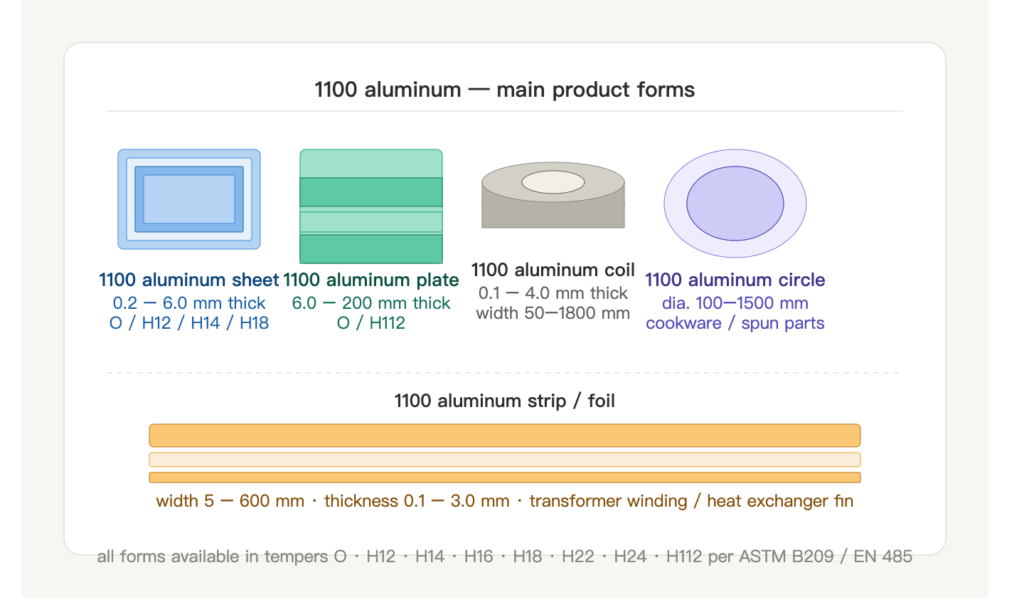
1100 aluminum sheet and 1100 aluminum plate are available in a wide range of thicknesses and widths. The table below lists standard dimensions. Custom sizes are available on request.
| Product Form | Thickness Range | Width Range | Common Tempers | Standard |
|---|---|---|---|---|
| 1100 aluminum sheet | 0.2 – 6.0 mm | 500 – 2650 mm | O, H12, H14, H16, H18 | ASTM B209 / EN 485 |
| 1100 aluminum plate | 6.0 – 200 mm | 500 – 2650 mm | O, H112 | ASTM B209 / GB/T 3880 |
| 1100 aluminum coil | 0.1 – 4.0 mm | 50 – 1800 mm | O, H14, H18, H22, H24 | ASTM B209 |
| 1100 aluminum circle | 0.5 – 6.0 mm | Diameter 100–1500 mm | O, H14, H18 | EN 573 / GB/T |
| 1100 aluminum strip | 0.1 – 3.0 mm | 5 – 600 mm | O, H14, H18 | ASTM B209 |
The 1100 aluminum plate price depends on the LME aluminum spot price, the temper, thickness tolerance, and quantity. Contact our sales team for a current quotation with mill test report.
1100 Aluminum Circle for Cookware
One of the largest applications for 1100 aluminum is cookware manufacturing. 1100 aluminum circle blanks are stamped or deep-drawn into pots, pans, woks, and pressure cooker bodies. The soft O temper allows the material to flow without cracking during multi-stage deep drawing.
Standard 1100 aluminum circles for cookware range from 200 mm to 1,000 mm in diameter and 0.8 mm to 4.0 mm in thickness. Surface finish options include mill finish, brushed finish, and anodizing-ready surfaces.
1100 Aluminum Strips and Coil for Industrial Use
1100 aluminum strips and coils are used in transformer winding, cable wrapping, fin stock for heat exchangers, and food packaging. The high electrical conductivity (59% IACS) makes 1100 aluminum strips a cost-effective replacement for copper in certain transformer applications.
We supply 1100 aluminum strips coil in slit widths from 5 mm to 1,800 mm with tight thickness tolerances of ±0.01 mm for precision applications.
1100 Aluminum for Curtain Wall Panels
1100 aluminum sheet for curtain wall applications is gaining popularity as architects favor lightweight, corrosion-resistant cladding materials. The alloy’s excellent anodizing response allows deep, uniform anodic oxide coatings in bronze, gold, black, and natural silver finishes.
For curtain wall panels, H14 or H18 temper sheets between 2 mm and 4 mm are most common. Flatness tolerance follows EN 485-4 or ASTM B209 straightness standards.
Key Applications of 1100 Aluminum
Cookware & kitchen equipment
Electrical bus bars & transformer windings
Curtain wall & architectural cladding
Chemical & food processing tanks
Food & pharmaceutical packaging
Heat exchanger fin stock
Nameplates & reflectors
Lighting fixtures & lampshades
Why Source 1100 Aluminum from a Manufacturer?
As a direct manufacturer with in-house rolling, slitting, annealing, and quality control, we offer several advantages over trading companies:
- Mill test reports (MTR) and full traceability from cast to finished product
- Competitive 1100 aluminum plate price with no middleman markup
- Custom sizes, alloy certifications (ASTM, EN, JIS, GB), and surface treatments
- Minimum order quantities starting from 1 metric ton
- Export packaging compliant with ISPM-15 (heat-treated wooden pallets)
- Lead time from 7 to 25 working days depending on size and quantity
Export Markets and Shipping
We regularly export 1100 aluminum sheet, plate, coil, and circle to over 60 countries, including the United States, Mexico, Brazil, Germany, Turkey, Saudi Arabia, UAE, Australia, Vietnam, and Indonesia. Shipment is by sea (FCL/LCL) or air freight for urgent orders. We provide full export documentation including CO, packing list, invoice, and bill of lading.
Frequently Asked Questions
What is the difference between 1100 and 1050 aluminum?
Both are commercially pure aluminum alloys. 1050 has a minimum purity of 99.5%, slightly higher than 1100’s 99.0%. 1050 has marginally better conductivity and corrosion resistance, while 1100 offers slightly better machinability due to its small copper addition.
Is 1100 aluminum weldable?
Yes. 1100 aluminum welds easily using TIG or MIG processes. Recommended filler alloys are 1100 or 4043. Post-weld annealing is not normally required.
Can 1100 aluminum be anodized?
Yes, and it produces an excellent anodic oxide layer. Because of its high purity, the anodized finish is very clear and uniform, ideal for decorative and architectural applications.
What is the 1100 aluminum bar used for?
1100 aluminum bar is used for rivets, cold-headed fasteners, wire, and light structural shapes where formability is more important than strength. It is also used in chemical processing equipment where corrosion resistance is critical.
Request a quote for 1100 aluminum
Tell us your required size, temper, quantity, and destination — we will respond within 24 hours with pricing and lead time.Get a quote ↗