
Stucco pattern aluminum is one of the most widely used embossed aluminum products in industrial insulation, construction cladding, and HVAC jacketing. Its distinctive orange-peel-like surface not only adds strength and rigidity but also gives a clean, professional appearance on finished installations. This guide covers everything buyers and engineers need to know — from alloy selection and dimensions to pricing and supplier considerations.
Whether you need stucco aluminum sheets for pipe jacketing, stucco aluminum siding for wall cladding, or stucco aluminum trim for architectural finishing, this page will help you specify the right product and source it efficiently.
What Is Stucco Pattern Aluminum?
Stucco pattern aluminum — also written as stucco and aluminium in British English markets — refers to aluminum sheet or coil that has been cold-rolled through an embossing mill to produce a raised, random-bump texture. The result looks similar to the exterior plaster finish known as “stucco,” hence the name.
The process creates an aluminum stucco finish that is harder and stiffer than flat-rolled sheet of the same gauge. This makes it ideal for large-format panels that need to resist denting, oil-canning, and physical handling damage during installation.
The core product is also referred to as a stucco plate when supplied in cut sheet form, or stucco coil when supplied on rolls for fabricators who slit or shear it to size.
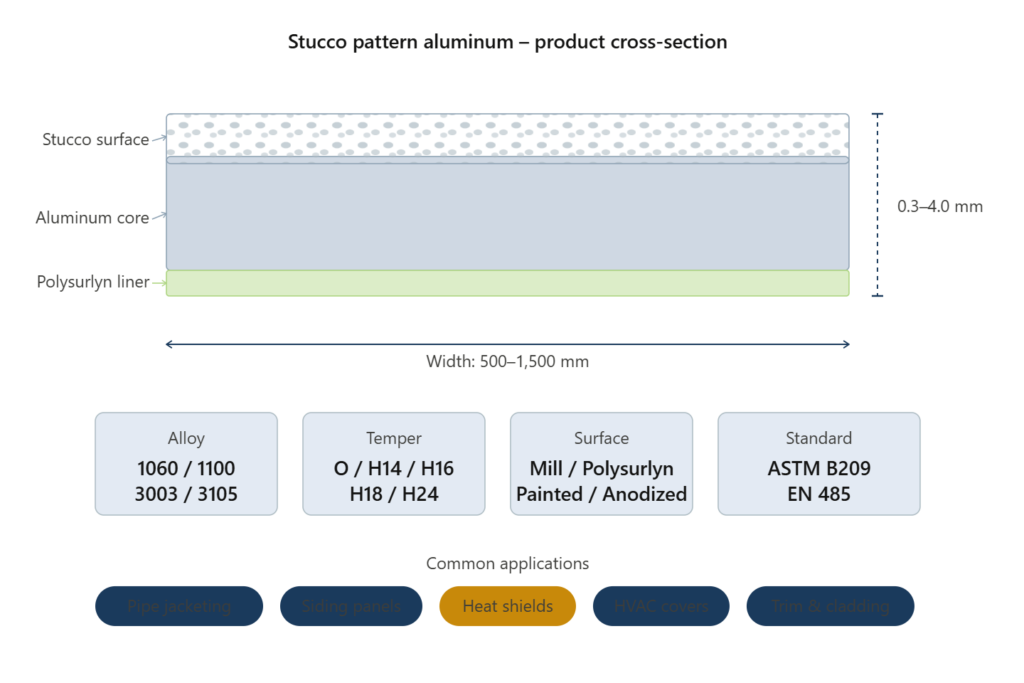
Stucco Pattern Aluminum – Full Specification Table
The following table covers the standard product range offered by most aluminum stucco embossed sheet suppliers. Custom dimensions and tempers are available on request.
| Parameter | Standard Range | Common Specification |
|---|---|---|
| Alloy | 1050, 1060, 1100, 3003, 3105 | 1060 / 3003 |
| Temper | O, H14, H16, H18, H24 | H14 / H18 |
| Thickness | 0.3 mm – 4.0 mm | 0.4 mm / 0.5 mm / 0.6 mm / 1.0 mm |
| Width | 500 mm – 1,500 mm | 914 mm / 1,000 mm / 1,200 mm |
| Length (sheet) | 1,000 mm – 6,000 mm | 2,000 mm / 2,440 mm |
| Coil ID | 150 mm / 405 mm / 505 mm | 405 mm |
| Coil Weight | Up to 3,000 kg | 500 – 2,000 kg |
| Surface | Stucco embossed (one side) | Mill finish / anodized / painted |
| Pattern depth | 0.10 mm – 0.35 mm | 0.20 mm |
| Standard | ASTM B209 / EN 485 | ASTM B209 |
Alloy Comparison for Stucco Embossed Aluminum
| Alloy | Tensile Strength | Corrosion Resistance | Best Use Case | Relative Cost |
|---|---|---|---|---|
| 1060 | ~95 MPa (H18) | Excellent | Jacketing, general insulation | Low |
| 1100 | ~110 MPa (H14) | Excellent | Food-grade panels, HVAC | Low–Medium |
| 3003 | ~145 MPa (H14) | Very Good | Siding, cladding, heat shields | Medium |
| 3105 | ~160 MPa (H16) | Very Good | Structural cladding, roofing | Medium |
Applications of Stucco Aluminum Sheets
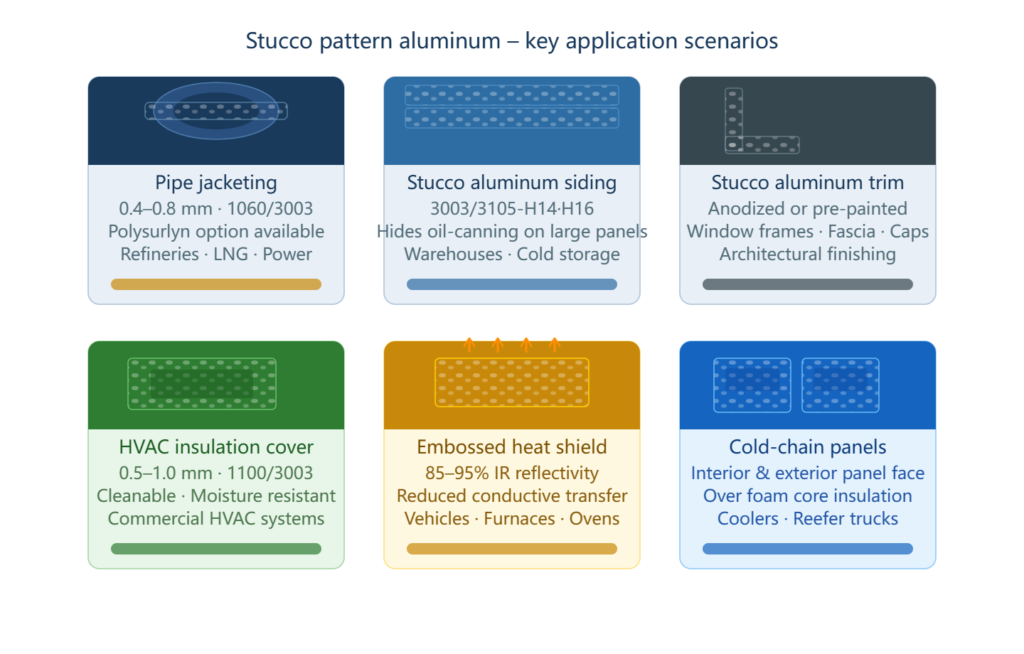
Stucco aluminum sheets serve a broad range of industrial and construction markets. Below are the most common end uses.
1. Pipe and Equipment Jacketing
Stucco embossed aluminum jacketing is the standard finish for protecting insulated pipelines in refineries, LNG plants, power stations, and chemical facilities. The embossed texture allows the jacketing to be handled without gloves cutting into a flat edge, and it hides minor surface dents that occur during shipping and installation. Typical thickness for pipe jacketing is 0.4 mm to 0.8 mm, alloy 1060 or 3003, with an optional polysurlyn moisture barrier laminated to the inner face.
2. Stucco Aluminum Siding and Wall Cladding
Stucco aluminum siding panels are popular in pre-engineered metal buildings, industrial warehouses, and cold-storage facilities. The stucco texture hides oil-canning — the slight waviness that flat aluminum develops under thermal expansion — making it far more attractive than smooth panels in large formats. Alloy 3003-H14 or 3105-H16 is recommended for structural siding because of its higher dent resistance.
3. Stucco Aluminum Trim and Architectural Finishing
Stucco aluminum trim is used to cap, frame, and finish building elements including window surrounds, door frames, fascia, and corner guards. The uniform stucco texture matches panel cladding and provides a cohesive architectural look. Pre-painted stucco trim in white, beige, or silver-gray is widely specified by architects.
4. HVAC Duct Insulation Covers
Air handling units, ductwork, and chilled water pipes in commercial buildings are frequently wrapped in mineral wool or foam insulation, then finished with a stucco aluminum sheet jacket. The finish resists condensation damage and can be cleaned easily with standard solvents.
5. Embossed Aluminum Heat Shield Sheet
Embossed aluminum heat shield sheet takes advantage of the high reflectivity of aluminum — typically 85–95% in the infrared spectrum — combined with the structural rigidity the embossing provides. Heat shields manufactured from stucco-embossed 1060 or 3003 aluminum are used under vehicle bodies, around industrial furnaces, and behind cooking equipment. The pattern reduces direct contact surface area, lowering conductive heat transfer compared to flat sheet.
6. Cold-Chain and Refrigeration Panels
Walk-in coolers, refrigerated trucks, and temperature-controlled storage rooms use stucco aluminum sheets as the interior and exterior panel face over foam core insulation. The textured surface is hygienic, easy to clean, and resistant to minor impact from warehouse equipment.
Stucco vs. Other Embossed Aluminum Sheet Metal Patterns
Embossed aluminum sheet metal comes in several standard patterns. Understanding the differences helps buyers select the correct product.
| Pattern | Description | Typical Use | Relative Rigidity Gain |
|---|---|---|---|
| Stucco / Orange Peel | Random raised bumps, uniform coverage | Jacketing, siding, heat shields | High |
| Diamond / Tread Plate | Raised diamond pattern, directional | Flooring, ramps, truck beds | Very High |
| Linen / Hammered | Woven-textile-like texture | Decorative panels, elevator interiors | Medium |
| Compass / Elongated Stucco | Elongated oval bumps | Jacketing (alternative to standard stucco) | High |
| Flat / Mill Finish | No pattern | Sheet metal fabrication | Baseline |
For thermal insulation jacketing applications, the stucco pattern remains the industry standard because it provides a balance of rigidity, clean appearance, and ease of rolling around curved pipe surfaces — a flat tread plate cannot be bent around pipe without cracking the raised diamonds.
Surface Finish Options for Stucco Pattern Aluminum
Beyond the base embossed texture, aluminum stucco finish products can be further treated for specific environments:
- Mill finish (bare): Natural aluminum surface, suitable for most dry indoor and outdoor industrial environments. Forms a self-protecting oxide layer.
- Polysurlyn laminated: A thin polymer film laminated to the back of the sheet. Blocks moisture vapor from migrating through the jacketing into the insulation. Standard for cold-service jacketing in petrochemical plants.
- Painted / coated: PVDF or polyester paint applied to the stucco face. Extends service life in coastal or corrosive environments. White and silver-gray are the most common colors for building cladding.
- Anodized: Electrochemical process that thickens the oxide layer to 10–25 microns. Provides superior scratch and abrasion resistance for trim and architectural applications.
Stucco Pattern Aluminum Price Guide
Prices for stucco pattern aluminum are quoted in USD per metric ton (MT) or per square meter depending on the buyer’s region. The following table provides indicative ex-works factory pricing for common specifications as of mid-2026. Final prices depend on quantity, alloy, thickness, and delivery terms.
| Specification | MOQ (MT) | Indicative Price (USD/MT) | Typical Lead Time |
|---|---|---|---|
| 1060-H18 / 0.4 mm stucco sheet | 2 | $2,400 – $2,700 | 7–15 days |
| 1060-H18 / 0.5 mm stucco sheet | 2 | $2,350 – $2,650 | 7–15 days |
| 3003-H14 / 0.6 mm stucco sheet | 2 | $2,700 – $3,000 | 10–20 days |
| 3003-H14 / 1.0 mm stucco sheet | 3 | $2,750 – $3,100 | 10–20 days |
| 1060 stucco coil, 914 mm wide | 5 | $2,300 – $2,600 | 7–15 days |
| Polysurlyn laminated stucco coil | 3 | $2,600 – $3,000 | 15–25 days |
| Painted stucco sheet (PVDF) | 3 | $3,200 – $3,800 | 20–30 days |
Note: Prices fluctuate with the LME aluminum benchmark. Request a formal quotation with the current LME component clearly stated. Freight, customs duties, and local taxes are not included in the figures above.
How to Specify Stucco Embossed Aluminum Jacketing
When inquiring with aluminum stucco embossed sheet suppliers, provide the following information to receive an accurate quotation quickly:
- Alloy and temper – e.g., 3003-H14
- Thickness (mm) – e.g., 0.5 mm
- Width (mm) – e.g., 1,000 mm
- Length (mm) or coil – e.g., 2,000 mm sheet or coil
- Quantity (MT or m²)
- Surface requirement – mill finish, polysurlyn, painted, or anodized
- Standard required – ASTM B209, EN 485, or other
- Delivery port or destination
Quality Standards and Inspection for Stucco Aluminum Sheets
Reputable suppliers of stucco aluminum sheets can provide the following documentation with each shipment:
- Mill Test Certificate (MTC) / Material Test Report (MTR) confirming chemical composition and mechanical properties
- Dimensional inspection report (thickness, width, length tolerances per ASTM B209 or EN 485)
- Third-party inspection (SGS, Bureau Veritas, or Intertek) available on request
- Surface quality certificate confirming pattern depth and finish uniformity
- Polysurlyn peel strength test report (for laminated products)
Packaging and Export for Stucco Embossed Aluminum
Proper packaging prevents surface damage during ocean freight. Standard export packing for stucco embossed aluminum includes:
- Interleaving paper between sheets to prevent scratch damage to the embossed surface
- Wooden pallet or steel skid base, fumigation certificate issued on request
- Steel banding with corner protectors
- Waterproof kraft paper outer wrap
- Labels: alloy, temper, heat/lot number, net weight, gross weight, dimensions
Coils are shipped on eye-to-sky or eye-to-wall orientation, wrapped in stretch film and steel banding, placed on A-frame or flat wooden skids.
Why Choose a Manufacturer as Your Stucco Aluminum Sheet Supplier
Working directly with a factory rather than a trading company offers several advantages when sourcing stucco pattern aluminum:
- Lower price: No middleman margin. Factory ex-works prices are 8–15% lower than trader prices on equivalent material.
- Custom dimensions: Factories can roll specific widths and thicknesses not carried in trader inventory.
- Consistent quality: One melting source, one rolling mill — batch-to-batch variation is minimal.
- Full documentation: Factories issue genuine mill test certificates signed by the metallurgical department.
- Larger capacity: Suitable for projects requiring 50+ MT per month.
Export Markets for Stucco Pattern Aluminum
China-based manufacturers of stucco and aluminium products export to over 80 countries. The largest receiving markets include:
| Region | Key Countries | Main Application |
|---|---|---|
| Middle East | Saudi Arabia, UAE, Qatar, Kuwait | Petrochemical pipe jacketing, HVAC |
| Southeast Asia | Vietnam, Indonesia, Thailand, Philippines | Building cladding, cold-chain |
| South America | Brazil, Chile, Peru, Colombia | Industrial insulation jacketing |
| Africa | South Africa, Nigeria, Egypt, Kenya | Construction, refrigeration |
| Europe | Poland, Romania, Germany, Netherlands | Siding, architectural trim |
| North America | USA, Canada, Mexico | Pipe jacketing, heat shields |
| South Asia | Pakistan, Bangladesh, Sri Lanka | Building panels, HVAC jacketing |
Frequently Asked Questions
What is the difference between stucco embossed aluminum and regular aluminum sheet?
Regular aluminum sheet has a flat, smooth surface. Stucco embossed aluminum has a raised random-bump texture rolled into the surface. The embossing increases panel stiffness by 15–25% compared to flat sheet of the same gauge. It also hides minor surface defects and provides better grip during handling.
Can stucco aluminum sheets be cut and bent on site?
Yes. Stucco aluminum sheets cut easily with standard tin snips, circular saw blades, or shears. They can be bent with a sheet metal brake to form jacketing segments, trim channels, or siding panels. For pipe jacketing, the sheet rolls around the pipe by hand or with a slip roll machine.
What alloy is best for outdoor stucco aluminum siding?
Alloy 3003-H14 or 3105-H16 is the standard recommendation for stucco aluminum siding. Both alloys have better strength than 1xxx series and maintain excellent corrosion resistance without any surface treatment. For coastal or high-humidity environments, apply a PVDF paint or anodize finish for additional protection.
Is stucco embossed aluminum jacketing compatible with polysurlyn lamination?
Yes. Stucco embossed aluminum jacketing is routinely supplied with a polysurlyn moisture retarder laminated to the inner flat face. The lamination does not interfere with the outer stucco pattern. This combination is required by many engineering specifications for cold insulation systems (below ambient temperature service).
What is the minimum order quantity for stucco pattern aluminum?
Most manufacturers set an MOQ of 2–5 metric tons per specification (alloy + temper + thickness + width combination). Mixed specifications can often be combined to meet the minimum total order weight of 5 MT per container.
Request a Quote for Stucco Pattern Aluminum
We supply stucco embossed aluminum sheets, coils, and jacketing to industrial buyers worldwide.
Alloys: 1060 · 1100 · 3003 · 3105 | Thickness: 0.3 – 4.0 mm | Mill finish, polysurlyn, painted
Send your specification to our sales team for a factory-direct quotation within 24 hours.