
What Is Aluminum Channel Letter Coil?
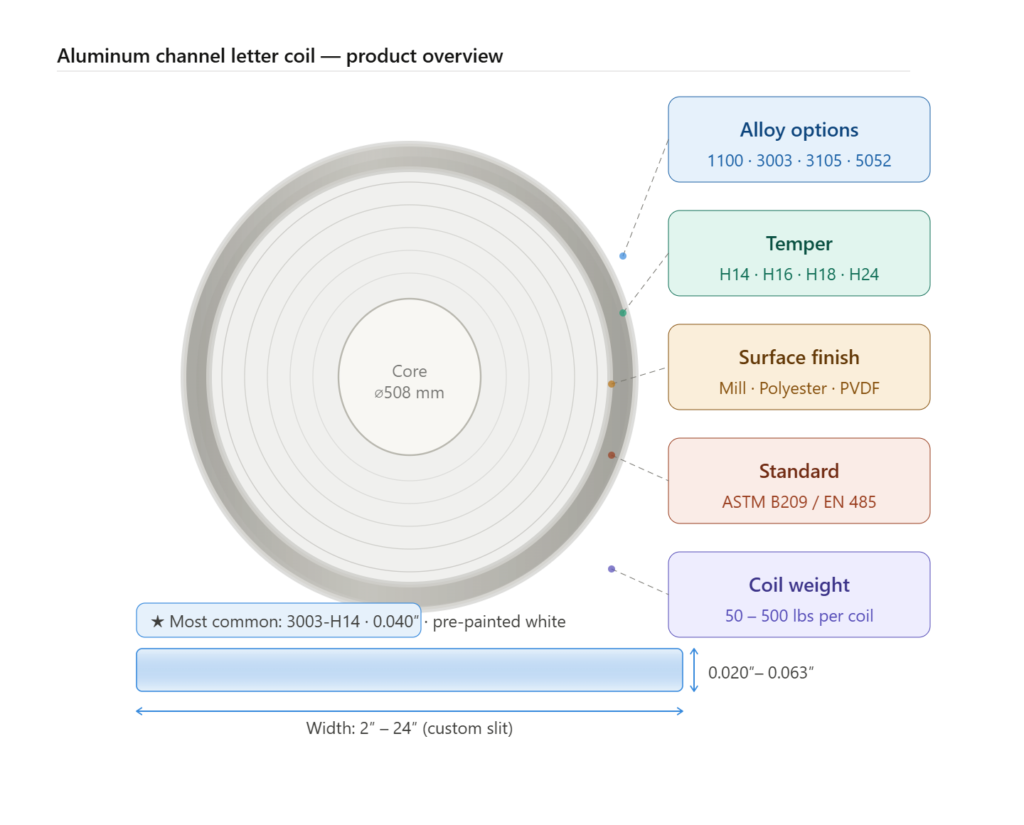
Aluminum channel letter coil is a continuous strip of aluminum sheet wound into a coil form. It is the primary raw material used by sign fabricators to bend, cut, and form the faces, returns, and backs of illuminated channel letters.
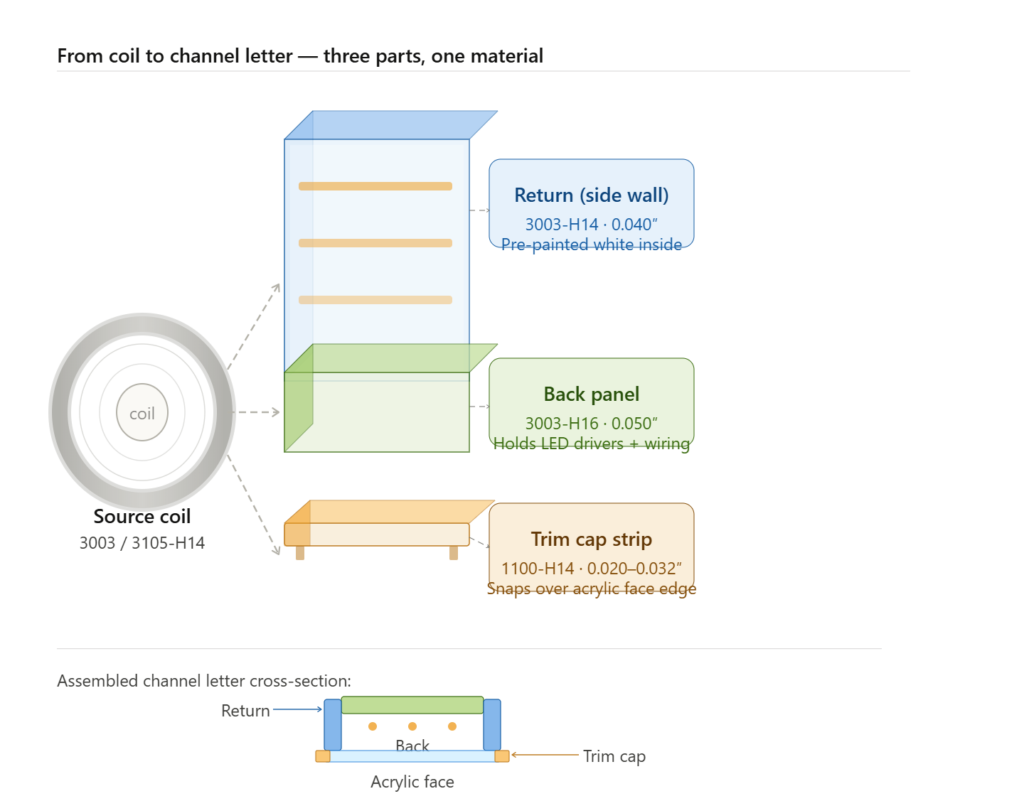
Channel letter signs are the three-dimensional, individually cut letters mounted on storefronts, malls, and commercial buildings. Each letter is built like a small metal box. The front face holds the translucent acrylic. The side wall — called the return — gives the letter its depth. The back plate seals the structure and holds the LED modules. All three parts are cut and formed from aluminium coil for channel letters.
Because the coil is processed through automated letter-bending machines (such as channel letter benders), the material must meet tight requirements: consistent thickness, smooth surface, excellent ductility, and reliable paint adhesion. Standard aluminum channel letter coil is pre-painted on one side or both sides using PVDF or polyester coating systems.
Why Aluminum — Not Steel or Plastic?
Sign fabricators choose aluminum over steel for two main reasons: weight and corrosion resistance. An aluminum channel letter weighs roughly one-third of an equivalent steel letter. Lightweight signs reduce installation hardware costs and simplify wall mounting. Aluminum also does not rust, which is critical for outdoor signage exposed to rain, humidity, and UV radiation.
Key Specifications & Parameters
The table below summarizes the standard product specifications for aluminum channel letter coil supplied from our mill.
| Parameter | Standard Range | Common Specification |
|---|---|---|
| Alloy | 1100, 3003, 3105, 5052 | 3003 / 3105 |
| Temper | H14, H16, H18, H24, H26 | H14 / H16 |
| Thickness | 0.020 in – 0.063 in (0.5 mm – 1.6 mm) | 0.040 in (1.0 mm) |
| Width | 2 in – 24 in (50 mm – 610 mm) | 6 in – 12 in (150 mm – 305 mm) |
| Coil Weight | 50 lbs – 500 lbs (23 kg – 227 kg) | 100–200 lbs per coil |
| Surface Finish | Mill finish, polyester coated, PVDF coated | Polyester pre-painted (1-side or 2-side) |
| Core Diameter | 400 mm / 508 mm (16 in / 20 in) | 508 mm (20 in) |
| Color | RAL/Pantone custom, white, black, silver | White (most common) |
| Standard | ASTM B209 / EN 485 | ASTM B209 |
Thickness is one of the most critical parameters. Thinner coil (0.020 in – 0.032 in) bends more easily on automated machines and is preferred for small letters with tight radius curves. Thicker coil (0.040 in – 0.063 in) gives greater structural rigidity for large outdoor letters. Most sign shops stock 0.040 in as a universal thickness that works across a wide range of letter sizes.
Coil Width and Letter Return Height
The coil width determines the maximum return depth (depth) of the channel letter. A 6-inch wide coil produces a letter return of up to approximately 5.5 inches, allowing space for LED modules and wiring. Wider coils are used for monument-style letters with returns of 8 inches or more. Custom widths are available on request for non-standard projects.
Alloy & Temper Selection Guide
Choosing the right alloy and temper affects how the coil performs on letter-bending equipment, how well paint adheres, and how long the finished sign lasts outdoors.
| Alloy | Key Properties | Best For | Notes |
|---|---|---|---|
| 1100 | Highest ductility, commercially pure aluminum | Very small letters, complex curves | Softer; less structural strength |
| 3003 | Good formability, moderate strength, excellent corrosion resistance | General-purpose channel letters, standard returns | Most popular choice in the industry |
| 3105 | Slightly higher strength than 3003, good paint adhesion | Larger outdoor letters, returns >6 in | Common in North American sign industry |
| 5052 | High strength, excellent marine-grade corrosion resistance | Coastal installations, heavy-duty applications | Higher cost; harder to bend in thicker gauges |
Understanding Temper Designations
The temper code describes how the aluminum was work-hardened after rolling. For channel letter fabrication, the most relevant tempers are:
- H14 — Half-hard. Balanced between formability and strength. The most common temper for channel letter coil.
- H16 — Three-quarter hard. Slightly stiffer. Good for returns that need to hold shape without springing back.
- H18 — Full-hard. Maximum strength within the H series. Less ductile; used for flat back panels rather than bent returns.
- H24 — Work-hardened and partially annealed. Similar softness to H14 but achieved differently. Used when extra surface smoothness is required for paint quality.
For most channel letter bending machines, 3003-H14 and 3105-H14 are the industry standard starting points. They feed smoothly, hold painted surfaces without cracking along bend lines, and resist oil-canning (waviness) on flat faces.
Aluminum Coil for Trim Cap Applications
Channel letter aluminum coil trim cap refers to the narrow aluminum strip used to finish the front edge of a channel letter — the visible border between the acrylic face and the metal return. Trim cap coil has specific requirements that differ from standard letter return coil.
| Parameter | Trim Cap Coil Specification |
|---|---|
| Thickness | 0.020 in – 0.032 in (0.5 mm – 0.8 mm) |
| Width | 1 in – 3 in (25 mm – 75 mm) |
| Alloy/Temper | 1100-H14, 3003-H14 |
| Surface | Pre-painted polyester, anodized, or mill finish |
| Edge Condition | Slit edge (deburred) — critical for trim cap forming |
Trim cap coil must be thin enough to snap into trim cap retainer channels without cracking. The edge condition is critical: burr-free slit edges prevent cuts during handling and ensure the retainer snaps cleanly. We supply trim cap coil with slit-edge tolerance of ±0.005 in width and guaranteed burr-free edges on both sides.
Integrated Trim Cap Coil Supply
Many sign shops order return coil and trim cap coil together. Matching the paint color and gloss level between these two coils ensures a consistent visual appearance on the finished letter. We can supply both from the same paint batch when colors are specified together in one order, eliminating color-matching issues between separate shipments.
Applications in Channel Letter Fabrication
Aluminum channel letter coil is used in multiple stages of sign manufacturing. Understanding each application helps sign shops order the right product for each purpose.
1. Letter Returns (Side Walls)
The return is the most material-intensive part of a channel letter. It defines the letter’s depth and must withstand outdoor exposure for 10+ years. A 3003-H14 coil at 0.040 in thickness is the benchmark choice. Painted finishes — typically white on the inside to maximize LED light reflection — are standard.
2. Letter Back Panels
The back panel holds LED driver boards and wiring. It does not need to bend, so slightly harder tempers (H16 or H18) can be used here for added rigidity. Thicker gauges (0.050 in – 0.063 in) are sometimes specified for large letters where back panel stability is important.
3. Letter Face Blanks
Some fabricators use aluminum face blanks cut from coil instead of acrylic faces. This is common for halo-lit (reverse-lit) channel letters where a solid aluminum face with no translucency is needed. A smooth, mill-finish or polyester-painted coil at 0.040 in is the typical material.
4. Cabinet and Raceway Panels
Aluminum coil is also used to fabricate the raceways (mounting boxes that house wiring behind channel letter sets) and lightbox cabinets. Heavier gauges in 5052 alloy are preferred for these structural applications.
Key Export Markets for Aluminum Channel Letter Coil
We supply aluminium coil for channel letters to sign fabricators and distributors in the following markets:
- North America — USA, Canada, Mexico (ASTM B209 standard)
- Middle East — UAE, Saudi Arabia, Kuwait (high UV resistance required)
- Southeast Asia — Vietnam, Thailand, Malaysia, Indonesia
- Europe — Poland, Germany, Netherlands (EN 485 standard available)
- South America — Brazil, Colombia, Chile
- Africa — South Africa, Nigeria, Kenya
How to Choose the Right Aluminum Coil for Channel Letters
The selection process should follow four steps. Work through each one before placing an order.
Step 1 — Define the Letter Size Range
Small letters (under 6 inches tall) need a thinner, softer coil that bends on tight-radius curves. Letters 6–24 inches tall work well with standard 0.040 in / 3003-H14. Large letters (over 24 inches) may need 0.050 in or 5052 alloy for adequate rigidity.
Step 2 — Confirm Machine Compatibility
Most letter-bending machines specify a maximum material thickness and hardness range. Check your machine manufacturer’s specifications before ordering. Common machines accept 0.020 in – 0.060 in material in H14 temper. If you use thicker or harder material, the machine may not complete the bend cycle correctly.
Step 3 — Select Surface Finish and Color
Pre-painted coil is ready to use immediately after cutting. Mill-finish coil requires post-painting by the shop, which adds labor and equipment cost. White is the most common interior color to maximize LED luminance. Custom RAL or Pantone colors are available for exterior returns where brand color matching is required.
Step 4 — Determine Order Quantity
Coil orders are typically placed by weight (lbs or kg) or by linear footage. Minimum order quantities (MOQ) for standard coil are typically 1,000 lbs (approx. 454 kg) per specification. Mixed-specification orders are accepted when total order weight meets the MOQ threshold. Sample coils in small quantities are available for machine testing and paint approval before bulk orders.
| Application Scenario | Recommended Alloy | Temper | Thickness | Surface |
|---|---|---|---|---|
| Small indoor channel letters (<6 in) | 1100 or 3003 | H14 | 0.020–0.032 in | Pre-painted white |
| Standard outdoor channel letters (6–18 in) | 3003 or 3105 | H14 | 0.040 in | Pre-painted white or custom color |
| Large outdoor channel letters (>18 in) | 3105 or 5052 | H14 / H16 | 0.050–0.063 in | Pre-painted or mill finish |
| Halo-lit / reverse-lit face blanks | 3003 | H14 | 0.040 in | Mill finish or matte black painted |
| Trim cap strips | 1100 or 3003 | H14 | 0.020–0.032 in | Matching color to return coil |
Aluminum Channel Letter Coil Price: What Affects Your Cost?
The aluminum channel letter coil price is not a fixed number. It changes based on several variables. Understanding these factors helps buyers compare quotes accurately and avoid unexpected costs.
1. LME Aluminum Base Price
Raw aluminum is traded on the London Metal Exchange (LME). The base metal price is the largest single cost component — typically 50–70% of the total coil price. LME prices fluctuate daily. Most mills quote coil prices with a base-price validity period of 7–30 days.
2. Alloy and Temper Premiums
Higher-alloy materials (5052 vs. 1100) carry processing premiums. Work-hardened tempers (H18 vs. H14) require additional rolling passes and add to cost.
3. Coating and Paint
Pre-painted coil costs more than mill-finish coil. PVDF paint systems (superior weather resistance, 20-year warranty) cost more than polyester systems (standard 5–10 year warranty). Custom color matching adds a setup fee, typically charged once per color standard or sample.
4. Coil Dimensions
Non-standard widths require slitting from wider master coils. Custom slitting adds processing cost. Standard widths (6 in, 8 in, 12 in) are the most economical because they are produced in high volume.
5. Order Volume and Frequency
Larger orders (5,000 lbs+) and repeat orders with blanket purchase agreements receive better pricing. Sign shop networks and distributors that consolidate demand across multiple shops typically achieve the best unit costs.
| Cost Factor | Lower Cost Option | Higher Cost Option |
|---|---|---|
| Alloy | 1100, 3003 | 5052, 6-series |
| Surface | Mill finish | PVDF painted, custom color |
| Width | Standard (6 in, 8 in, 12 in) | Custom slit width |
| Order Quantity | 5,000 lbs+ per spec | Near-MOQ orders |
| Delivery | Sea freight (bulk) | Air freight (urgent orders) |
We provide firm price quotes with a 15-day validity on all standard specifications. For ongoing projects, we offer quarterly pricing agreements that lock in the fabrication margin while passing through LME fluctuations at a transparent, agreed formula.
Why Source Aluminum Channel Letter Coil from a Direct Manufacturer?
Sourcing directly from an aluminum coil manufacturer — rather than a trading company or local distributor — brings measurable advantages for sign fabricators who consume coil in volume.
Mill-Direct Traceability
Every coil we ship carries a mill test certificate (MTC) documenting the alloy, temper, mechanical properties, and chemical composition. This traceability matters when projects require documented material compliance (ASTM B209, EN 485, or RoHS). Trading companies often cannot provide original MTCs.
Consistent Quality Across Batches
Paint color and gloss consistency across coil batches is a common complaint in the sign industry. When a shop orders white coil from two different sources — or even from the same trading company in two different months — color variation between letters is visible to end customers. As a manufacturer, we control the paint line and maintain color standards across production runs.
Custom Specifications Without Minimum Penalty
Distributors typically stock only the most common specifications. Non-standard widths, unusual tempers, or specific paint gloss levels require a manufacturer. We accept custom specifications at standard lead times (20–35 days) with no custom-spec surcharge on orders above minimum quantity.
Technical Support for Sign Fabricators
We work with sign shops to troubleshoot material issues: cracking along bend lines, paint delamination, oil-canning on large flat faces. Our technical team can recommend the correct alloy, temper, and thickness combination for specific bending machine models and letter geometry requirements.
Export Packaging for Long-Distance Shipping
Coil delivered by sea freight must survive a 15–45 day ocean voyage and multiple cargo handling events. We pack coils in moisture-barrier film with wooden pallet cradles rated for stacking. Coil OD is marked on each pallet. This packaging reduces edge damage and moisture-related paint defects — a common problem with standard export packing from trading companies.
Frequently Asked Questions
Q1: What is the standard thickness for aluminum channel letter coil?
The most widely used thickness is 0.040 inches (approximately 1.0 mm). This gauge works on most letter-bending machines and provides good strength-to-weight performance for letters in the 6–24 inch size range. Thin gauges (0.020–0.032 in) are used for small letters; heavy gauges (0.050–0.063 in) are used for large structural letters.
Q2: What alloy is best for aluminium coil for channel letters?
3003-H14 is the industry standard. It combines good formability (important for bending tight curves) with adequate corrosion resistance for outdoor use. 3105-H14 is an alternative with slightly higher strength, popular in North America. 1100-H14 is used when maximum ductility is needed for very small or complex letter shapes.
Q3: Can I get custom coil widths for non-standard return depths?
Yes. We slit coil to any width from 2 inches to 24 inches. Standard widths (4 in, 6 in, 8 in, 10 in, 12 in) are available from stock. Custom widths have the same lead time as standard products on orders above minimum quantity.
Q4: What is the difference between polyester and PVDF paint on channel letter coil?
Polyester paint is a cost-effective coating suitable for standard commercial signage. It offers good color stability for 5–10 years outdoors. PVDF (polyvinylidene fluoride) paint — known by trade names such as Kynar — provides superior UV resistance and retains color and gloss for 20+ years. PVDF-coated coil is recommended for high-end projects, coastal environments, or applications where the sign must look new for an extended period without repainting.
Q5: What is channel letter aluminum coil trim cap?
Trim cap is the thin, narrow strip of aluminum used to create the snap-in border that covers the joint between the acrylic face and the letter return. Trim cap coil is thinner (0.020–0.032 in) and narrower (1–3 in) than return coil. It must be soft enough to snap into plastic or aluminum retainer channels without cracking. We supply trim cap coil in matching colors to return coil to ensure a consistent finished appearance.
Q6: Do you supply mill test certificates with each shipment?
Yes. Every shipment includes a mill test certificate documenting alloy composition, temper, tensile strength, yield strength, and elongation values in accordance with ASTM B209 or EN 485. Certificates are provided in English and are available in digital format before shipment for import documentation purposes.
Q7: What is the minimum order quantity for aluminum channel letter coil?
The standard MOQ is 1,000 lbs (approximately 454 kg) per specification. For mixed orders with multiple specifications, the total order weight must meet this threshold. Sample coils for machine testing are available at lower quantities — contact us to discuss your testing requirements.
Q8: How long is the lead time for standard aluminum coil?
Standard specifications in stock alloys and common tempers ship within 20–30 days of order confirmation. Custom widths, special tempers, or custom paint colors require 25–35 days. Air freight is available for urgent orders with shorter lead times.
Get a Quote for Aluminum Channel Letter Coil
We manufacture and export aluminum channel letter coil to sign fabricators, sign material distributors, and wholesale buyers worldwide. Our products cover the full range of standard and custom specifications — alloys 1100, 3003, 3105, and 5052; tempers H14 through H18; thicknesses 0.020 in to 0.063 in; mill finish and pre-painted surfaces in any RAL or Pantone color.
To receive a firm price quote, please provide the following information:
- Alloy and temper (e.g., 3003-H14)
- Thickness (in inches or mm)
- Width (in inches or mm)
- Surface finish and color (if pre-painted)
- Estimated quantity (lbs or kg)
- Destination port or country
We respond to all inquiries within 24 hours on business days. Free samples are available for qualified buyers before bulk order placement.