
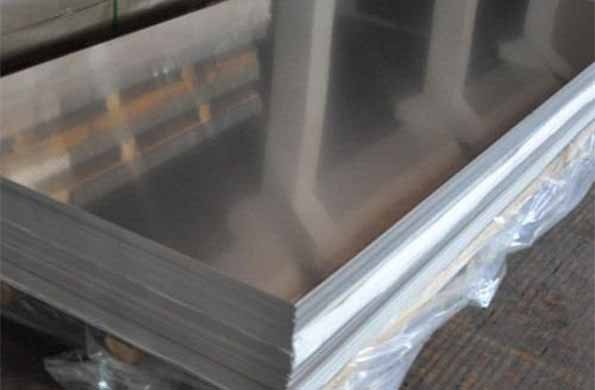
What Is 3105 Aluminum?
3105 aluminum is a wrought alloy in the 3000 series aluminum family. It uses manganese as its primary alloying element, with additional magnesium and chromium. These three elements work together to give aluminum 3105 a unique combination of moderate strength, excellent corrosion resistance, and outstanding formability.
The 3105 alloy sits between the softer 3003 alloy and the stronger 5052 alloy in terms of mechanical performance. This middle-ground position makes it ideal for applications that need more strength than 3003 can offer but do not require the full strength of 5052.
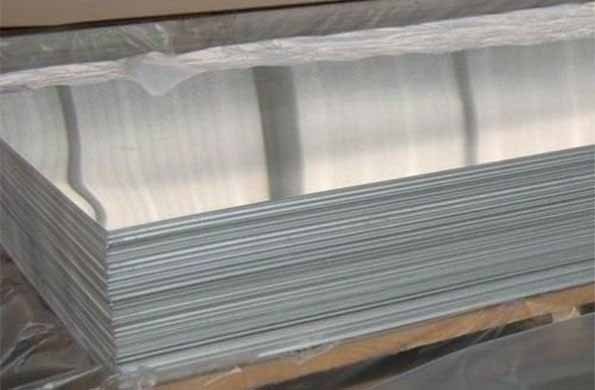
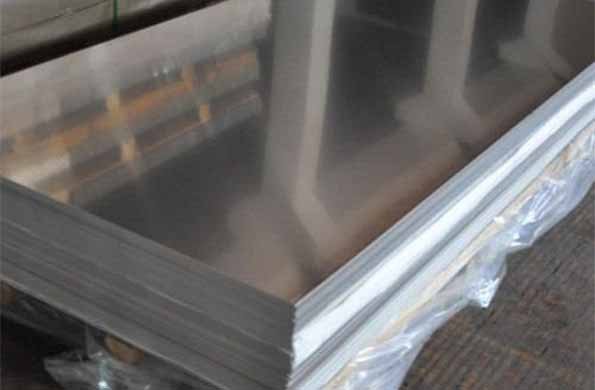
3105 aluminum sheet is the most common product form. It appears primarily in the building and construction industry. Roofing systems, wall cladding, gutters, downspouts, siding panels, and architectural trim all use 3105 aluminum. The mobile home, RV, and manufactured housing industries also consume large volumes of this alloy.
A key advantage of aluminum 3105 is its excellent paintability. It accepts paint coatings uniformly and holds them reliably for long service life. This makes it the standard base material for prepainted and color-coated aluminum coil products worldwide.
3105 Aluminum Alloy Composition
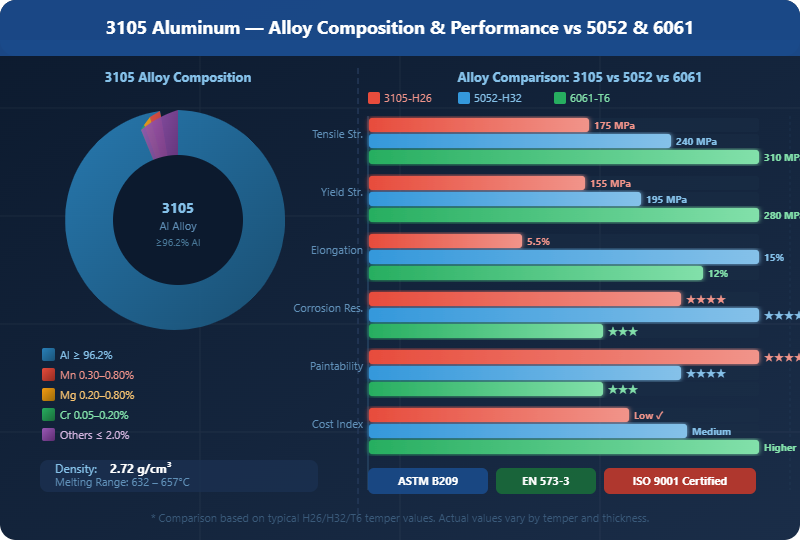
The 3105 aluminum alloy composition defines its properties and performance. It follows strict international standards including ASTM B209 and EN 573-3.
Chemical Composition Table
| Element | Symbol | Content (%) |
|---|---|---|
| Aluminum | Al | Balance ≥ 96.2% |
| Manganese | Mn | 0.30 – 0.80 |
| Magnesium | Mg | 0.20 – 0.80 |
| Chromium | Cr | 0.05 – 0.20 |
| Copper | Cu | Max 0.30 |
| Iron | Fe | Max 0.70 |
| Silicon | Si | Max 0.60 |
| Zinc | Zn | Max 0.40 |
| Titanium | Ti | Max 0.10 |
| Other (each) | — | Max 0.05 |
| Other (total) | — | Max 0.15 |
3105 Aluminum Chemistry — What Each Element Does
Manganese (0.30–0.80%)
Manganese is the primary strengthening element in 3105. It dissolves into the aluminum matrix and increases tensile strength through solid solution hardening. Manganese also improves corrosion resistance and helps control grain structure during processing.
Magnesium (0.20–0.80%)
Magnesium adds additional solid solution strengthening beyond what manganese provides alone. It also improves the alloy’s response to work hardening. This means 3105 develops higher strength during rolling compared to alloys without magnesium.
Chromium (0.05–0.20%)
Chromium refines the grain structure and improves corrosion resistance. It also enhances the adhesion of paint and conversion coatings to the aluminum surface. This is especially important for prepainted applications.
Low levels of Cu, Fe, Si, Zn
These elements are controlled at low levels. High levels would reduce corrosion resistance or affect formability negatively.
3105 Aluminum Properties
Understanding 3105 aluminum properties helps engineers and buyers select the right material for each application.
Physical Properties
| Property | Value |
|---|---|
| Density | 2.72 g/cm³ |
| Melting Range | 632 – 657°C |
| Thermal Conductivity | ~170 W/m·K |
| Electrical Conductivity | ~40% IACS |
| Coefficient of Thermal Expansion | 23.6 µm/m·°C |
| Elastic Modulus | 68.9 GPa |
| Poisson’s Ratio | 0.33 |
3105 Aluminum Density
3105 aluminum density is 2.72 g/cm³. This is approximately one-third the density of carbon steel (7.85 g/cm³) and less than half the density of copper (8.96 g/cm³).
This low density delivers practical benefits:
- Lightweight structures — Building panels made from 3105 weigh significantly less than steel panels of equal size
- Reduced structural loads — Lighter roof and wall panels reduce the loads on building frames
- Easy handling — Workers can handle and install 3105 panels without heavy lifting equipment
- Lower transport costs — More square meters of aluminum fit into each shipping container compared to heavier metals
Mechanical Properties by Temper
| Temper | Tensile Strength (MPa) | Yield Strength (MPa) | Elongation (%) | Hardness (HB) |
|---|---|---|---|---|
| O | 95 – 130 | 35 – 70 | 24 – 30 | 25 – 35 |
| H12 | 115 – 155 | 95 – 130 | 8 – 12 | 32 – 42 |
| H14 | 130 – 175 | 110 – 155 | 5 – 8 | 36 – 48 |
| H16 | 150 – 195 | 130 – 175 | 4 – 6 | 42 – 54 |
| H18 | 170 – 215 | 155 – 200 | 2 – 4 | 48 – 60 |
| H22 | 115 – 155 | 85 – 125 | 10 – 14 | 30 – 40 |
| H24 | 130 – 175 | 105 – 145 | 6 – 9 | 34 – 46 |
| H25 | 145 – 190 | 120 – 165 | 5 – 8 | 38 – 50 |
| H26 | 150 – 200 | 130 – 180 | 4 – 7 | 42 – 56 |
| H28 | 170 – 215 | 155 – 200 | 2 – 4 | 48 – 60 |
Key Property Highlights
Formability
In O and H2X tempers, 3105 aluminum bends and forms without cracking. It roll-forms into complex profiles efficiently. Minimum bend radii are lower than higher-strength alloys.
Corrosion Resistance
3105 resists corrosion in outdoor environments, coastal atmospheres, and industrial air. The natural oxide layer and chromium addition provide strong passive protection.
Weldability
3105 welds well using TIG, MIG, and resistance welding. Post-weld strength in the heat-affected zone is acceptable for most building applications.
Paintability
The chromium content in 3105 gives it excellent response to conversion coating pre-treatments. Paint adhesion is strong and uniform. This is why 3105 is the preferred base for prepainted coil products.
3105 Aluminum Sheet — Specifications
3105 aluminum sheet is available in a wide range of sizes and finishes.
Standard Sheet and Coil Specifications
| Parameter | Range |
|---|---|
| Thickness | 0.15mm – 4.0mm |
| Width | 100mm – 1650mm |
| Length (sheet) | 1000mm – 6000mm |
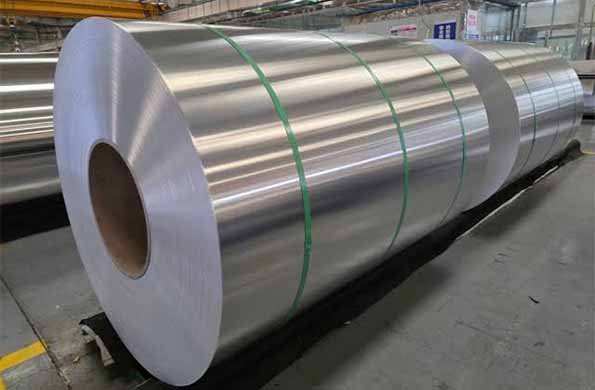
| Coil inner diameter | 505mm or 610mm |
| Coil outer diameter | Up to 1800mm |
| Coil weight | 2 – 8 tons per coil |
Surface Finish Options
| Finish Type | Description | Typical Use |
|---|---|---|
| Mill finish | As-rolled, standard | General fabrication |
| Bright finish | Polished, reflective | Decorative applications |
| Stucco embossed | Diamond or other texture | Decorative panels |
| Prepainted | Color coated (PE/SMP/PVDF) | Building products |
| Anodized | Hard oxide layer | Architectural trim |
Available Tempers for Sheet
Most common tempers for 3105 aluminum sheet:
- H14 — General purpose. Good balance of strength and formability
- H24 — Better formability than H14. Good for roll-formed profiles
- H26 — Higher strength. Standard for prepainted roofing and cladding
- H18 — Maximum strength. Minimal forming required
What Is 3105 Aluminum Used For?
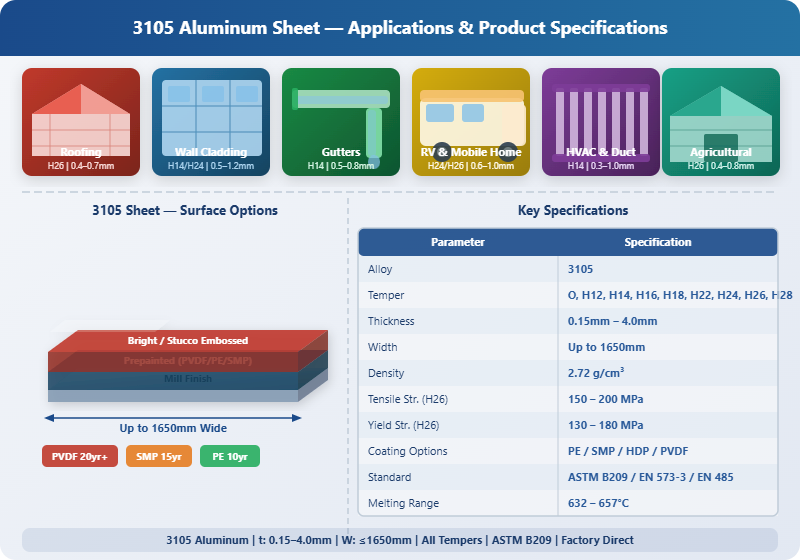
Roofing and Wall Cladding
This is the largest application for 3105 aluminum sheet. Standing seam roofing, corrugated panels, ribbed panels, and flat cladding sheets all use 3105.
Why 3105 suits roofing:
- Lightweight reduces roof load
- Excellent corrosion resistance for outdoor exposure
- Good formability for roll-forming roof profiles
- Accepts PVDF and other durable coatings for 20+ year color life
Gutters and Downspouts
3105 aluminum forms gutters and downspouts efficiently. The corrosion resistance of 3105 eliminates the rusting problems common with steel gutters. Prepainted 3105 gutters maintain their appearance for decades with no maintenance.
Siding and Soffit Panels
Horizontal siding and soffit panels for residential and commercial buildings use prepainted 3105 sheet. The lightweight material is easy to install. Colors stay bright for many years with PVDF coating.
Mobile Homes and RVs
The manufactured housing and recreational vehicle industries use 3105 aluminum for exterior wall panels, roof panels, and fascia trim. The combination of low weight, good strength, and paintability suits these applications perfectly.
Shutters and Window Accessories
Roll-formed shutters, window hoods, and architectural trim use 3105 for its combination of formability and corrosion resistance. Prepainted finishes eliminate field painting.
HVAC and Ventilation
Ductwork, louvers, and ventilation housings use 3105 for corrosion resistance and easy fabrication.
Agricultural Buildings
Corrugated and ribbed 3105 panels clad farm buildings, grain storage facilities, and equipment sheds. Long service life with minimal maintenance suits agricultural use.
Signage and Displays
Flat 3105 sheet provides a smooth, uniform surface for printed and illuminated signs. The alloy’s dimensional stability prevents warping over time.
3105 Aluminum vs 5052 — Detailed Comparison
3105 aluminum vs 5052 is one of the most common comparison questions from buyers.
Side-by-Side Comparison
| Property | 3105-H26 | 5052-H32 |
|---|---|---|
| Tensile Strength | 150–200 MPa | 215–265 MPa |
| Yield Strength | 130–180 MPa | 160–215 MPa |
| Elongation | 4–7% | 12–18% |
| Density | 2.72 g/cm³ | 2.68 g/cm³ |
| Corrosion Resistance | Excellent | Superior |
| Marine Resistance | Good | Excellent |
| Weldability | Good | Excellent |
| Formability | Good | Better |
| Paintability | Excellent | Good |
| Cost | Lower | Higher |
| Main Use | Building panels, roofing | Marine, pressure vessels |
When to Choose 3105
- Building products and architectural panels
- Prepainted roofing and wall cladding
- Applications where paintability is critical
- Cost-sensitive markets where marine resistance is not needed
- Gutters, downspouts, and trim
When to Choose 5052
- Marine environments and boat building
- Chemical storage vessels and tanks
- Applications needing superior corrosion resistance
- Higher structural loads requiring more strength
- Pressure vessel components
Summary: 3105 is better for building and construction. 5052 is better for marine and high-corrosion environments. The cost advantage of 3105 makes it the preferred choice when 5052’s extra corrosion resistance is not required.
3105 Aluminum vs 6061 — Detailed Comparison
3105 aluminum vs 6061 covers two very different types of aluminum alloy.
Side-by-Side Comparison
| Property | 3105-H26 | 6061-T6 |
|---|---|---|
| Tensile Strength | 150–200 MPa | 290–330 MPa |
| Yield Strength | 130–180 MPa | 240–280 MPa |
| Elongation | 4–7% | 10–14% |
| Density | 2.72 g/cm³ | 2.70 g/cm³ |
| Heat Treatable | No | Yes |
| Corrosion Resistance | Excellent | Good |
| Weldability | Good | Good (with precautions) |
| Machinability | Fair | Excellent |
| Cost | Lower | Higher |
| Main Use | Roofing, cladding, panels | Structural, aerospace, machined parts |
Key Differences
Strength
6061-T6 is significantly stronger than 3105-H26. For structural applications requiring high load capacity, 6061 is the better choice.
Heat treatment
6061 is heat-treatable. Its strength comes from solution heat treatment and artificial aging. 3105 is non-heat-treatable. Its strength comes only from work hardening.
Formability
3105 is easier to form into thin sheet products and complex profiles. 6061 machines better but is less suited to thin-gauge roll-forming.
Cost
3105 is more affordable. 6061 carries a premium for its higher strength and heat treatment processing.
When to Choose 3105
- Sheet metal building products
- Roofing, cladding, and gutters
- Prepainted coil products
- Applications needing thin gauge with good formability
When to Choose 6061
- Structural components and frames
- Machined parts and precision components
- Aerospace and transportation structures
- Applications requiring high strength-to-weight ratio
Available Tempers Explained
What Does “H” Temper Mean?
The “H” designation indicates strain-hardened aluminum. The number after H describes the degree of hardening and any subsequent annealing treatment.
H1X Tempers (Strain Hardened Only)
| Temper | Hardening Level |
|---|---|
| H12 | Quarter hard |
| H14 | Half hard |
| H16 | Three-quarter hard |
| H18 | Full hard |
H2X Tempers (Strain Hardened + Partially Annealed)
| Temper | Description |
|---|---|
| H22 | Quarter hard after partial anneal |
| H24 | Half hard after partial anneal |
| H26 | Three-quarter hard after partial anneal |
| H28 | Full hard after partial anneal |
H2X tempers offer better ductility than H1X at the same strength level. This makes them preferred for roll-forming operations.
Which Temper Is Right for Your Application?
| Application | Recommended Temper |
|---|---|
| Deep drawing | O |
| Complex roll forming | H24 |
| Standard roofing panels | H26 |
| Wall cladding | H14 or H24 |
| Gutters and downspouts | H14 |
| Stiff flat panels | H18 |
| Prepainted roofing | H26 |
Quality Standards for 3105 Aluminum
International Standards
| Standard | Region | Scope |
|---|---|---|
| ASTM B209 | USA | Sheet and plate specifications |
| EN 573-3 | Europe | Chemical composition |
| EN 485-1/2 | Europe | Mechanical properties and tolerances |
| GB/T 3880 | China | Aluminum sheet standard |
| JIS H4000 | Japan | Aluminum sheet standard |
| AS/NZS 1734 | Australia/NZ | Aluminum sheet standard |
Quality Inspection Points
Chemical Composition
Every batch receives spectrometer testing. Manganese, magnesium, and chromium must fall within specification limits.
Mechanical Properties
Tensile strength, yield strength, and elongation testing confirms the correct temper condition. Results must meet ASTM B209 or EN 485 minimum values.
Dimensional Tolerances
| Parameter | Tolerance |
|---|---|
| Thickness | ±4% – ±6% of nominal |
| Width | ±1mm – ±3mm |
| Length (sheet) | +6mm / 0mm |
| Flatness | Max 4mm per 1000mm |
| Squareness | Max 2mm per 1000mm |
Surface Quality
No scratches, roll marks, oxidation spots, or oil contamination. For prepainted products, additional checks on coating thickness, adhesion, gloss, and color.
Packaging and Shipping
Standard Packaging for 3105 Aluminum Sheet
Sheet packaging:
- Stacked flat on wooden pallets
- Protective paper between sheets
- Waterproof outer wrapping
- Steel strapping bands
- Edge protectors on all four sides
Coil packaging:
- Coil wrapped in waterproof kraft paper
- Inner and outer diameter protection rings
- Placed on coil saddle or A-frame pallet
- Secured with steel strapping
Export Packaging
For overseas shipments:
- Sea-worthy wooden crates for sensitive surfaces
- Extra waterproofing for tropical destinations
- Desiccant bags inside packaging for humidity-sensitive markets
- Full documentation: MTC, packing list, certificate of origin
Shipping Methods
| Method | Best For | Transit Time |
|---|---|---|
| Sea freight (FCL) | Large orders | 15–40 days |
| Sea freight (LCL) | Medium orders | 20–50 days |
| Air freight | Samples, urgent orders | 3–7 days |
| Rail freight | Europe-bound | 15–25 days |
Why Choose Us as Your 3105 Aluminum Supplier?
Integrated Manufacturing
We produce 3105 aluminum sheet in our own rolling mill. We control the entire process from casting through rolling and finishing. This gives consistent quality and competitive pricing.
Wide Product Range
We supply 3105 aluminum in:
- All standard tempers: O, H12, H14, H16, H18, H22, H24, H26, H28
- Thickness from 0.15mm to 4.0mm
- Width up to 1650mm
- Mill finish, bright finish, stucco embossed, and prepainted surfaces
Full Certification
Every shipment includes:
- Mill Test Certificate (MTC) with chemical and mechanical data
- ASTM B209 or EN 485 compliance statement
- Third-party inspection available (SGS, BV, TUV)
- RoHS and REACH compliance documentation
Global Export Experience
We supply 3105 aluminum to customers in:
| Region | Countries |
|---|---|
| North America | USA, Canada, Mexico |
| Europe | UK, Germany, France, Poland, Netherlands, Italy |
| Middle East | UAE, Saudi Arabia, Turkey, Israel, Iran |
| Southeast Asia | Vietnam, Thailand, Indonesia, Malaysia |
| Africa | Nigeria, South Africa, Egypt, Kenya |
| Oceania | Australia, New Zealand |
Technical Support
Our engineering team helps you:
- Select the right temper for your forming process
- Choose the appropriate coating system for your climate
- Calculate material requirements for your projects
- Solve forming or surface quality problems
Frequently Asked Questions
What is 3105 aluminum used for?
3105 aluminum is used primarily for building and construction products. The main applications are roofing panels, wall cladding, gutters, downspouts, siding, shutters, and fascia trim. It is also used for mobile home and RV panels, signage, and HVAC components. Its excellent paintability makes it the standard base for prepainted aluminum coil.
What is the density of 3105 aluminum?
The density of 3105 aluminum is 2.72 g/cm³. This is about one-third the density of steel. Low density makes 3105 aluminum panels lightweight and easy to handle and install.
How does 3105 aluminum compare to 5052?
3105 is less strong than 5052 but costs less and has better paintability. 5052 offers superior corrosion resistance, especially in marine environments. Choose 3105 for building products and painted applications. Choose 5052 for marine, chemical, or high-corrosion applications.
How does 3105 aluminum compare to 6061?
6061 is significantly stronger than 3105 and is heat-treatable. 3105 is more formable in thin-gauge sheet and better suited for roll-forming and painting. Choose 3105 for building panels and sheet products. Choose 6061 for structural components and machined parts.
What temper is best for roofing panels?
H26 is the most common temper for prepainted roofing panels. It provides good strength and stiffness with acceptable formability. H24 is also used when more complex forming is needed.
Is 3105 aluminum food safe?
3105 aluminum meets general food safety requirements. However, it is not commonly used for food contact applications. Alloys 1060, 1100, and 3003 are more common choices for cookware and food containers.
What is the minimum order quantity?
Minimum order quantity is typically 2–5 tons per specification for standard sizes and tempers. Contact us to discuss your specific requirements.
Can 3105 aluminum be welded?
Yes. 3105 aluminum welds well using TIG and MIG processes. Use 4043 or 5356 filler wire depending on the application. Post-weld strength in the heat-affected zone is lower than the base metal, which is normal for non-heat-treatable alloys.
Product Inquiry
We supply 3105 aluminum sheet and coil to building product manufacturers, roofing companies, cladding fabricators, and distributors worldwide.
Quick Specification Summary
| Parameter | Details |
|---|---|
| Alloy | 3105 |
| Temper | O, H12, H14, H16, H18, H22, H24, H26, H28 |
| Thickness | 0.15mm – 4.0mm |
| Width | Up to 1650mm |
| Surface | Mill / Bright / Stucco / Prepainted |
| Standard | ASTM B209, EN 573-3, EN 485 |
| Certification | ISO 9001, SGS, MTC |
| MOQ | 2 – 5 tons per specification |
| Lead Time | 15 – 25 days |
| Payment | T/T, L/C |
Request a Free Quote
Contact our sales team today. We respond within 24 hours with pricing and technical confirmation.
Please include:
- Temper and thickness
- Width and length (or coil)
- Surface finish
- Quantity
- Destination country
- Any certification requirements