
When searching for 5083 aluminum sheet price, you will quickly realize there is no single fixed number. The cost varies significantly based on multiple factors. Understanding these factors is essential for making a smart purchasing decision, whether you are building a ship, a pressure vessel, or a truck component.
This guide provides a comprehensive overview of 5083 aluminum sheets, covering current price ranges, key applications, technical specifications, and tips for finding reliable 5083 aluminum sheet suppliers. Plus, you will find a helpful price estimation table for how much is a 4×8 sheet of aluminum in 5083 alloy.
1. Current 5083 Aluminum Sheet Price Overview
The price of 5083 aluminum sheet is not static—it fluctuates daily based on global metal markets. However, for budgeting purposes, the following ranges provide a reliable reference.
Estimated 5083 Aluminum Sheet Price Range (USD):
| Product Type / Order Condition | Estimated Price per kg | Estimated Price per Metric Ton |
|---|---|---|
| Standard 5083 Sheet (Bulk Order) | $2.80 – $3.50 | $2,800 – $3,500 |
| Marine Certified Plate (DNV/ABS/LR) | $3.50 – $4.50 | $3,500 – $4,500 |
| Small Quantity / Trial Order | Supplier-dependent premium | Subject to quote |
| Custom Cut / CNC Machined Parts | Base price + processing fees | Base price + processing fees |
The base price of 5083-H321 aluminum typically ranges from $2.8 to $4.5 per kg, depending on thickness, quantity, certification requirements, and current LME aluminum prices. Standard industrial plates ordered in bulk usually fall between $2.8 and $3.5 per kg, while marine-certified plates can reach up to $4.5 per kg due to stricter testing and quality control requirements.
Some suppliers also offer quotes around $2,100–$3,800 per metric ton, with marine-grade plates commonly priced at $2,350–$3,300 per ton.
If you are asking “5083 aluminum price per pound,” the conversion is approximately $1.27–$2.04 per pound (based on $2.8–$4.5 per kg). For the most accurate and current pricing, contact multiple 5083 aluminum sheet suppliers directly with your specific requirements.
2. What Factors Affect 5083 Aluminum Sheet Price?
Understanding why prices vary is more important than knowing a single quote. Here are the five critical factors that determine your final cost.
2.1 Raw Material Cost (LME Aluminum Price)
The London Metal Exchange (LME) aluminum price forms the foundation of all aluminum product costs. When LME prices rise, the cost of 5083 aluminum sheet rises immediately. In 2026, the LME price has been trading above $3,700 per ton, reflecting a tightening global supply market. Global aluminum prices have continued to rise, increasing from USD 2,569 per tonne in January 2025 to USD 3,210 per tonne in January 2026—a 25% year-on-year increase.
2.2 Thickness and Dimensions
Standard sizes (such as 4×8 sheets or 1220mm x 2440mm) are more cost-effective to produce and therefore cheaper. In contrast:
- Ultra-thin plates (<2mm) have a higher unit price due to greater rolling difficulty.
- Ultra-thick plates (>20mm) require more time in the hot rolling mill and extensive ultrasonic testing.
- Ultra-wide plates (>2000mm) require specialized wide-rolling mills, which carry premium processing fees.
2.3 Marine Certifications
If your project is for a commercial vessel or offshore platform, you will need plates certified by international classification societies like DNV (Norway), ABS (USA), or LR (UK). Having third-party surveyors inspect and stamp the material adds direct costs to the final per-kg price.
2.4 Order Quantity
Aluminum rolling mills operate continuously. Setting up a production line for a 1-ton order takes the same effort as a 50-ton order. Therefore, bulk orders dramatically reduce the per-kg manufacturing cost. Small orders often incur setup fees or minimum order quantity surcharges.
2.5 Processing Requirements
If you require secondary processing—such as precise waterjet cutting, CNC routing, surface brushing, or PVC protective films—these value-added services will increase the final quoted price.
3. What Is 5083 Aluminum Sheet? Key Properties
5083 aluminum sheet belongs to the Al-Mg (aluminum-magnesium) series alloy and is widely recognized as the highest-strength corrosion-resistant alloy among non-heat-treatable alloys. The 5000 series is known for its high strength and excellent corrosion resistance.
Here are the key 5083 aluminum properties that make it the material of choice for demanding applications:
3.1 Chemical Composition (ASTM B209 / EN 485)
| Element | Percentage (wt.%) |
|---|---|
| Aluminum (Al) | Remainder (approx. 92.4–95.6%) |
| Magnesium (Mg) | 4.0 – 4.9% |
| Manganese (Mn) | 0.40 – 1.0% |
| Chromium (Cr) | 0.05 – 0.25% |
| Silicon (Si) | ≤ 0.40% |
| Iron (Fe) | ≤ 0.40% |
| Copper (Cu) | ≤ 0.10% |
| Zinc (Zn) | ≤ 0.25% |
| Titanium (Ti) | ≤ 0.15% |
Magnesium is the primary strengthening element, while manganese and chromium enhance corrosion resistance and grain refinement.
3.2 Mechanical Properties (by Temper)
The mechanical properties of 5083 aluminum vary by temper. The most common tempers used in marine applications are H111, H116, and H321.
| Temper | Tensile Strength (MPa) | Yield Strength (MPa) | Elongation (%) | Typical Application |
|---|---|---|---|---|
| 5083-O (Annealed) | 275 – 350 | 125 – 200 | ≥ 16 | Deep drawing, bending parts |
| 5083-H111 | 275 – 350 | 125 – 200 | 10 – 16 | General fabrication |
| 5083-H116 | ≥ 305 | ≥ 215 | ≥ 10 | Boat hulls, underwater structures |
| 5083-H321 | 305 – 385 | 215 – 295 | ≥ 10 | Decking, marine components, upper structures |
| 5083-H36 | 305 – 365 | 215 – 260 | 10 – 16 | High-strength structural applications |
The H116 temper is specifically designed for alloys with magnesium content of 4% or more. These products have the required mechanical properties and resistance to stress corrosion cracking, which is critical for ships and offshore platforms.
3.3 Physical Properties
| Property | Value |
|---|---|
| Density | 2.66 g/cm³ (0.096 lb/in³) |
| Melting Point | 518°F (270°C) – 574°C |
| Modulus of Elasticity | 69 – 72 GPa |
| Thermal Conductivity | 121 W/mK |
| Poisson‘s Ratio | ~0.33 |
4. Main Applications of 5083 Aluminum Sheet
5083 aluminum sheet is a versatile material used across multiple industries. Its combination of high strength, excellent corrosion resistance, and good weldability makes it indispensable in demanding environments.
4.1 Marine & Shipbuilding
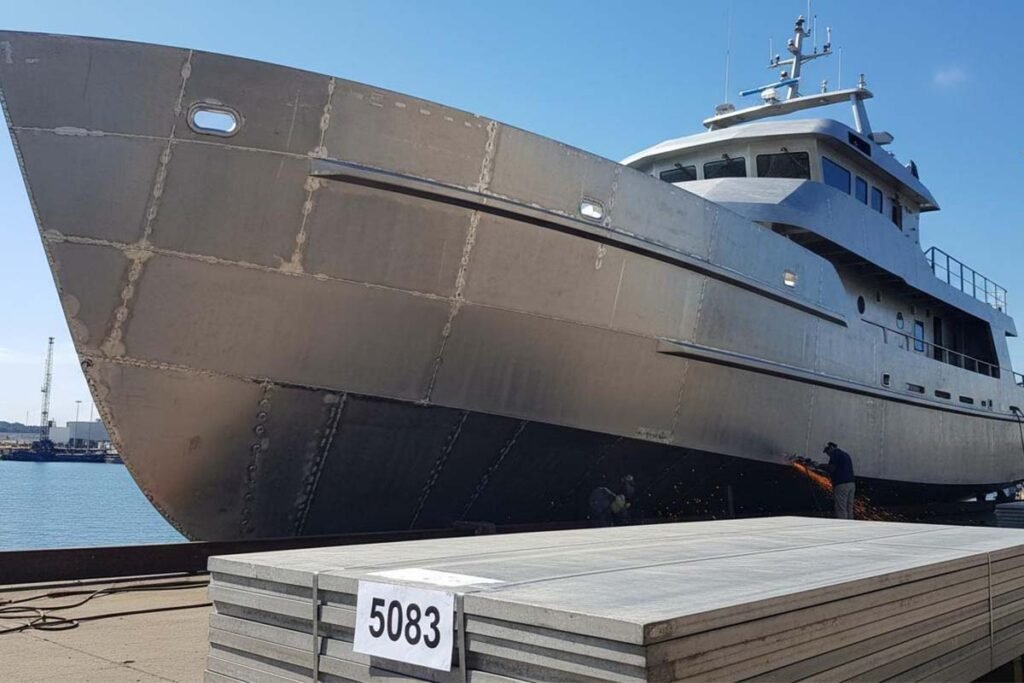
The most common application of 5083 aluminum sheet is in shipbuilding and marine environments. It is the most widely used aluminum sheet in ship construction, with common thicknesses of 4–12mm and standard dimensions of 2000*6000mm, 1500*6000mm, and 2000*8000mm.
Typical marine applications include:
- Boat hulls and ship structures – The lightweight and corrosion-resistant properties make 5083 aluminum ideal for forming the outer structure of vessels.
- Ship decks and bulkheads – 5083 aluminum stands out for its exceptional corrosion resistance and high strength for ship bulkheads.
- Marine platforms and equipment – Includes offshore platform components, naval ships, yachts, and fishing boats.
- Pressure vessels and cryogenic tanks – For LNG carriers and liquefied gas transportation.
Why marine-grade aluminum 5083? The alloy contains 4–4.9% magnesium, forming a dense oxide film that effectively resists seawater chloride ion corrosion. With BV-certified salt spray tests exceeding 1,000 hours without red rust, it significantly outperforms ordinary steel in marine environments.
4.2 Transportation
5083 aluminum sheet is widely used in the transportation industry:
- Aluminum alloy tank car body/tank body
- Car fuel tanks and air reservoirs
- Bus skins
- Truck components
- Roof and bottom guard boards
4.3 Industrial Applications
Beyond marine and transportation, 5083 aluminum sheet serves:
- Pressure vessels and refrigeration devices
- LNG ships and cryogenic storage tanks
- Television towers and drilling equipment
- Molds and precision machined parts
- Subway flooring and anti-skid applications
5. Price of 4×8 Aluminum Sheet (5083 Alloy)
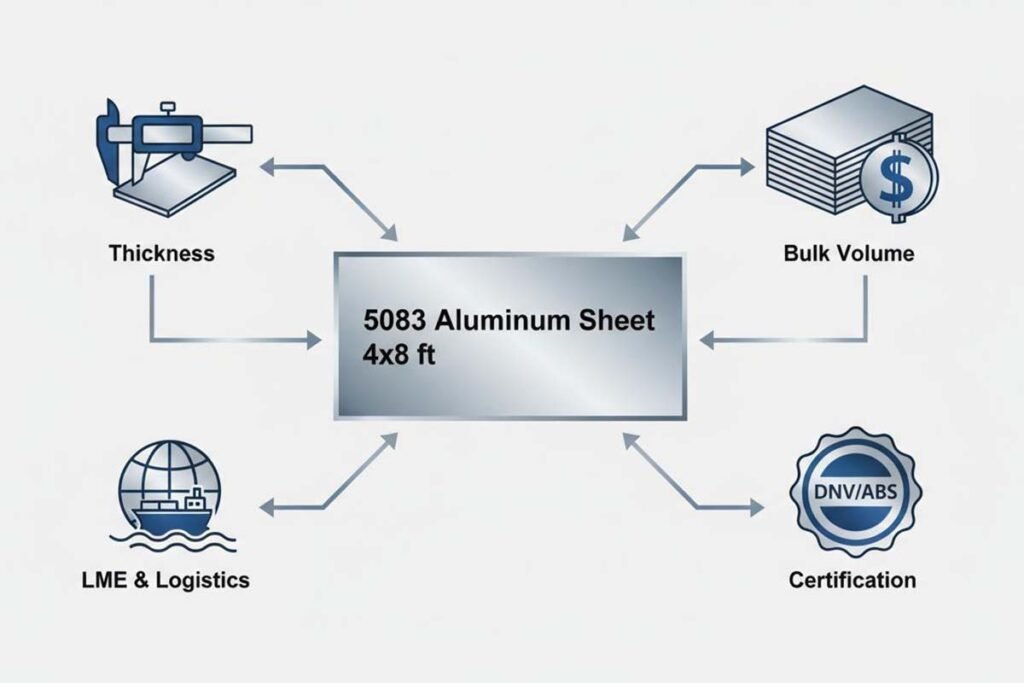
One of the most frequently asked questions is “how much is a 4×8 sheet of aluminum?” For 5083 alloy specifically, the price depends heavily on thickness. A 4×8 sheet of aluminum measures 4 feet (1,220 mm) in width and 8 feet (2,440 mm) in length.
Below is a price reference for 4×8 aluminum sheet across different thicknesses. Note that 5083 alloy is typically priced higher than standard alloys like 3003 or 5052 due to its superior properties.
Estimated 4×8 Aluminum Sheet Price Reference (USD):
| Thickness (Inch) | Thickness (mm) | Typical Price Range (USD per sheet) | Notes |
|---|---|---|---|
| 1/16″ (0.063″) | 1.6 mm | $70 – $110 | Thin sheet, easy forming |
| 1/8″ (0.125″) | 3.175 mm | $120 – $190 | Most popular thickness |
| 3/16″ (0.190″) | 4.76 mm | $180 – $260 | Increased rigidity |
| 1/4″ (0.250″) | 6.35 mm | $260 – $380 | Heavy-duty applications |
A 4×8 sheet of 1/8 inch aluminum (3.175mm thick) typically weighs approximately 41–45 kg. For 5083 marine-grade alloy, expect pricing at the higher end of these ranges, plus any certification premiums if DNV, ABS, or LR approval is required.
6. Temper Comparison: H111 vs H116 vs H321 vs H112
Understanding the difference between tempers is crucial for selecting the right product for your application. Here is a quick comparison:
| Temper | Description | Best For |
|---|---|---|
| 5083-H111 | Strain-hardened to a strength lower than H11 (1/8-hard); good formability | General fabrication, moderate forming |
| 5083-H112 | As-hot-rolled condition; mechanical properties as regulated | Hot-rolled plates, general structural use |
| 5083-H116 | Strain-hardened and stabilized; excellent stress corrosion resistance | Ship hulls, underwater structures, commercial vessels |
| 5083-H321 | Similar to H116 but with slightly different stabilization; good performance stability | Decking, upper structures, marine components |
| 5083-O | Fully annealed (softest); maximum formability | Deep drawing, complex curved parts, fuel tanks |
For commercial marine use, marine grade aluminium 5083 with H116 or H321 temper is the industry standard. If you are building a vessel over 15 meters or a commercial ferry, marine surveyors will look for 5083 with proper certification.
7. Finding Reliable 5083 Aluminum Sheet Suppliers
When sourcing 5083 aluminum sheet suppliers, consider the following factors to ensure you get both competitive pricing and quality assurance.
7.1 What to Look for in a Supplier
- Certifications – Reputable suppliers provide Mill Test Certificates (MTC) and marine classification society approvals (DNV, ABS, BV, LR) when required.
- Production capacity – Large-scale manufacturers with complete production chains typically offer more competitive pricing due to economies of scale.
- Quality assurance – Ensure the supplier complies with international standards such as ASTM B209 and EN 485.
- Export experience – Established 5083 aluminum sheet suppliers serve global markets including Europe, North America, Middle East, Southeast Asia, Australia, and South America.
7.2 Inquiry Checklist
To get accurate and comparable quotes from 5083 aluminum sheet suppliers, prepare the following information:
- Alloy and temper (e.g., 5083 H116 or 5083 H321)
- Detailed dimensions (thickness, width, length – e.g., 4×8 aluminum sheet)
- Total quantity (kg or metric tons)
- Delivery destination (for freight calculation)
- Certification requirements (standard MTC vs. DNV/ABS/LR approval)
- Any value-added services needed (cutting, CNC machining, surface treatment)
Providing complete specifications upfront will help you get the best aluminum sheet price and avoid unexpected costs later.
8. Key Takeaways
- 5083 aluminum sheet price typically ranges from $2.8 to $4.5 per kg, depending on order volume, thickness, and certification requirements.
- For marine-grade applications requiring DNV, ABS, or LR approval, expect a premium of $0.5–$1.0 per kg.
- The price per pound of 5083 aluminum converts to approximately $1.27–$2.04 per lb.
- 5083 aluminum properties include exceptional corrosion resistance, high strength (305–385 MPa tensile), good weldability, and density of 2.66 g/cm³.
- The alloy is the highest-strength non-heat-treatable corrosion-resistant alloy, making it the preferred choice for marine, shipbuilding, pressure vessel, and transportation applications.
- A 4×8 sheet of aluminum in 5083 alloy ranges from approximately $70 for 1/16″ thickness to $380 for 1/4″ thickness.
- Always request current quotes from multiple 5083 aluminum sheet suppliers because prices fluctuate with LME aluminum market movements.
- In 2026, aluminum prices have shown a steady upward trend, with global supply tightening due to production caps and rising energy costs. Early purchasing is recommended for budget-sensitive projects.
Need a specific price for your project? Contact us with your required thickness, quantity, and certification needs to receive a customized quote for 5083 aluminum sheet.