

When industrial buyers and packaging engineers specify aluminum foil for demanding applications, aluminum foil 3003 is one of the most practical choices available. The 3003 alloy adds manganese to pure aluminum, giving it better strength than 1xxx series alloys while keeping excellent formability and corrosion resistance. It is widely used in heat exchangers, food containers, packaging laminates, and industrial applications where standard household foil alloys are not strong enough.
This guide covers everything buyers need to know about 3003 aluminum foil: what it is, how it compares to other foil alloys, its chemical composition, mechanical properties, standard sizes, applications, price factors, and how to order.
1. What Is Aluminum Foil 3003?
Aluminum foil 3003 is a thin-gauge aluminum product made from the 3003 alloy. It belongs to the 3xxx series aluminum-manganese alloy family. The manganese content gives 3003 approximately 20% more strength than commercially pure 1100 aluminum, while maintaining good formability and excellent corrosion resistance.
3003 aluminum foil is not the same as household kitchen foil. Household foil is usually made from 1235, 8011, or 1100 alloys. 3003 foil is an industrial and semi-rigid grade used where higher strength is needed.
It is also called:
- 3003 aluminum foil
- Aluminum 3003 foil
- 3003 alloy foil
- 3003 industrial foil
- 3003 fin stock foil
Is Aluminum Foil Made of Aluminum?
Yes. All aluminum foil — including 3003 aluminum foil — is made of aluminum. The number designation (3003) refers to the specific alloy composition. Pure aluminum is the base metal. Alloying elements like manganese are added in small amounts to improve specific properties.
Is Aluminum Foil 100 Percent Aluminum?
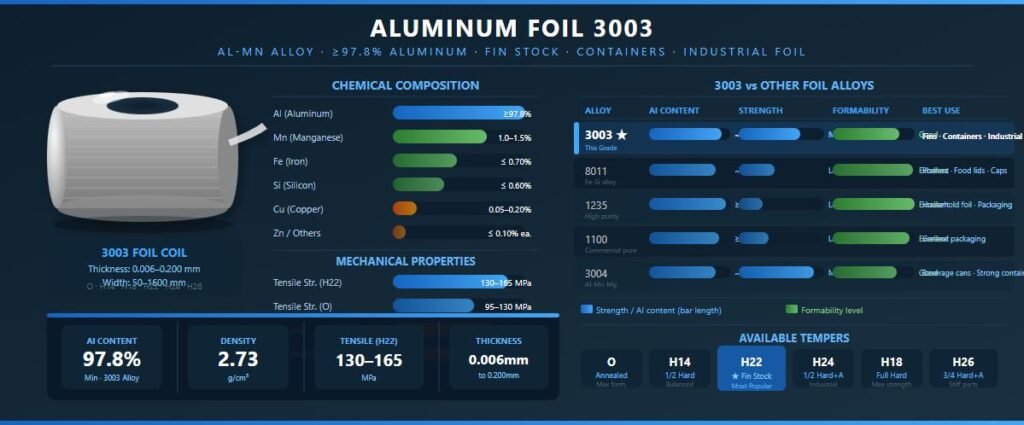
Not exactly. No commercial aluminum alloy is 100% aluminum. 3003 aluminum foil contains approximately 97.8–99.0% aluminum by weight. The remaining fraction includes manganese (0.3–1.5%), iron (≤0.7%), silicon (≤0.6%), copper (0.05–0.20%), and trace elements. These additions are controlled to improve strength and performance without significantly affecting corrosion resistance or formability.
What Is the Aluminum Foil Formula?
The chemical formula for aluminum is Al. Aluminum foil has no single molecular formula because it is a metallic alloy, not a chemical compound. The composition of 3003 aluminum foil is described by its alloy designation and chemical analysis — not a molecular formula.
2. Aluminum 3003 Chemical Composition
The controlled composition of 3003 aluminum is what sets it apart from pure aluminum foil alloys.
| Element | Content (%) | Role |
|---|---|---|
| Aluminum (Al) | Balance (≈97.8–99.0%) | Base metal — provides light weight and corrosion resistance |
| Manganese (Mn) | 1.0 – 1.5 | Primary strengthener — increases strength by ~20% vs 1100 |
| Iron (Fe) | ≤ 0.70 | Controlled impurity — affects grain structure |
| Silicon (Si) | ≤ 0.60 | Controlled impurity — minor strength contribution |
| Copper (Cu) | 0.05 – 0.20 | Minor strengthener — improves strength slightly |
| Zinc (Zn) | ≤ 0.10 | Controlled for corrosion stability |
| Others (each) | ≤ 0.05 | Trace elements — tightly controlled |
The manganese content is the key differentiator. Manganese forms a solid solution in aluminum and also precipitates as fine dispersoids that strengthen the alloy without significantly reducing formability or corrosion resistance.
3. Mechanical Properties of 3003 Aluminum Foil
The mechanical properties of aluminum 3003 depend on the temper. For foil applications, the most common tempers are O (annealed), H14, H18, and H22.
| Property | O Temper | H14 Temper | H18 Temper | H22 Temper |
|---|---|---|---|---|
| Tensile Strength (MPa) | 95 – 130 | 145 – 180 | 185 – 215 | 130 – 165 |
| Yield Strength (MPa) | 35 – 75 | 125 – 160 | 170 – 200 | 105 – 145 |
| Elongation (%) | 18 – 28 | 3 – 8 | 1 – 4 | 6 – 12 |
| Hardness (HB) | 28 – 35 | 40 – 50 | 52 – 62 | 38 – 48 |
| Density (g/cm³) | 2.73 | 2.73 | 2.73 | 2.73 |
| Thermal Conductivity (W/m·K) | 155 – 165 | 155 – 165 | 155 – 165 | 155 – 165 |
| Electrical Conductivity (% IACS) | ~41 | ~41 | ~41 | ~41 |
| Melting Range (°C) | 643 – 654 | 643 – 654 | 643 – 654 | 643 – 654 |
3003 aluminum foil has noticeably higher tensile strength than 8011 or 1100 foil at equivalent tempers. This makes it preferred for applications where the foil must resist tearing, forming loads, or mechanical stress in service.
4. How Much Aluminum Is in Aluminum Foil 3003?
3003 aluminum foil contains approximately 97.8–99.0% aluminum by weight. The exact percentage depends on the specific heat and the levels of manganese, iron, silicon, and copper in that batch.
By comparison:
- 1235 aluminum foil: ≥99.35% aluminum
- 8011 aluminum foil: ≈97.5–98.5% aluminum
- 1100 aluminum foil: ≥99.00% aluminum
- 3003 aluminum foil: ≈97.8–99.0% aluminum
All of these are considered “aluminum foil.” The alloy designation tells you what the remaining fraction contains — which directly determines the mechanical properties and application suitability.
5. 3003 Aluminum Foil vs Other Foil Alloys
Buyers often compare 3003 with 8011, 1235, 1100, and 3004 foil alloys. Each has different strengths.
| Property | 3003 | 8011 | 1235 | 1100 | 3004 |
|---|---|---|---|---|---|
| Al Content | ~98–99% | ~97.5–98.5% | ≥99.35% | ≥99.00% | ~97.5–98.5% |
| Mn Content | 1.0–1.5% | — | — | — | 1.0–1.5% |
| Tensile Str. (O) | 95–130 MPa | 60–90 MPa | 55–85 MPa | 75–105 MPa | 130–160 MPa |
| Strength Level | Medium | Low-Med | Low | Low | Med-High |
| Formability | Good | Excellent | Excellent | Excellent | Good |
| Corrosion Resistance | Excellent | Good | Excellent | Excellent | Good |
| Typical Use | Heat exchangers, containers, industrial foil | Pharma, food, caps | Household foil, packaging | General packaging | Beverage can body stock |
Choose 3003 when you need higher strength than pure aluminum foil alloys, while keeping good formability and corrosion resistance. 3003 is the right choice for heat exchanger fin stock, food service containers, and industrial foil applications.
6. Common Applications of Aluminum Foil 3003
Heat Exchanger Fin Stock
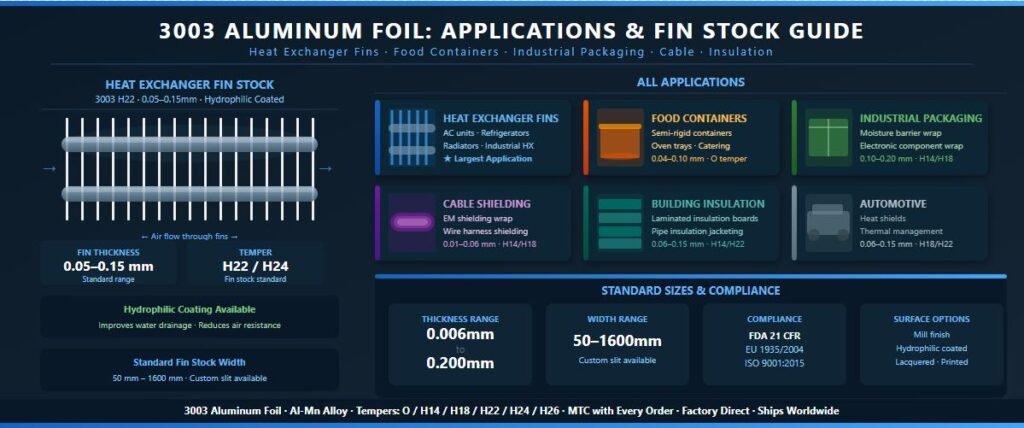
This is the largest application for 3003 aluminum foil. The foil is formed into corrugated fins bonded to aluminum tubes in air conditioning units, refrigerators, radiators, and industrial heat exchangers.
3003 is chosen for fins because:
- Higher strength resists fin deformation during handling and service
- Excellent thermal conductivity transfers heat efficiently
- Good corrosion resistance in humid and chemical environments
- Easily formed into complex fin shapes
Standard fin stock thickness: 0.05 mm – 0.15 mm
Food Service Containers and Trays
3003 aluminum foil is used for semi-rigid food containers, oven trays, and catering containers. These products require:
- Enough strength to hold food without collapsing
- Good forming for container shapes
- Food-safe material with no migration issues
- Compatibility with heat sealing and lacquering
Thickness for containers: 0.04 mm – 0.10 mm
Industrial Packaging Foil
3003 foil is used as a moisture and corrosion barrier in industrial packaging. Applications include:
- Moisture barrier wrapping for electronic components
- Corrosion barrier in industrial shipments
- Protective wrapping for sensitive instruments
- Shielding layers in composite packaging structures
Building and Insulation Foil
3003 aluminum foil is laminated to insulation boards, pipe insulation, and vapor barrier products. The higher strength of 3003 compared to 1xxx alloys improves handling and installation performance.
Pharmaceutical and Medical Packaging
While 8011 and 8021 are more common for pharmaceutical blister foil, 3003 foil is used in some medical and laboratory packaging applications where higher mechanical strength is required.
Cable and Wire Shielding
3003 aluminum foil is used as a shielding layer in cables and wire harnesses. The higher strength allows thinner foil to provide reliable shielding without tearing during cable assembly.
Other Applications
- Automotive heat shields
- Household foil rolls (specialty grade)
- Capacitor foil (some grades)
- Solar collector panels
- Marine and aerospace insulation
7. Standard Sizes of 3003 Aluminum Foil
3003 aluminum foil is produced in a wide range of thicknesses and widths.
Thickness Range
| Thickness | Classification | Typical Application |
|---|---|---|
| 0.006 – 0.010 mm | Ultra-thin foil | Specialized industrial use |
| 0.010 – 0.030 mm | Thin foil | Cable wrap, shielding |
| 0.030 – 0.060 mm | Standard foil | Heat exchanger fin stock |
| 0.060 – 0.100 mm | Semi-rigid foil | Food containers, trays |
| 0.100 – 0.200 mm | Light gauge sheet/foil | Industrial packaging, insulation |
Width and Form
| Parameter | Standard Range |
|---|---|
| Width | 50 mm – 1600 mm (custom widths available) |
| Inner diameter | 76 mm / 152 mm (standard cores) |
| Outer diameter | Up to 800 mm depending on weight |
| Coil weight | 50 kg – 3,000 kg |
| Sheet length | Custom cut-to-length available |
Available Tempers
| Temper | Condition | Best Use |
|---|---|---|
| O | Fully annealed | Maximum formability, container forming |
| H14 | 1/2 hard | Balance of strength and formability |
| H18 | Full hard | Maximum strength, less forming |
| H22 | 1/4 hard + partial anneal | Fin stock, industrial foil |
| H24 | 1/2 hard + partial anneal | Moderate strength with good ductility |
| H26 | 3/4 hard + partial anneal | Stiffer applications |
8. Surface Finish Options for 3003 Aluminum Foil
Surface finish affects performance in downstream processing and end use.
| Finish | Description | Application |
|---|---|---|
| Mill finish (both sides bright) | Standard as-rolled finish | General industrial, packaging |
| One-side bright, one-side matte | Single-side polished | Household foil style products |
| Lacquered | Organic coating applied | Food containers, heat seal |
| Printed | Flexo or gravure printing | Branded packaging, labels |
| Hydrophilic coated | Special coating for water wettability | Air conditioning fin stock |
| Embossed | Pattern applied to surface | Decorative, grip surface |
For heat exchanger fin stock, hydrophilic coating on 3003 foil is commonly specified. The coating improves water drainage from the fin surface and reduces air resistance in the heat exchanger.
9. 3003 Aluminum Foil for Heat Exchanger Fins: Technical Detail
Heat exchanger fin stock is the dominant application for 3003 aluminum foil. The performance requirements are demanding.
Why 3003 Is the Standard for Fin Stock
Heat exchanger fins must withstand:
- Forming into complex corrugated or louvered shapes
- Mechanical stress during assembly (brazing, bonding, or mechanical expansion)
- Vibration and thermal cycling in service
- Corrosion from condensate, refrigerants, and ambient atmosphere
3003 aluminum delivers on all of these requirements because:
- Higher manganese content improves strength versus pure aluminum
- Excellent thermal conductivity maintains heat transfer efficiency
- Good formability allows complex fin profiles
- Natural oxide film provides corrosion protection
Fin Stock Specification
| Parameter | Typical Specification |
|---|---|
| Alloy | 3003 |
| Temper | H22 or H24 |
| Thickness | 0.05 – 0.15 mm |
| Width | As required by fin design |
| Coating | Hydrophilic (for AC fins) or bare |
| Tensile strength | 130–165 MPa (H22) |
| Yield strength | 105–145 MPa (H22) |
10. 3003 Aluminum Foil vs 3004 Aluminum Foil
Buyers sometimes compare 3003 and 3004 aluminum for foil applications.
| Property | 3003 | 3004 |
|---|---|---|
| Manganese | 1.0–1.5% | 1.0–1.5% |
| Magnesium | None | 0.8–1.3% |
| Tensile Strength (O) | 95–130 MPa | 130–160 MPa |
| Yield Strength (O) | 35–75 MPa | 65–100 MPa |
| Formability | Good | Good |
| Corrosion Resistance | Excellent | Excellent |
| Typical Use | Fin stock, containers, industrial foil | Beverage can body, stronger containers |
3004 adds magnesium to the 3003 base, which increases strength further. For most fin stock and industrial foil applications, 3003 provides sufficient strength. 3004 is selected when even higher strength is required, such as in beverage can body stock.
11. 3003 Aluminum Foil Price Factors
The price of 3003 aluminum foil depends on several variables.
| Factor | Effect on Price |
|---|---|
| LME aluminum price | Base metal cost changes daily with market |
| Alloy premium | 3003 commands a small premium over 1xxx alloys due to Mn content |
| Thickness | Thinner foil costs more per kg to produce |
| Temper | Annealed (O) and H22 may require additional processing steps |
| Width | Narrow slit coils cost more per kg than wide coils |
| Surface coating | Hydrophilic, lacquered, or printed coils cost more |
| Quantity | Larger orders receive lower per-kg pricing |
| Packaging | Industrial coils vs finished retail rolls |
For accurate pricing, provide your alloy, temper, thickness, width, coating requirement, quantity, and delivery destination.
12. Certifications and Compliance
For food contact, pharmaceutical, and electronic applications, compliance documentation is important.
| Standard | Relevance |
|---|---|
| ASTM B479 | Standard specification for annealed aluminum foil |
| EN 546 | European aluminum foil standard |
| FDA 21 CFR | Food contact compliance (USA) |
| EU 1935/2004 | Food contact material regulation (Europe) |
| RoHS | Restriction of hazardous substances (electronics) |
| ISO 9001:2015 | Quality management system |
Always request mill test certificates (MTC) confirming chemical composition and mechanical properties for every batch.
13. How to Order 3003 Aluminum Foil: RFQ Checklist
A complete inquiry helps suppliers respond quickly and accurately.
Include the following:
- Alloy: 3003
- Temper: O / H14 / H18 / H22 / H24 / H26
- Thickness: mm or micron (µm)
- Width: mm — specify slit width tolerance
- Form: coil / sheet / finished roll
- Surface: mill finish / hydrophilic coated / lacquered / printed
- Inner diameter: 76 mm / 152 mm or other
- Coil weight: kg per coil
- Quantity: total kg or metric tons
- Application: fin stock / container / packaging / cable / other
- Compliance: FDA / EU food contact / RoHS required
- Certification: MTC / third-party inspection
- Delivery term: FOB / CIF / DDP
- Destination port or address
14. Why Source 3003 Aluminum Foil From Us
We supply 3003 aluminum foil to heat exchanger manufacturers, food container producers, industrial packagers, and cable manufacturers worldwide.
Our advantages:
✅ Full temper range — O, H14, H18, H22, H24, H26 available
✅ Thickness from 0.006 mm to 0.200 mm
✅ Custom width slitting to your specification
✅ Hydrophilic coated fin stock available
✅ Lacquering and printing services
✅ Food contact compliance documentation
✅ Mill test certificate with every order
✅ Competitive factory pricing — direct from mill
✅ Export experience to 50+ countries
✅ Fast RFQ response — reply within 24 hours
Frequently Asked Questions
Q: Is aluminum foil made of aluminum?
A: Yes. All aluminum foil is made of aluminum as the base metal. The alloy designation (such as 3003) tells you what other elements are added to achieve specific properties.
Q: Is aluminum foil 100 percent aluminum?
A: No commercial aluminum foil is 100% pure aluminum. 3003 aluminum foil contains approximately 97.8–99.0% aluminum. The remainder is manganese, iron, silicon, copper, and trace elements that improve strength and performance.
Q: What is the aluminum foil formula?
A: Aluminum foil is a metallic alloy, not a chemical compound. It has no molecular formula. It is described by its alloy designation (3003) and chemical composition analysis.
Q: What is the difference between 3003 and 8011 aluminum foil?
A: 3003 has higher strength due to manganese content. 8011 has better formability at very thin gauges and is preferred for pharmaceutical blister foil and food lidding. 3003 is preferred for heat exchanger fins and food containers.
Q: What temper is best for heat exchanger fin stock?
A: H22 or H24 temper is standard for 3003 heat exchanger fin stock. These tempers provide good strength combined with enough ductility for fin forming operations.
Q: Does 3003 aluminum foil need a hydrophilic coating for AC fins?
A: For air conditioning applications, hydrophilic coating is commonly specified. It improves water drainage from the fin surface and improves heat transfer efficiency over the product life.
Q: What is the minimum thickness of 3003 aluminum foil?
A: We supply 3003 aluminum foil from 0.006 mm thickness. Standard fin stock is 0.05–0.15 mm. Food containers typically use 0.04–0.10 mm.
Conclusion
Aluminum foil 3003 is a versatile, medium-strength foil alloy with excellent corrosion resistance, good formability, and reliable performance across heat exchanger, packaging, and industrial applications. Its manganese-strengthened composition makes it the preferred choice when standard pure aluminum foil alloys lack the mechanical performance required.
Whether you need hydrophilic-coated fin stock, food container foil, industrial packaging material, or cable shielding — 3003 aluminum foil offers the right combination of properties at a competitive cost.
Contact us with your thickness, width, temper, coating requirement, quantity, and application. We will reply within 24 hours with pricing and availability.