
What Is 8011 Aluminum?
8011 aluminum is a wrought aluminum alloy in the 8000 series. It contains iron and silicon as its main alloying elements beyond aluminum. This combination gives 8011 excellent formability, good corrosion resistance, and strong barrier properties.
The 8000 series is different from other aluminum series. Most series use elements like copper, manganese, or magnesium as primary additions. The 8000 series uses iron and other elements to achieve specific properties suited for thin-gauge applications.
8011 aluminum alloy is the most widely used grade in the 8000 series. It dominates the aluminum foil market worldwide. Food packaging, pharmaceutical blister packs, bottle caps, and household foil all rely on 8011 aluminum.
If you need a reliable, food-safe, highly formable aluminum alloy for foil or sheet applications, aluminum grade 8011 is the top choice.

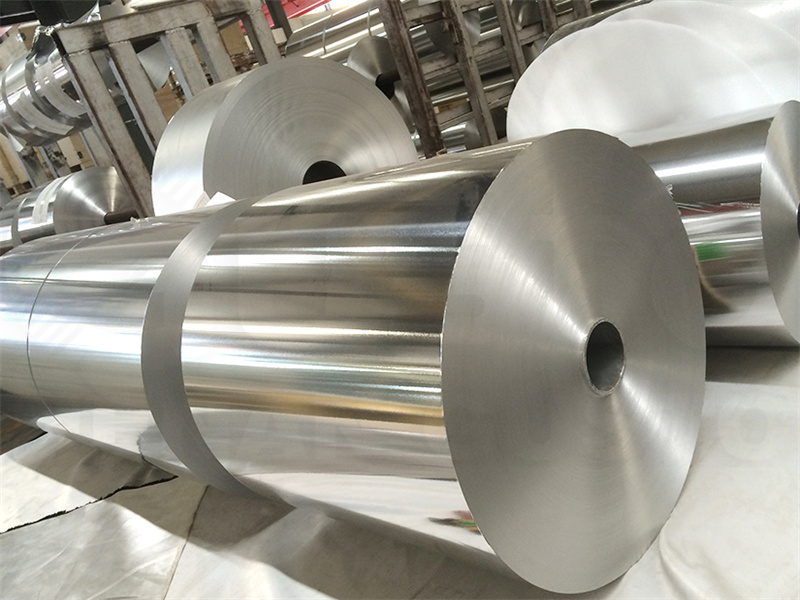

What Is 8011 Grade Aluminium?
8011 grade aluminium belongs to the Al-Fe-Si alloy system. The “8” in 8011 indicates the 8000 series. This series covers alloys with iron as a major alloying element.
Here is what makes 8011 grade aluminium special:
- High iron content — Iron improves strength without reducing formability significantly
- Silicon addition — Silicon improves casting characteristics and workability
- Very high aluminum purity base — The aluminum content stays above 97%
- Excellent rollability — Can be rolled to very thin gauges (as thin as 0.006mm)
- Food-safe — Meets international food contact standards
This grade sits between pure aluminum (1000 series) and higher-strength structural alloys. It prioritizes formability and barrier performance over high mechanical strength.
8011 Aluminum Alloy Composition
The 8011 aluminum alloy composition follows strict international standards. Here is the full chemical breakdown.
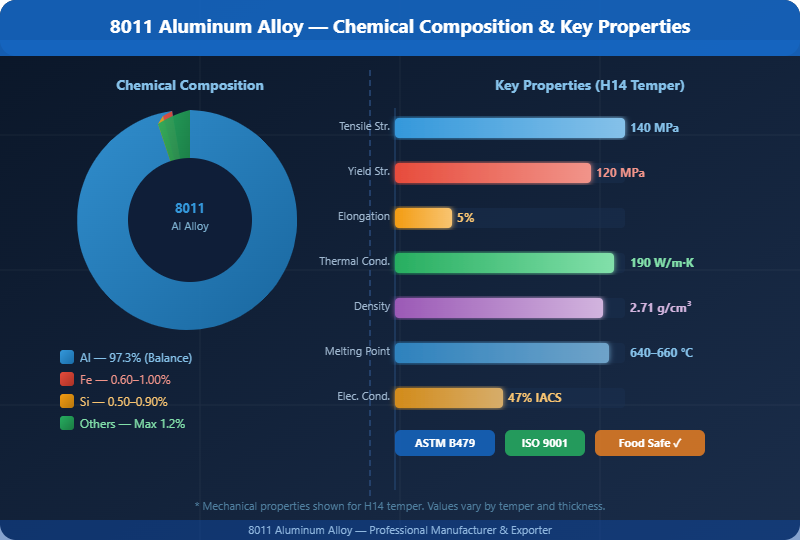
8011 Aluminum Chemical Composition
| Element | Content (%) |
|---|---|
| Aluminum (Al) | Balance (≥97.3%) |
| Iron (Fe) | 0.60 – 1.00 |
| Silicon (Si) | 0.50 – 0.90 |
| Copper (Cu) | Max 0.10 |
| Manganese (Mn) | Max 0.20 |
| Magnesium (Mg) | Max 0.05 |
| Chromium (Cr) | Max 0.10 |
| Zinc (Zn) | Max 0.10 |
| Titanium (Ti) | Max 0.08 |
| Other (each) | Max 0.05 |
| Other (total) | Max 0.15 |
Key Points About the Composition
Iron (0.60 – 1.00%)
Iron is the most important alloying element in 8011. It increases tensile strength and hardness. It also helps the alloy maintain structural integrity at thin gauges.
Silicon (0.50 – 0.90%)
Silicon works together with iron. It improves the alloy’s ability to be cast and rolled. Silicon also helps control the size and distribution of intermetallic particles in the microstructure.
Low copper, manganese, and zinc
These elements are kept very low. High levels of these elements would reduce corrosion resistance and food safety. Keeping them minimal ensures 8011 remains safe for food contact applications.
This aluminum alloy chemical composition makes 8011 ideal for thin foil production and packaging applications.
Alloy 8011 Specifications
Alloy 8011 specifications cover temper, thickness, width, and mechanical properties. Here is a complete overview.
Available Tempers
| Temper | Description | Typical Use |
|---|---|---|
| O | Fully annealed, softest | Deep drawing, complex forming |
| H14 | Strain hardened, half hard | General sheet and foil |
| H16 | Strain hardened, three-quarter hard | Stiffer sheet applications |
| H18 | Fully strain hardened | Maximum strength foil |
| H22 | Strain hardened and partially annealed | Moderate strength with good formability |
| H24 | Strain hardened and partially annealed | Balance of strength and ductility |
Aluminum 8011 H14 is one of the most popular tempers. It offers a good balance between strength and formability. Many bottle cap and packaging applications use H14.
Thickness Range
| Product Type | Thickness Range |
|---|---|
| Aluminum Foil | 0.006mm – 0.2mm |
| Thin Sheet | 0.2mm – 2.0mm |
| Standard Sheet | 2.0mm – 6.0mm |
Width Range
- Foil rolls: 100mm – 1600mm
- Sheet: 500mm – 2600mm
Standard Lengths
- Coil: Continuous rolls up to several tons per coil
- Sheet: 1000mm – 6000mm standard lengths
- Cut-to-length available on request
8011 Aluminum Properties
Understanding 8011 aluminum properties helps buyers select the right temper and gauge for their application.
Mechanical Properties of 8011 Aluminum
| Property | O Temper | H14 Temper | H18 Temper |
|---|---|---|---|
| Tensile Strength | 90 – 120 MPa | 120 – 160 MPa | 145 – 185 MPa |
| Yield Strength | 35 – 70 MPa | 100 – 140 MPa | 130 – 170 MPa |
| Elongation | 15 – 25% | 3 – 8% | 2 – 4% |
| Hardness (HB) | 25 – 35 | 35 – 45 | 45 – 55 |
Physical Properties of 8011 Aluminum
| Property | Value |
|---|---|
| Density | 2.71 g/cm³ |
| Melting Range | 640 – 660°C |
| Thermal Conductivity | 190 W/m·K |
| Electrical Conductivity | 45 – 50% IACS |
| Coefficient of Thermal Expansion | 23.5 µm/m·°C |
| Elastic Modulus | 69 GPa |
Key Performance Characteristics
Barrier Properties
Even at very thin gauges, 8011 aluminum foil provides a complete barrier against:
- Moisture and humidity
- Oxygen and gases
- Light and UV radiation
- Bacteria and microorganisms
- Odors and flavors
This makes it unmatched for food and pharmaceutical packaging.
Formability
8011 in O temper has excellent ductility. It forms into complex shapes without cracking or tearing. Deep drawing, stamping, and embossing all work well with this alloy.
Corrosion Resistance
8011 forms a natural oxide layer that protects against corrosion. It performs well in most environments including food processing and outdoor exposure.
Heat Resistance
8011 aluminum handles cooking temperatures well. It works in conventional ovens, steam sterilization, and other thermal processing environments.
ASTM B479 — Standard for 8011 Aluminum
ASTM B479 is the key standard for annealed aluminum and aluminum-alloy foil for flexible barrier applications. This standard directly applies to 8011 aluminum foil used in packaging.
What ASTM B479 Covers
- Chemical composition requirements for 8011 and other foil alloys
- Mechanical property requirements by temper
- Dimensional tolerances for thickness and width
- Testing and inspection methods
- Certification and documentation requirements
Why ASTM B479 Matters
Buyers in the food, pharmaceutical, and packaging industries often require ASTM B479 compliance. This certification proves the foil meets established safety and performance standards.
Always ask your supplier for a mill test certificate (MTC) referencing ASTM B479 when ordering 8011 aluminum foil for regulated applications.
Other Relevant Standards
| Standard | Scope |
|---|---|
| ASTM B479 | Aluminum foil for flexible barrier use |
| EN 546 | European aluminum foil standard |
| GB/T 3198 | Chinese national aluminum foil standard |
| ISO 1060 | International aluminum foil standard |
| JIS H4160 | Japanese aluminum foil standard |
8011 Aluminum Foil — The Most Important Application
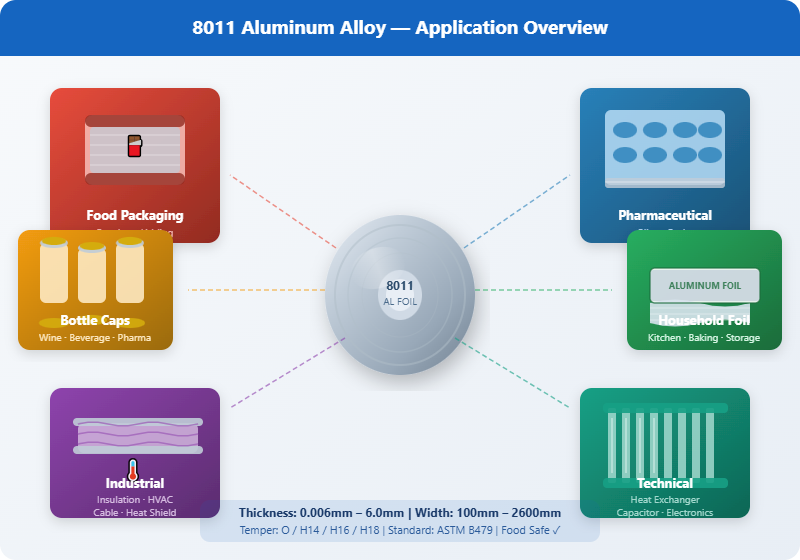
8011 aluminum foil represents the largest market for this alloy. Here is everything buyers need to know.
What Makes 8011 the Best Foil Alloy?
8011 outperforms other alloys for foil production because:
- Excellent rollability — Can be rolled to extremely thin gauges without breaking
- Pin-hole free surface — At standard foil gauges, 8011 achieves very low pin-hole counts
- Good surface quality — Clean, bright surface suitable for printing and coating
- Food safe — Chemical composition approved for direct food contact
- Cost effective — More affordable than higher-purity alloys like 1235
Types of 8011 Aluminum Foil
Household Foil
- Thickness: 0.009mm – 0.025mm
- Width: 280mm – 450mm
- Use: Cooking, wrapping, food storage
Food Service Foil
- Thickness: 0.012mm – 0.040mm
- Width: 300mm – 600mm
- Use: Catering, takeaway containers, tray lining
Pharmaceutical Foil (Blister Pack)
- Thickness: 0.016mm – 0.025mm
- Special requirements: Pinhole-free, high forming quality
- Use: Tablet and capsule blister packaging
Bottle Cap Foil
- Thickness: 0.15mm – 0.25mm
- Temper: H14 or H16
- Use: Wine bottle caps, beverage bottle seals
Flexible Packaging Foil
- Thickness: 0.006mm – 0.012mm
- Use: Laminated packaging for snacks, coffee, condiments
Industrial Foil
- Thickness: 0.02mm – 0.20mm
- Use: Insulation, cable wrapping, heat shields
Surface Finish Options for 8011 Foil
| Finish | Description |
|---|---|
| Bright/Bright | Both sides shiny |
| Bright/Matte | One shiny, one matte side |
| Matte/Matte | Both sides matte (rare) |
| Printed | Custom printing on one or both sides |
| Lacquered | Protective or decorative coating applied |
| Embossed | Textured surface pattern |
8011 Aluminium Alloy Applications
8011 aluminium alloy applications span many industries. Here is a detailed breakdown.
Food Packaging
This is the largest application area. 8011 aluminum foil and sheet appear throughout food packaging:
- Flexible pouches — Coffee, tea, snacks, pet food
- Lidding foil — Yogurt cups, butter containers, dairy products
- Tray containers — Ready meals, airline food, catering
- Wrapping foil — Chocolate, cheese, confectionery
- Laminated packaging — Multi-layer barrier packaging for long shelf life
Pharmaceutical Packaging
The pharmaceutical industry depends on 8011 aluminum for:
- Blister packs — Tablets, capsules, suppositories
- Strip packaging — Individually sealed medicine doses
- Sachets — Powder and liquid medicines
- Ampoule sealing — Sterile product packaging
The barrier properties of 8011 foil protect medicines from moisture, oxygen, and light. This extends shelf life and maintains drug efficacy.
Bottle Caps and Closures
Aluminum grade 8011 in H14 or H16 temper makes excellent bottle caps:
- Wine and spirits bottle caps
- Milk bottle foil caps
- Beverage bottle seals
- Pharmaceutical vial seals
The alloy’s combination of strength and formability allows clean crimping and sealing.
Household Products
Consumers use 8011 aluminum every day:
- Kitchen foil rolls
- Baking cups and molds
- Disposable trays and containers
- Foil wrapping for leftovers
Industrial and Technical Applications
Beyond packaging, 8011 aluminum sheet and foil serves industrial markets:
- Thermal insulation — Building insulation facing
- HVAC systems — Duct insulation and vapor barriers
- Cable wrapping — Electromagnetic shielding for cables
- Capacitors — Electronic component manufacturing
- Heat exchangers — Fin stock for HVAC and refrigeration
Agricultural Applications
8011 aluminum foil helps agriculture:
- Greenhouse insulation and light reflection
- Mulch film applications
- Seed packet and fertilizer packaging
8011 Aluminum Sheet
Beyond foil, 8011 aluminum sheet serves several markets that need thin, formable aluminum with good surface quality.
Key Uses of 8011 Aluminum Sheet
Closure Stock
Thick foil and thin sheet (0.15mm – 0.30mm) in H14 temper becomes bottle caps, pull-tab seals, and container lids.
Fin Stock
8011 sheet in 0.08mm – 0.15mm thickness makes heat exchanger fins. Good thermal conductivity and corrosion resistance suit this application well.
Label Stock
Bright-finish 8011 sheet becomes aluminum labels for bottles and containers. The alloy takes printing and embossing well.
Decorative Applications
Embossed 8011 sheet appears in decorative panels, gift wrapping, and specialty packaging.
8011 Sheet vs 8011 Foil
| Feature | 8011 Sheet | 8011 Foil |
|---|---|---|
| Thickness | 0.2mm and above | Below 0.2mm |
| Form | Flat sheets or coils | Rolls |
| Main Use | Closures, fins, labels | Packaging, wrapping |
| Typical Temper | H14, H16, H18 | O, H14, H18 |
8011 vs 8079 Aluminum Alloy
Buyers sometimes compare 8079 aluminum alloy with 8011. Both are 8000 series alloys used in foil applications.
Chemical Composition Comparison
| Element | 8011 | 8079 |
|---|---|---|
| Iron (Fe) | 0.60 – 1.00% | 0.70 – 1.30% |
| Silicon (Si) | 0.50 – 0.90% | Max 0.10% |
| Copper (Cu) | Max 0.10% | Max 0.05% |
| Aluminum | Balance | Balance |
Performance Comparison
| Property | 8011 | 8079 |
|---|---|---|
| Tensile Strength | Medium | Slightly higher |
| Elongation | Good | Better |
| Pinhole Performance | Good | Excellent |
| Surface Brightness | Good | Better |
| Cost | Lower | Slightly higher |
| Food Safety | Yes | Yes |
When to Choose Each
Choose 8011 when:
- Cost efficiency is important
- Standard food packaging applications
- Bottle caps and closures
- Household foil production
- General industrial foil use
Choose 8079 when:
- Ultra-thin foil below 0.009mm
- Maximum pinhole-free performance required
- Premium pharmaceutical packaging
- Highest surface brightness needed
- Lithium battery soft pack applications
Both alloys meet food safety requirements. The choice depends on technical requirements and budget.
Aluminium Alloy Composition Percentage — 8000 Series Overview
Many buyers want to understand aluminium alloy composition percentage across the 8000 series. Here is a comparison of common 8000 series alloys.
8000 Series Alloy Comparison
| Alloy | Fe (%) | Si (%) | Cu (%) | Main Use |
|---|---|---|---|---|
| 8011 | 0.60–1.00 | 0.50–0.90 | Max 0.10 | Foil, packaging, caps |
| 8079 | 0.70–1.30 | Max 0.10 | Max 0.05 | Premium foil, battery |
| 8021 | 1.20–1.70 | Max 0.15 | Max 0.05 | Pharmaceutical foil |
| 8006 | 1.20–2.00 | Max 0.40 | Max 0.30 | Fin stock, containers |
Why Iron Content Matters
Higher iron content generally means:
- Higher tensile strength
- Better performance at very thin gauges
- Slightly lower ductility
- Better creep resistance
This is why pharmaceutical foil alloys like 8021 use higher iron than general packaging alloy 8011.
8011a Aluminum — What Is It?
8011a aluminum is a variant of the standard 8011 alloy. The “a” suffix indicates a modified composition with tighter control over certain elements.
Key differences in 8011a:
- Slightly tighter silicon and iron ratio control
- Often used in European markets following EN standards
- Properties are very similar to standard 8011
- Suitable for the same applications as 8011
For most practical purposes, 8011 and 8011a are interchangeable. Always confirm with your supplier which designation applies to your regional standard requirements.
What Is the Price of Aluminum 8011?
The price of aluminum 8011 depends on several factors. Here is what drives the cost.
Price Factors
1. LME Aluminum Price
The base price of aluminum follows the London Metal Exchange. When LME prices rise, 8011 aluminum prices follow.
2. Processing Premium (Conversion Cost)
Producing thin foil requires many rolling passes. Thinner gauges carry higher processing premiums per kg.
3. Temper
O temper (annealed) adds cost due to the annealing process. H14 and H18 tempers have different rolling requirements that affect cost.
4. Thickness and Width
Thinner gauges and wider widths are harder to produce. They cost more per kg.
5. Surface Treatment
Plain mill finish is cheapest. Printed, lacquered, or embossed surfaces add cost.
6. Order Quantity
Larger orders get lower per-kg pricing. Minimum order quantities (MOQ) typically start at 1–5 tons for sheet and 2–10 tons for foil.
7. Certification Requirements
ASTM B479 or pharmaceutical-grade certification adds testing cost.
Indicative Price Range
| Product | Approximate Price Range |
|---|---|
| 8011 Foil (standard) | $2.8 – $4.5 per kg |
| 8011 Sheet (H14) | $2.5 – $4.0 per kg |
| 8011 Foil (pharmaceutical grade) | $3.5 – $6.0 per kg |
Prices vary with market conditions. Contact us for current pricing.
Quality Standards for 8011 Aluminum
Good quality 8011 aluminum must meet strict standards. Here is what to check when ordering.
Chemical Composition Testing
Every batch needs spectrometer testing. The iron and silicon content must fall within specification. Out-of-spec composition leads to forming problems and product failures.
Mechanical Property Testing
Tensile strength, yield strength, and elongation must meet temper requirements. Request test reports with every shipment.
Surface Quality
Check for:
- No cracks, scratches, or roll marks
- No oil stains or contamination
- Consistent surface brightness
- No edge waviness or camber
Pinhole Testing (Foil)
For foil applications, pinhole count per square meter is critical. Pharmaceutical applications have the strictest requirements. Ask for pinhole test data.
Dimensional Accuracy
- Thickness tolerance: Typically ±4% to ±6% of nominal thickness
- Width tolerance: ±1mm to ±3mm
- Coil weight and diameter within specified range
Food Safety Certification
For food contact applications, request:
- FDA compliance documentation (USA market)
- EU food contact material compliance (European market)
- RoHS compliance
- SGS or third-party food safety test reports
How to Choose the Right 8011 Aluminum
Follow these steps to select the right 8011 aluminum alloy for your application.
Step 1: Determine the Application
- Foil packaging → Choose foil gauge (below 0.2mm)
- Bottle caps → Choose 0.15mm – 0.25mm in H14
- Sheet forming → Choose sheet gauge (0.2mm and above)
- Industrial use → Confirm specific requirements
Step 2: Select the Temper
- Need maximum formability → O temper
- Need balance of strength and formability → H14 or H24
- Need maximum strength → H18
Step 3: Specify Thickness and Width
Be precise about dimensions. Thickness affects barrier performance and formability. Width affects waste in converting operations.
Step 4: Choose Surface Finish
- Standard packaging → Bright/matte
- Printing required → Confirm printability requirements
- Special application → Discuss with supplier
Step 5: Confirm Certifications
List all required certifications before ordering. Include food safety, ASTM B479, or other applicable standards.
Step 6: Request Samples
Always test samples before large orders. Check formability, surface quality, and dimensional accuracy.
Why Work with a Professional 8011 Aluminum Supplier?
Choosing the right supplier matters as much as choosing the right alloy. Here is what a professional supplier provides.
Consistent Quality
Professional suppliers maintain strict quality control across every coil and sheet. Composition, temper, and dimensions stay consistent batch after batch.
Wide Product Range
Good suppliers stock multiple tempers, thicknesses, and widths. They can fulfill diverse orders from one source.
Certifications and Documentation
Professional suppliers provide:
- Mill test certificates (MTC)
- ASTM B479 compliance certificates
- Food safety documentation
- SGS or third-party inspection reports
Technical Support
Experienced suppliers help you:
- Select the right temper and gauge
- Solve forming or converting problems
- Meet regulatory requirements in your market
- Optimize specifications to reduce cost
Flexible Order Sizes
Good suppliers handle both small trial orders and large production runs. They work with your order schedule and delivery requirements.
Export Experience
Leading 8011 aluminum suppliers export to markets worldwide. They understand import requirements, shipping documentation, and local standards in major markets.
Export Markets for 8011 Aluminum
We supply 8011 aluminum foil and 8011 aluminum sheet to customers in:
Asia Pacific
- Southeast Asia: Vietnam, Thailand, Indonesia, Malaysia, Philippines
- South Asia: India, Bangladesh, Pakistan
Middle East
- Turkey, UAE, Saudi Arabia, Iran, Egypt
Europe
- Germany, Italy, France, Spain, Poland, Netherlands
Americas
- USA, Brazil, Mexico, Colombia, Chile
Africa
- Nigeria, Ethiopia, Kenya, South Africa
Our team understands the packaging and pharmaceutical standards in each market. We help customers meet local requirements efficiently.
FAQ — Common Questions About 8011 Aluminum
What is 8011 grade aluminium?
8011 grade aluminium is a wrought alloy in the 8000 series. Its main alloying elements are iron (0.60–1.00%) and silicon (0.50–0.90%). It is the most widely used alloy for aluminum foil, packaging, and bottle cap applications.
What is the price of aluminum 8011?
8011 aluminum price ranges from approximately $2.8 to $4.5 per kg for standard foil. Pharmaceutical-grade and specialty products cost more. Prices change with LME aluminum market rates. Contact suppliers for current pricing.
What is the difference between 8011 and 8079 aluminum?
8011 has higher silicon content and is more cost-effective. 8079 has higher iron and lower silicon, giving better pinhole performance and surface brightness. 8079 suits premium pharmaceutical and battery applications. 8011 suits general packaging and household foil.
What is ASTM B479?
ASTM B479 is the American standard for annealed aluminum and aluminum-alloy foil for flexible barrier applications. It covers chemical composition, mechanical properties, and dimensional tolerances for foil alloys including 8011.
Is 8011 aluminum food safe?
Yes. 8011 aluminum meets FDA and EU food contact material regulations. It is safe for direct contact with food and beverages. It is used in billions of food packages worldwide every year.
What temper is best for 8011 aluminum foil?
For maximum formability (pharmaceutical blister, deep draw applications), use O temper. For bottle caps and closures, H14 is standard. For household foil, H18 provides the right stiffness and feel.
How thin can 8011 aluminum foil be made?
8011 aluminum foil can be rolled as thin as 0.006mm (6 microns). Standard household foil is typically 0.009mm to 0.025mm. Thinner gauges require more precise processing and carry higher costs.
Contact Us for 8011 Aluminum
We are a professional manufacturer and supplier of 8011 aluminum foil and 8011 aluminum sheet. Our products serve packaging, pharmaceutical, and industrial customers in over 50 countries.
What We Offer
| Specification | Details |
|---|---|
| Alloy | 8011, 8011a, 8079, 8021 |
| Temper | O, H14, H16, H18, H22, H24 |
| Thickness | 0.006mm – 6.0mm |
| Width | 100mm – 2600mm |
| Surface | Bright/matte, printed, lacquered, embossed |
| Standards | ASTM B479, EN 546, GB/T 3198 |
| Certifications | ISO 9001, FDA, EU food contact, SGS |
| MOQ | 1 ton (sheet), 2 tons (foil) |
| Lead Time | 15 – 25 days |
Get a Free Quote
Contact our team today. We respond within 24 hours with competitive pricing and full technical support.
Provide these details for a fast quote:
- Product type (foil or sheet)
- Thickness and width
- Temper required
- Quantity needed
- Surface finish
- Certification requirements
- Destination country
Our sales and technical team will send you a detailed quotation with all specifications confirmed.