
A floor aluminum plate — more precisely called an aluminum checkered plate or aluminum tread plate — is a flat aluminum sheet with a raised surface pattern rolled directly into one face. The raised pattern provides slip resistance underfoot, making it the standard choice for trailer floors, truck bodies, boat decks, ramp surfaces, stair treads, and heavy-duty industrial flooring worldwide.
This guide covers everything procurement teams, fabricators, and fleet operators need to know: alloy options, thickness selection, standard sheet sizes, load-bearing data, surface finish, pricing factors, and application-specific recommendations for aluminum diamond plate flooring, trailer use, and marine environments.
What Is Floor Aluminum Plate? Checkered Plate vs. Diamond Plate vs. Tread Plate
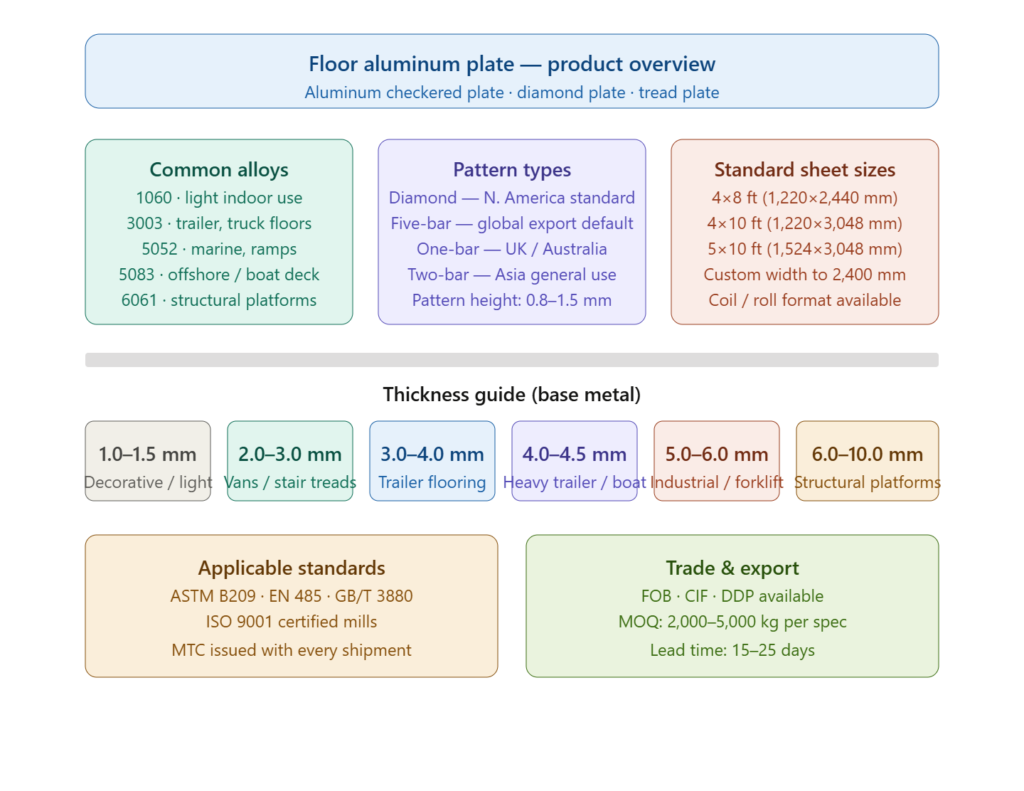
Three terms dominate the market for aluminum plate flooring, and buyers often use them interchangeably. Here is how they relate:
| Term | Meaning | Common Usage |
|---|---|---|
| Floor aluminum plate | Use-oriented term — any aluminum plate used as a floor surface | General procurement, construction specs |
| Aluminum checkered plate | Product name — raised checker/lentil pattern on one face | Industry standard name in manufacturing and export trade |
| Aluminum diamond plate | North American market term — raised diamond pattern on one face | US, Canada, trailer and truck body markets |
| Aluminum tread plate | UK/Australia market term — same product, bar or lentil pattern | UK, AU, industrial flooring and marine markets |
All four terms refer to the same core product: an aluminum alloy sheet with a mechanically rolled raised pattern. The pattern geometry varies — diamond, lentil (also called “one-bar”), or five-bar — but the manufacturing process, alloy options, and performance characteristics are the same.


Standard Specifications for Floor Aluminum Plate
When sourcing aluminum checkered plate for flooring applications, buyers must specify alloy, temper, thickness, sheet size, and pattern type. The table below covers the full standard range.
| Parameter | Standard Range | Notes |
|---|---|---|
| Alloy | 1060, 1100, 3003, 5052, 5083, 6061 | 3003 and 5052 most common for flooring; 5083 for marine |
| Temper | H14, H22, H24, H32, T6 | H14 standard; H32 for 5052; T6 for 6061 structural use |
| Thickness (base metal) | 1.0 mm – 10.0 mm | Pattern height adds ~0.8–1.2 mm to nominal thickness |
| Sheet width | 600 mm – 2,400 mm | 1,220 mm (48″) and 1,500 mm most common export widths |
| Sheet length | 1,000 mm – 6,000 mm | 2,440 mm (96″) standard; 3,048 mm (120″) also common |
| Standard sheet size (imperial) | 4×8 ft, 4×10 ft, 4×4 ft | 4×8 ft (1,220×2,440 mm) most widely stocked |
| Pattern type | Diamond, one-bar (lentil), five-bar, two-bar | Five-bar most common in Asia/EU; diamond dominant in North America |
| Pattern height | 0.8 mm – 1.5 mm above base surface | Higher pattern = better grip; standard is ~1.0–1.2 mm |
| Surface | Mill finish (standard), anodized, painted | Mill finish most common for industrial/trailer flooring |
| Applicable Standards | ASTM B209, EN 485, GB/T 3880 | ISO 9001 mill certification recommended for all orders |
Aluminum Diamond Plate Thickness Chart for Flooring
Thickness is the most critical selection variable for any floor aluminum plate application. The right thickness depends on the load it must carry, the span between supports, and whether the surface is fixed or movable.
| Base Thickness | Total Thickness (incl. pattern) | Weight (kg/m²) | Typical Application |
|---|---|---|---|
| 1.0 mm | ~1.8–2.0 mm | ~2.8 | Decorative panels, light-duty wall cladding |
| 1.5 mm | ~2.3–2.5 mm | ~4.2 | Light foot traffic, interior floor panels |
| 2.0 mm | ~2.8–3.0 mm | ~5.6 | Standard foot traffic, van floors, stair treads |
| 3.0 mm | ~3.8–4.0 mm | ~8.4 | Light vehicle floors, ramps, trailer side panels |
| 4.0 mm | ~4.8–5.0 mm | ~11.0 | Standard trailer flooring, truck beds, boat floors |
| 4.5 mm | ~5.3–5.5 mm | ~12.5 | Heavy-duty trailer floors, forklift traffic |
| 6.0 mm | ~6.8–7.0 mm | ~16.8 | Industrial flooring, heavy equipment platforms |
| 8.0 mm | ~8.8–9.0 mm | ~22.4 | Structural floor plates, heavy machinery bases |
What Thickness Aluminum Diamond Plate for Trailer Floor?
For standard enclosed trailer and flatbed trailer flooring, the industry-standard thickness is 3.0 mm to 4.5 mm base metal (approximately 4.0–5.5 mm total including pattern). The specific recommendation depends on the trailer’s intended load:
- Light cargo trailers (hand trucks, motorcycles): 3.0 mm base metal is sufficient.
- Standard enclosed trailers (general freight): 4.0 mm base metal is the most common specification.
- Heavy-duty trailers (forklift traffic, palletized freight): 4.5 mm or 5.0 mm base metal for adequate stiffness and long-term durability.
- Gooseneck and flatbed trailers: 4.0–6.0 mm, depending on cross-member spacing. Wider cross-member spans require thicker plate to resist flexing under load.
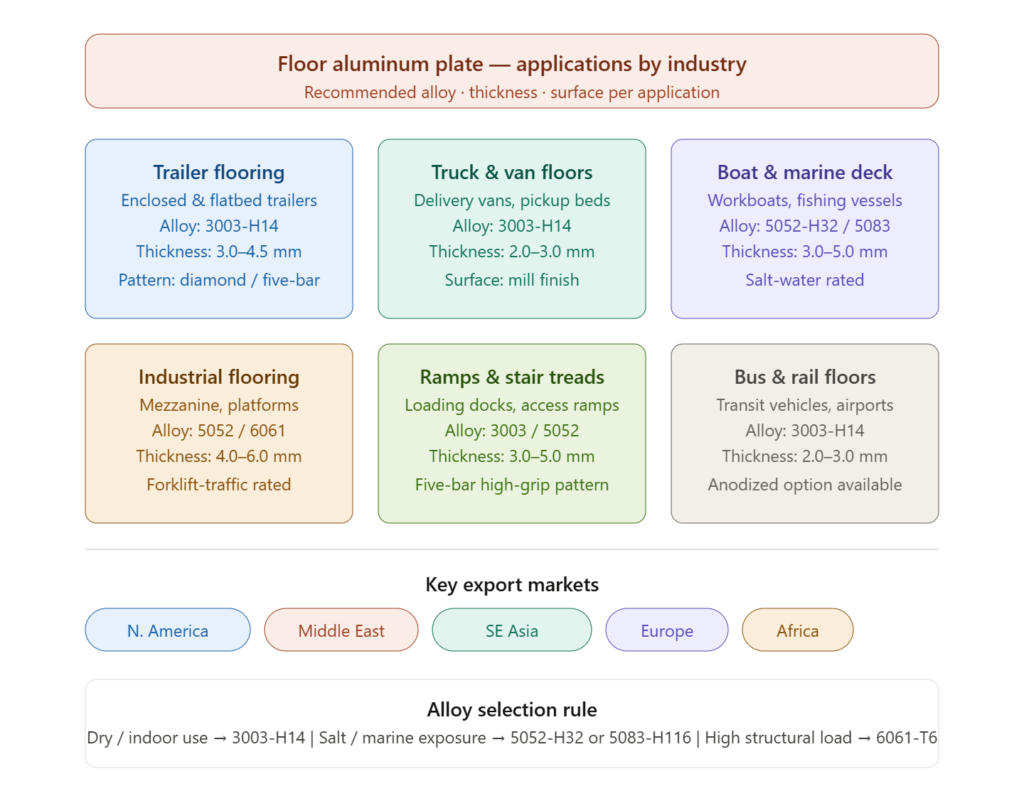
Alloy 3003-H14 is the standard for most aluminum diamond plate trailer flooring. Where corrosion resistance is more critical — for example in livestock trailers or trailers exposed to road salt — 5052-H32 is the preferred upgrade.
Alloy Selection Guide for Aluminum Floor Plate
Choosing the right alloy determines the long-term performance of any aluminum checker plate flooring installation. The table below compares the most common alloys used in flooring applications.
| Alloy | Temper | Yield Strength (MPa) | Corrosion Resistance | Weldability | Best For |
|---|---|---|---|---|---|
| 1060 | H14 | ~85 | Excellent | Good | Light-duty indoor floors, decorative use |
| 3003 | H14, H22 | ~145 | Very Good | Good | Trailer floors, truck bodies, ramps, van floors |
| 5052 | H32, H34 | ~195 | Excellent | Very Good | Marine floors, salt-exposure environments, heavy ramps |
| 5083 | H111, H116 | ~215 | Excellent | Excellent | Boat floors, offshore platforms, marine-grade flooring |
| 6061 | T6 | ~275 | Good | Good | Structural floor plates, high-load platforms |
For most trailer and commercial vehicle flooring, 3003-H14 is the optimal balance of cost, formability, and performance. For diamond plate aluminum boat floor and marine deck applications, 5052-H32 or 5083-H116 should be specified to withstand salt water and humid conditions without corrosion pitting.
Pattern Types for Aluminum Checkered Plate Flooring
The surface pattern on a floor aluminum plate directly affects grip performance, drainage behavior, and aesthetic appearance. The four standard patterns are:
| Pattern | Description | Slip Resistance | Main Market |
|---|---|---|---|
| Diamond (two-bar) | Raised diamond shapes in a regular grid | High | North America — trailers, truck beds, stairs |
| Five-bar | Five parallel raised bars in each repeat unit | Very High | Europe, Asia, Middle East — industrial flooring |
| One-bar (lentil) | Single elongated raised bar per unit | High | UK, Australia — stair treads, ramp surfaces |
| Two-bar | Two parallel bars per unit, alternate orientation | High | General industrial, Asia export markets |
Five-bar pattern is the most widely produced globally and the default for export orders unless a specific pattern is requested. Diamond pattern dominates the North American market for aluminum diamond plate flooring and trailer applications.
Applications: Where Floor Aluminum Plate Is Used
Aluminum Diamond Plate Trailer Flooring
Aluminum diamond plate trailer flooring is one of the highest-volume applications for checkered plate globally. Trailers benefit from aluminum flooring because it is roughly one-third the weight of steel, does not rust, and provides excellent traction for loading and unloading. Standard specification for enclosed trailers is 3003-H14, 4.0 mm base thickness, diamond or five-bar pattern, in sheets sized to the trailer interior width — most commonly 1,524 mm (60″) or 1,600 mm wide.
Truck and Van Floors
Commercial vans, pickup truck beds, and flatbed trucks use aluminum tread plate flooring at 2.0–3.0 mm thickness. The combination of low weight and high slip resistance makes it ideal for delivery vehicles that require frequent loading and unloading. 3003-H14 mill finish is the standard specification for this market.
Diamond Plate Aluminum Boat Floor
Aluminum workboats, fishing boats, and aluminum-hull vessels use checkered plate for deck and cockpit flooring. Marine flooring requires higher corrosion resistance than trailer applications. 5052-H32 or 5083-H116 alloy is specified for salt water environments. Typical thickness is 3.0–5.0 mm depending on deck span and expected foot traffic. The raised pattern channels water away from the standing surface, reducing slip risk in wet conditions.
Industrial and Workshop Flooring
Aluminum plate flooring is widely used in factories, warehouses, mezzanine decks, access platforms, and machine guards. Industrial flooring typically requires 4.0–6.0 mm plate. Where forklift or heavy equipment traffic is expected, 5052 or 6061 alloy provides the additional yield strength needed to resist permanent deformation.
Ramps and Stair Treads
Loading dock ramps, vehicle access ramps, and stair tread covers are among the most demanding applications for aluminum tread plate floor products. High slip resistance is critical in wet or oily conditions. Five-bar or diamond pattern at 3.0–5.0 mm thickness is standard. Ramp edges often incorporate a nose bend or abrasive strip for additional safety.
Bus and Rail Floors
Transit bus floors, rail car interiors, and airport terminal walkways use bus floor aluminum sheet in checkered plate format. The combination of light weight, durability, and easy cleaning makes aluminum the preferred material over rubber or vinyl in high-traffic public transport applications. Typical spec: 3003-H14, 2.0–3.0 mm, mill finish or anodized.
Aluminum Door Floor Plate
Door threshold plates and entrance step covers use narrow-format aluminum door floor plate sections cut from standard checkered plate sheet. These are typically 2.0–3.0 mm thick, anodized or mill finish, and cut to custom widths matching door frame openings.
Aluminum Floor Plate Load Table
The following table provides indicative load capacity data for 3003-H14 aluminum checkered plate at standard thicknesses and span widths. These figures are for uniform distributed load (UDL) and should be used for reference only — final structural design must be verified by a qualified engineer for specific applications.
| Base Thickness | Span 300 mm (kg/m²) | Span 500 mm (kg/m²) | Span 750 mm (kg/m²) | Span 1,000 mm (kg/m²) |
|---|---|---|---|---|
| 2.0 mm | ~480 | ~175 | ~78 | ~44 |
| 3.0 mm | ~1,080 | ~390 | ~174 | ~98 |
| 4.0 mm | ~1,920 | ~695 | ~308 | ~174 |
| 5.0 mm | ~3,000 | ~1,085 | ~482 | ~272 |
| 6.0 mm | ~4,320 | ~1,560 | ~694 | ~390 |
For aluminum diamond plate trailer flooring with cross-members spaced at 400–600 mm, a 4.0 mm base thickness provides adequate load capacity for general freight. Heavy-duty trailer applications with cross-member spacing above 600 mm should specify 4.5 mm or 5.0 mm.
Standard Sheet Sizes: 4×8, 4×10, and Custom Formats
The most commonly stocked size for aluminum diamond plate sheets in North American markets is 4×8 ft (1,220×2,440 mm). This format fits standard trailer widths and building material handling systems. Additional standard sizes include:
- 4×8 ft (1,220×2,440 mm): Universal stock size; most widely available; suitable for most trailer and van floor panels.
- 4×10 ft (1,220×3,048 mm): Extended length for longer panel runs; popular for flatbed truck beds and ramp fabrication.
- 5×10 ft (1,524×3,048 mm): Wider panels for trailers requiring minimal welded seams across the floor width.
- Custom cut: Mill-direct orders allow any length up to 6,000 mm and any width up to 2,400 mm, cut to specification before shipment.
For export orders, metric sheet sizes are standard. The 1,220×2,440 mm (4×8 ft) format is available across all alloys and thicknesses. Diamond plate aluminum roll format is also available for buyers requiring continuous coil supply for in-house slitting or custom length production.
Diamond Plate Aluminum Roll vs. Sheet
Floor aluminum plate is available in both sheet and coil (roll) format. The choice depends on the buyer’s downstream processing capability.
| Format | Advantages | Best For |
|---|---|---|
| Sheet (cut-to-length) | Ready to use; no slitting or leveling required; easier to handle and ship | Fabricators, trailer builders, general distributors |
| Coil / Roll | Lower cost per kg; continuous supply; custom cut lengths; less packaging waste | High-volume processors, rollforming lines, bus and rail manufacturers |
Most B2B buyers sourcing aluminum diamond plate for trailer floor and van floor applications order in sheet format, pre-cut to standard sizes. Coil orders are most common for transit vehicle manufacturers and flooring fabricators with their own slitting and leveling lines.
How to Clean Aluminum Diamond Plate Floor
Proper cleaning maintains the slip resistance and appearance of aluminum diamond plate flooring over its service life. The raised pattern traps dirt and grime more readily than flat sheet, so regular cleaning is important.
For routine cleaning, rinse with water to remove loose debris, then wash with a mild detergent solution and a stiff-bristle brush or pressure washer. Work the brush into the grooves between the raised pattern to remove compacted dirt. Rinse thoroughly and allow to dry. Avoid acidic or chlorine-based cleaners on mill finish aluminum — these accelerate surface oxidation and can pit the metal over time.
For oxidized or heavily soiled surfaces, a dedicated aluminum cleaner or a diluted solution of cream of tartar and water restores the bright metallic appearance. Follow with a light coat of aluminum wax or clear protective coating to slow re-oxidation in outdoor and marine environments.
Anodized aluminum checker plate flooring is easier to clean and more resistant to staining than mill finish. For installations requiring long-term appearance retention — retail environments, vehicle interiors, airport walkways — anodized finish is the preferred specification.
Pricing Factors for Floor Aluminum Plate
The price of aluminum checkered plate for flooring depends on several variables. Understanding each helps buyers negotiate effectively and plan material budgets.
- LME Aluminum Price: Base metal cost is indexed to the London Metal Exchange (LME) daily price. All supplier quotations are stated as LME + fabrication premium.
- Alloy: 1060 and 3003 carry the lowest premium. 5052 and 5083 alloys are priced higher due to magnesium content. 6061-T6 carries the highest fabrication cost.
- Thickness: Heavier gauge plate uses more material and is more expensive per sheet. Price per kilogram typically decreases with increasing thickness due to reduced fabrication complexity relative to material weight.
- Pattern complexity: Five-bar and diamond patterns are standard cost. Custom or non-standard patterns require tooling charges on small orders.
- Sheet size: Standard 4×8 ft sheets are the most competitively priced. Non-standard sizes or custom cut-to-length orders carry a cutting surcharge.
- Surface treatment: Mill finish is the base price. Anodized or painted finish adds a significant premium.
- Order volume (MOQ): Standard MOQ for export orders is 2,000–5,000 kg. Higher volumes attract better unit pricing. Mixed alloy/thickness orders may be combined to meet MOQ thresholds.
- Trade terms: FOB is the standard export quotation basis. CIF and DDP quotations are available for buyers who prefer freight-inclusive pricing.
Quality Standards and Certifications
| Standard | Scope | Required For |
|---|---|---|
| ASTM B209 | Aluminum sheet and plate mechanical and dimensional tolerances | North American buyers |
| EN 485 | European standard for aluminum alloy sheet products | EU market orders |
| GB/T 3880 | Chinese national standard for aluminum alloy sheet | Supply chain verification |
| ISO 9001 | Quality management system certification | All export orders |
| MTC (Mill Test Certificate) | Per-batch chemical composition and mechanical property test results | All shipments — mandatory for structural applications |
| REACH / RoHS | Hazardous substance compliance | EU market entry |
Export Markets for Aluminum Floor Plate
Global demand for aluminum checkered plate flooring is strongest in the following regions:
- North America (USA, Canada, Mexico): The largest market for aluminum diamond plate trailer flooring. Standard spec is 3003-H14, 4.0 mm, diamond pattern, 4×8 ft sheets. ASTM B209 compliance required.
- Middle East (UAE, Saudi Arabia, Qatar): High demand for industrial flooring, access platforms, and vehicle body sheet. Five-bar pattern dominates. Both 3003 and 5052 alloys are sourced in volume.
- Southeast Asia (Vietnam, Thailand, Indonesia, Philippines): Growing transport and construction sectors driving demand for trailer and bus floor aluminum sheet in cost-competitive 3003-H14 specification.
- Europe (Germany, Netherlands, Turkey, Poland): EN 485-compliant supply required. Five-bar pattern standard. 5052-H32 widely specified for marine and outdoor flooring.
- Africa (Nigeria, Kenya, South Africa, Egypt): Strong demand for commercial vehicle body sheet and industrial flooring driven by growing transport infrastructure investment.
- Australia and New Zealand: Active market for aluminum tread plate flooring in agricultural vehicles, marine applications, and commercial construction.
FAQ: Floor Aluminum Plate
What is the difference between aluminum diamond plate and aluminum checkered plate?
They are the same product — a rolled aluminum sheet with a raised anti-slip surface pattern. “Diamond plate” is the dominant term in North America, while “checkered plate” or “tread plate” is used in Europe, Asia, and Australia. The pattern geometry varies by market preference but the material and manufacturing process are identical.
What thickness aluminum diamond plate for a trailer floor?
For standard enclosed trailers, 4.0 mm base metal thickness (3003-H14) is the most common specification. Light-duty trailers can use 3.0 mm. Heavy-duty trailers with forklift traffic should specify 4.5–5.0 mm. Wider cross-member spacing requires thicker plate to prevent flexing under load.
What is the best alloy for aluminum diamond plate boat floor?
5052-H32 is the standard alloy for marine floor applications. It offers significantly better resistance to salt water corrosion than 3003. For offshore or severe marine environments, 5083-H116 provides the highest corrosion resistance in the common flooring alloy range.
Can aluminum floor plate be welded?
Yes. 3003, 5052, and 5083 alloys all weld well using MIG or TIG process with the appropriate filler wire (ER4043 or ER5356). 6061-T6 can be welded but loses some strength in the heat-affected zone. Mill finish checkered plate does not require special pre-treatment before welding.
What is the standard pattern for aluminum floor plate export orders?
Five-bar pattern is the global export default. Diamond pattern should be specified explicitly for North American market orders. One-bar (lentil) pattern is used for some European and Australian markets. Pattern type does not affect price for standard orders — it is a tooling selection at the mill.
How is floor aluminum plate priced?
Price is calculated as LME aluminum base price + alloy fabrication premium + pattern rolling surcharge. Mill finish 3003-H14 in standard 4×8 ft sheets at 4.0 mm is the most competitively priced specification. Surface treatments (anodize, paint), non-standard sizes, and higher-strength alloys all carry additional premiums. Always request a quotation referencing the current LME basis date.
Is aluminum floor plate slip-resistant when wet?
Yes. The raised surface pattern on aluminum checkered plate provides significant slip resistance even when wet. Five-bar and diamond patterns both meet standard anti-slip requirements for industrial and vehicle flooring. For applications where oil or grease contamination is expected alongside moisture, a higher-profile pattern (five-bar, 1.2 mm pattern height) is recommended over a low-profile diamond pattern.
Why Source Floor Aluminum Plate from a Direct Manufacturer
Buying aluminum checkered plate directly from a mill supplier — rather than through a domestic distributor or trading company — delivers measurable cost and quality advantages for B2B buyers:
- Mill-direct pricing: No distribution markup. Price reflects LME + factory fabrication cost only.
- Full specification flexibility: Alloy, temper, thickness, pattern, sheet size, and surface finish are all configurable per order.
- MTC documentation: Every shipment is accompanied by a Mill Test Certificate showing chemical composition and mechanical properties, tested per ASTM B209 or EN 485.
- Custom formats: Coil, cut-to-length, and custom-width orders are all available. No requirement to buy standard distributor stock sizes.
- Consistent quality: ISO 9001-certified production with full traceability from ingot to finished sheet.
- Flexible trade terms: FOB, CIF, and DDP options available. Sample orders supported for new product qualification.
Request a Quote for Floor Aluminum Plate
We supply aluminum checkered plate, aluminum diamond plate flooring, and aluminum tread plate to trailer manufacturers, vehicle body builders, marine fabricators, and industrial distributors in over 40 countries. Standard and custom specifications ship from major Chinese ports with 15–25 day lead times.
To receive a competitive quotation, please provide the following details:
- Alloy: 1060 / 3003 / 5052 / 5083 / 6061
- Temper: H14 / H22 / H32 / H34 / T6
- Thickness (mm) and sheet size (mm × mm or ft × ft)
- Pattern: five-bar / diamond / one-bar / two-bar
- Surface finish: mill finish / anodized / painted
- Format: sheet or coil
- Estimated quantity (kg or metric tons per order)
- Destination port and preferred trade terms (FOB / CIF / DDP)