
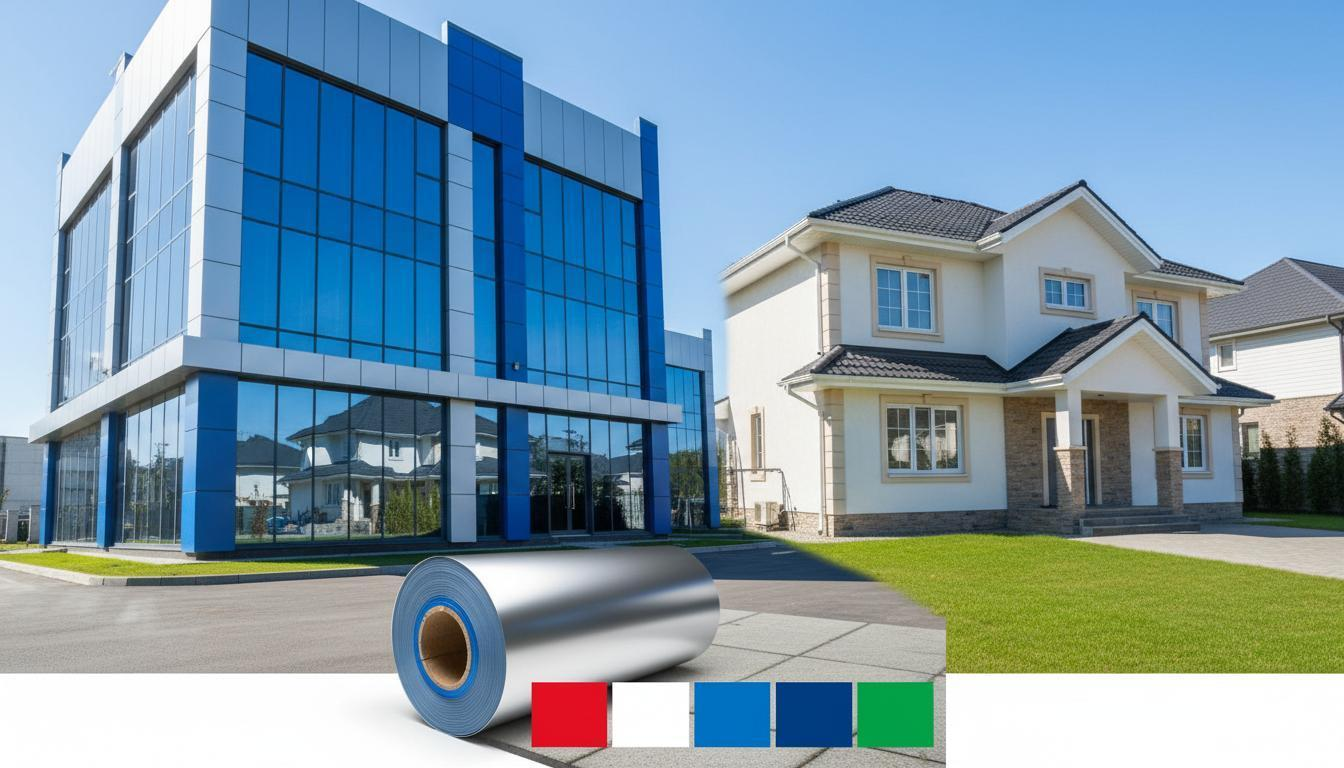
Roofing aluminum has become the material of choice for architects, contractors, and OEM procurement teams worldwide. With a unique combination of light weight, corrosion resistance, long service life, and broad alloy selection, aluminum roofing outperforms most traditional roofing materials in total cost of ownership. This guide covers everything B2B buyers need to know — from alloy specifications and product types to pricing factors, certifications, and how to select the right aluminum roofing panel or sheet for your project.
Quick Spec Reference: The most widely used alloys for roofing aluminum are 3003-H14, 3004-H16, 5052-H32, and 1100-H14. Standard thicknesses range from 0.3 mm to 3.0 mm, and widths from 600 mm to 1,500 mm.
1. What Is Roofing Aluminum?
Roofing aluminum refers to aluminum alloy sheet, coil, panel, or roll products specifically engineered for use in residential, commercial, and industrial roofing systems. These products are formed into profiles such as corrugated sheets, standing seam panels, shingles, and flat sheets, then applied as primary roofing cladding or as flashing, trim, and waterproofing components.
The core advantages that drive procurement of aluminum roofing material include a density of only 2.7 g/cm³ (roughly one-third that of steel), excellent natural oxidation resistance without additional coating, reflective surfaces that reduce building heat gain, and a fully recyclable end-of-life profile.
Roofing Aluminum vs. Other Metal Roofing Materials
| Property | Roofing Aluminum | Galvanized Steel | Copper | Zinc |
|---|---|---|---|---|
| Density (g/cm³) | 2.70 | 7.85 | 8.96 | 7.13 |
| Corrosion resistance | Excellent (self-passivating) | Good (coating-dependent) | Excellent | Good |
| Lifespan (years) | 40–70+ | 25–50 | 80–100+ | 50–80 |
| Weight (kg/m² at 0.7 mm) | ~1.9 | ~5.5 | ~6.3 | ~5.0 |
| Recyclability | 100% | 100% | 100% | 100% |
| Relative cost | Medium | Low–Medium | High | High |
| Thermal expansion coefficient | 23.6 µm/m·°C | 12.0 µm/m·°C | 17.0 µm/m·°C | 23.5 µm/m·°C |
| Typical surface finish | Mill, painted, anodized | Galvanized, painted | Natural patina | Natural patina |
2. Main Types of Aluminum Roofing Products
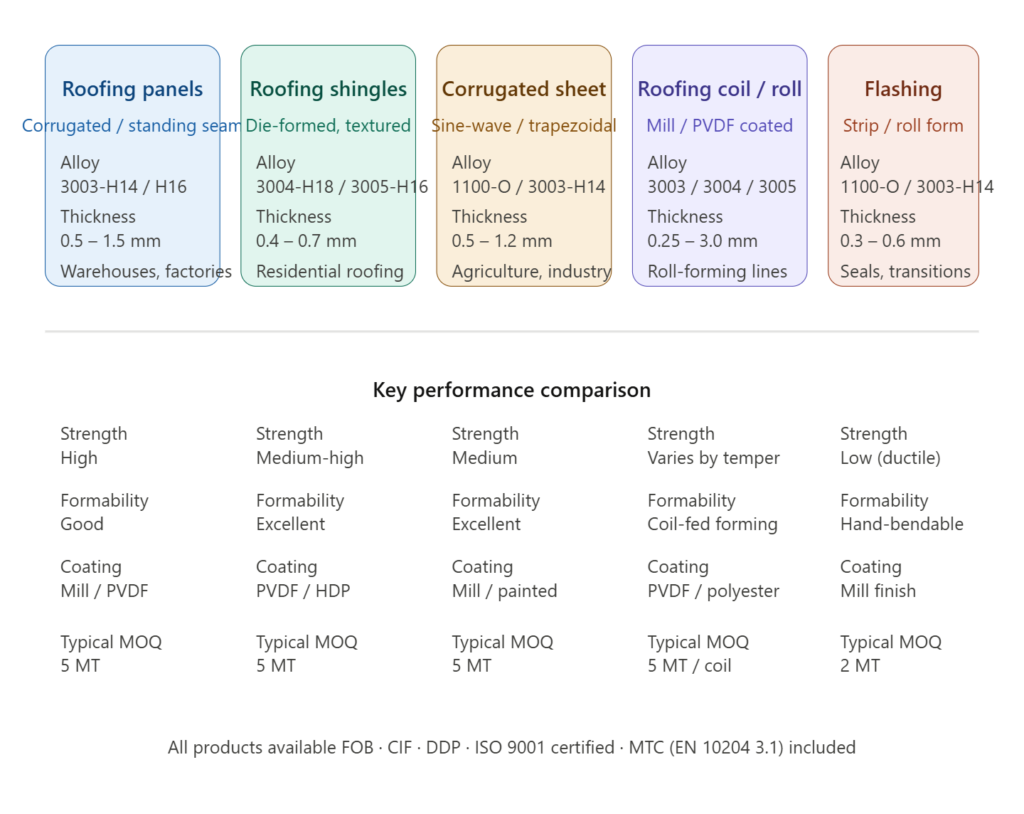
Procurement teams typically source across five main product categories. Understanding each is essential for correct specification and supplier communication.
2.1 Aluminum Roofing Panels
Aluminum roofing panels are the most common form of structural aluminum roofing. They are factory-formed into interlocking or standing-seam profiles and are installed as the primary weather barrier. Common panel systems include standing seam, snap-lock, T-bar clip, and exposed fastener configurations. Panel alloys are typically 3003-H14 or 3004-H16 for their superior roll-forming characteristics. Corrugated aluminum roofing panels (with sine-wave or trapezoidal profiles) are widely used in industrial and agricultural buildings.
2.2 Aluminum Roofing Shingles
Aluminum roofing shingles replicate the look of asphalt, wood, or slate shingles while delivering the durability of metal. They are typically die-formed from 0.4–0.7 mm aluminum alloy sheet (most commonly 3005-H16 or 3004-H18) and are individually fastened. Shingles are especially popular in residential re-roofing projects in North America and Europe. Embossed or textured surfaces simulate natural materials and improve paint adhesion.
2.3 Corrugated Aluminum Sheets
Corrugated aluminum roofing sheets are produced by passing flat coil through a corrugating roll machine. The resulting wave profile adds rigidity, enabling longer spans with thinner material. Profiles are standardized (e.g., 762 mm coverage width, 32 mm rib height for a standard 3-inch corrugation). These sheets are used on warehouses, agricultural buildings, and temporary shelters. Common alloys: 1100-O, 3003-H14, 5052-H32.
2.4 Aluminum Roofing Roll / Coil
Roofing aluminum roll (coil stock) is the upstream supply form from which panels, shingles, and flashing are further processed. Coil widths typically range from 600 mm to 1,500 mm; thicknesses from 0.25 mm (flashing stock) to 3.0 mm (structural panel stock). Buyers who operate their own roll-forming or brake-press lines procure aluminum roofing roll and process it in-house. Color-coated (PVDF or polyester-painted) coil is widely specified for architectural applications.
2.5 Aluminum Roofing Flashing
Aluminum roofing flashing is thin sheet or strip used to seal transitions — around chimneys, skylights, valleys, and wall-to-roof junctions. Flashing stock is generally 0.3–0.6 mm thick, soft-temper (O or H14), and supplied in rolls or cut strips. Alloy 1100-O is preferred for hand-forming at the job site due to its excellent ductility. Some specifications call for 3003-H14 where slightly higher strength is needed without sacrificing formability.
3. Alloy & Temper Specifications for Roofing Aluminum
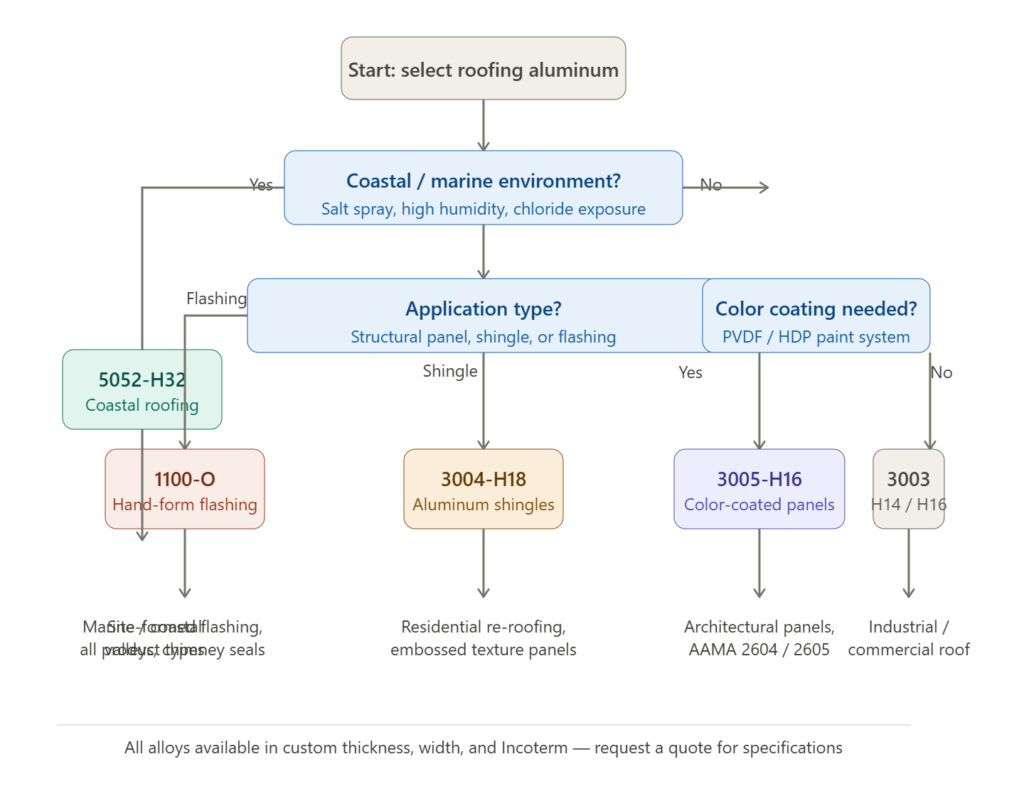
Selecting the correct alloy and temper is the most critical procurement decision. The following tables provide a comprehensive specification reference for buyers.
3.1 Chemical Composition by Alloy
| Alloy | Si (%) | Fe (%) | Cu (%) | Mn (%) | Mg (%) | Al |
|---|---|---|---|---|---|---|
| 1100 | 0.95 Si+Fe | — | 0.05–0.20 | 0.05 | — | ≥99.00% |
| 3003 | 0.60 | 0.70 | 0.05–0.20 | 1.0–1.5 | — | Bal. |
| 3004 | 0.30 | 0.70 | 0.25 | 1.0–1.5 | 0.8–1.3 | Bal. |
| 3005 | 0.60 | 0.70 | 0.30 | 1.0–1.5 | 0.20–0.60 | Bal. |
| 5052 | 0.25 | 0.40 | 0.10 | 0.10 | 2.2–2.8 | Bal. |
| 5005 | 0.30 | 0.70 | 0.20 | 0.20 | 0.50–1.1 | Bal. |
3.2 Mechanical Properties by Alloy & Temper
| Alloy / Temper | Tensile Strength (MPa) | Yield Strength (MPa) | Elongation (%) | Hardness (HB) | Primary Roofing Use |
|---|---|---|---|---|---|
| 1100-O | 75–105 | ≥25 | ≥25 | 23 | Hand-formed flashing |
| 1100-H14 | 115–150 | ≥95 | ≥9 | 32 | Corrugated sheet, flashing |
| 3003-H14 | 150–185 | ≥115 | ≥8 | 40 | Panels, corrugated sheet |
| 3003-H16 | 175–215 | ≥145 | ≥5 | 47 | Standing seam panels |
| 3004-H16 | 200–240 | ≥165 | ≥5 | 52 | Structural panels, shingles |
| 3004-H18 | 225–260 | ≥185 | ≥4 | 63 | High-strength shingles |
| 5052-H32 | 215–265 | ≥160 | ≥12 | 60 | Marine/coastal roofing |
| 5052-H34 | 235–285 | ≥180 | ≥10 | 68 | High-wind, industrial |
| 3005-H16 | 175–215 | ≥145 | ≥5 | 52 | Color-coated panels |
3.3 Alloy Selection Guide for Roofing Applications
| Application Scenario | Recommended Alloy / Temper | Key Reason |
|---|---|---|
| Standard industrial corrugated roofing | 3003-H14 | Good strength, excellent formability, cost-effective |
| Standing seam architectural panels | 3003-H16 / 3004-H16 | Higher strength for long spans, clean roll-forming |
| Residential aluminum roofing shingles | 3004-H18 / 3005-H16 | Stiffness for embossing, accepts PVDF paint well |
| Hand-formed site flashing | 1100-O | Excellent ductility, easy field bending |
| Factory-formed flashing / trim | 3003-H14 | Moderate strength, good corrosion resistance |
| Coastal / marine environment | 5052-H32 | Superior salt-spray resistance (Mg-alloyed) |
| Color-coated (PVDF painted) roofing | 3005-H16 / 3004-H16 | Excellent paint adhesion, dimensional stability |
| Insulated composite roofing panels | 3003-H14 / 5052-H32 | Consistent flatness, bond-friendly surface |
4. Dimensional Specifications
Buyers should specify dimensions clearly when sourcing aluminum roofing material. The table below lists standard dimensional ranges and tolerances in accordance with ASTM B209 and EN 485-2.
| Parameter | Standard Range | Tolerance (ASTM B209) | Notes |
|---|---|---|---|
| Thickness | 0.25 mm – 3.0 mm | ±0.03 mm (≤0.5 mm); ±5% (>0.5 mm) | Flashing: 0.25–0.6 mm; panels: 0.5–1.5 mm |
| Width (coil/flat sheet) | 600 mm – 1,500 mm | +3/−0 mm | Common: 914 mm, 1,000 mm, 1,219 mm, 1,500 mm |
| Length (cut sheet) | 1,000 mm – 6,000 mm | +6/−0 mm | Custom cutting available |
| Coil inner diameter | 405 mm / 508 mm | Standard | Specify for coil-fed forming lines |
| Coil outer diameter | Max 1,800 mm | — | Weight ~2,000–5,000 kg/coil |
| Flatness | I-unit ≤ 5 | As per EN 485-4 | Critical for panel forming lines |
| Surface finish | Mill / painted / anodized | — | PVDF, polyester, HDP coating options |
Corrugated Aluminum Roofing Sheet — Standard Profile Dimensions
| Profile Type | Coverage Width (mm) | Rib Height (mm) | Pitch (mm) | Sheet Thickness (mm) | Typical Alloy |
|---|---|---|---|---|---|
| Standard sine-wave corrugation | 762 | 32 | 76 | 0.5–0.9 | 3003-H14 |
| Deep corrugation (industrial) | 686 | 50 | 150 | 0.7–1.2 | 3003-H16 |
| Trapezoidal (T-rib) | 820 | 35 | 125 | 0.5–1.0 | 3004-H16 |
| R-panel (industrial) | 914 | 38 | 305 | 0.6–1.0 | 3003-H14 |
| Standing seam panel | 400–600 | 38–65 | Custom | 0.5–1.0 | 3003-H16 / 3004-H16 |
5. Applications of Aluminum Roofing
Aluminum roofing material is used across a broad range of construction types. Understanding the end application helps buyers specify the correct product and justify the material choice to stakeholders.
5.1 Industrial & Commercial Buildings
Large-span warehouses, logistics hubs, factories, and retail centers typically use corrugated aluminum roofing panels or R-panel / trapezoidal profiles. Alloy 3003-H14 or H16 is standard. The lightweight nature of aluminum reduces structural steel requirements, directly lowering total construction cost.
5.2 Residential Roofing
Aluminum roofing shingles and standing seam panels are increasingly specified in high-end residential construction, particularly where fire resistance ratings, hail impact resistance, and long-term warranty requirements eliminate asphalt shingle as an option. Color-coated aluminum roofing with PVDF paint systems carries 30–40 year color retention warranties in many markets.
5.3 Agricultural Structures
Livestock barns, grain storage facilities, and greenhouse roofing frames favor corrugated aluminum sheets for their ease of installation, resistance to agricultural chemicals, and low maintenance. The weight saving is especially valuable in areas with high snow loading because it reduces the total roof load compared with steel alternatives.
5.4 Coastal and Marine Environments
In marine environments, regular 3003 aluminum roofing may suffer pitting from chloride exposure over time. Alloy 5052-H32, with its higher magnesium content (2.2–2.8%), provides superior resistance to saltwater corrosion and is the specification of choice for coastal building projects.
5.5 Architectural and Façade Applications
Architects specify color-coated aluminum roofing panels (PVDF-coated 3003, 3004, or 3005) for their aesthetic flexibility. PVDF (polyvinylidene fluoride) coatings provide a gloss level of 30–70 units and color-retention performance that meets AAMA 2605 standards. Anodized aluminum panels are used where a metallic natural finish is required.
5.6 Aluminum Roofing Flashing Use Cases
Flashing is a critical component in any roofing system. Aluminum roofing flashing applications include: chimney step flashing, valley flashing, drip edge, head flashing over window and door openings, and wall-to-roof counter flashing. In all these applications, 1100-O or 3003-H14 in 0.3–0.6 mm thickness is standard.
6. Aluminum Roof Panels Prices — Key Pricing Factors
Aluminum roofing prices fluctuate based on multiple upstream and processing variables. The following table documents the primary cost drivers that B2B buyers should monitor.
| Pricing Factor | Typical Impact | Buyer Action |
|---|---|---|
| LME aluminum ingot price | ±15–30% over a quarter | Index-link contracts to LME monthly average |
| Alloy grade (3xxx vs 5xxx) | 5xxx series ~10–20% premium over 3xxx | Use 5052 only where corrosion spec demands it |
| Temper (H14 vs H18) | Higher temper = more cold-work = +5–10% | Match temper to minimum required strength |
| Thickness tolerance class | Tight tolerance (+5%) over standard | Specify tight tolerance only for panel lines that need it |
| Surface finish (mill vs PVDF painted) | PVDF coating adds USD 0.20–0.50/kg | Confirm coating spec early; PVDF vs polyester pricing differs |
| Coil width / length customization | Non-standard widths add cutting surcharge | Design products around standard coil widths |
| Order quantity (MOQ) | MOQ typically 5–10 MT per alloy/temper | Consolidate orders to meet MOQ and reduce per-kg cost |
| Trade terms (FOB vs CIF vs DDP) | Freight can add USD 0.03–0.15/kg depending on destination | Compare FOB + freight quote vs CIF quote |
| Delivery lead time | Rush orders +5–15% premium | Plan 30–60 day lead time for standard orders |
| Minimum order value | Below-MOQ orders carry surcharges | Combine product lines in a single order |
Price Benchmark (Reference Only): As of 2024, factory FOB prices for standard 3003-H14 aluminum roofing coil ranged approximately USD 2.20–2.80/kg; PVDF color-coated aluminum roofing coil ranged USD 2.80–3.60/kg, depending on LME price levels, order quantity, and coating system. Contact us for a current RFQ.
7. Insulated Aluminum Roofing Panels
Insulated aluminum roofing panels — also called sandwich panels or composite roofing panels — consist of two aluminum face sheets bonded to a rigid foam or mineral wool core. They are the dominant roofing solution for cold-storage facilities, food processing plants, and energy-efficient commercial buildings.
Insulated Panel Specifications
| Parameter | Typical Value |
|---|---|
| Face sheet alloy | 3003-H14 or 5052-H32 |
| Face sheet thickness | 0.5 mm – 1.0 mm (each face) |
| Core material | PIR (polyisocyanurate), EPS, or mineral wool |
| Panel total thickness | 40 mm – 200 mm |
| Thermal resistance (R-value) | R-10 to R-40+ depending on thickness and core |
| Fire classification | PIR: B-s2,d0 (EN 13501-1); Mineral wool: A2-s1,d0 |
| Surface finish | PVDF or HDP painted; embossed or smooth |
| Panel width | 1,000 mm / 1,150 mm standard |
| Panel length | 3,000 mm – 15,000 mm (custom cut) |
| Load capacity | Consult structural calculation per span and wind zone |
8. Color-Coated Aluminum Roofing Sheet
Color-coated aluminum roofing sheet is pre-painted coil stock processed through a continuous coil-coating line before delivery. This pre-painted approach provides a uniform, factory-controlled finish that field-applied paints cannot match. Buyers specify color-coated aluminum roofing for applications where aesthetics, long-term color stability, and low site labor cost are priorities.
Coating System Comparison
| Coating System | Film Thickness (µm) | Gloss Level | Color Retention | Chalking Resistance | Typical Standard |
|---|---|---|---|---|---|
| PVDF (70% Kynar) | 25–30 | 30–70 units | 25–35 years | Excellent | AAMA 2605 |
| HDP (High Durability Polyester) | 20–25 | 40–80 units | 15–20 years | Very good | AAMA 2604 |
| Standard Polyester (SMP) | 15–20 | 40–80 units | 10–12 years | Good | AAMA 2603 |
| Epoxy primer + PVDF topcoat | 30–35 | 30–50 units | 30+ years | Excellent | AAMA 2605 |
9. Certifications & Quality Standards
Aluminum roofing materials must meet defined standards to qualify for use in regulated construction markets. The following certifications and standards are most commonly referenced in international procurement specifications.
| Standard / Certification | Scope | Key Markets |
|---|---|---|
| ASTM B209 | Aluminum alloy sheet and plate | USA, Canada, Latin America |
| EN 485-1/2/4 | Aluminum sheet, strip, plate — conditions and properties | Europe, Middle East |
| GB/T 3880 | Aluminum and aluminum alloy sheet and strip | China |
| AS/NZS 1734 | Aluminum and aluminum alloy sheet, strip | Australia, New Zealand |
| ISO 9001:2015 | Quality management system | Global |
| AAMA 2605 / 2604 / 2603 | Voluntary spec for high-performance organic coatings | North America |
| REACH / RoHS | Chemical compliance (coatings, surface treatments) | Europe |
| FM Approvals | Factory Mutual fire and wind uplift testing | USA (insurance-driven) |
| UL 580 / 1897 | Uplift testing for roof assemblies | USA |
| CE Marking (EN 14782) | Self-supporting metal sheet for roofing | Europe |
Mill Test Certificates (MTC) conforming to EN 10204 3.1 are provided with all shipments as standard. Third-party inspection by SGS, BV, or TÜV can be arranged upon request.
10. Export Markets for Aluminum Roofing Material
Aluminum roofing is a globally traded commodity product. The following table shows key destination markets and the product types most demanded in each region.
| Region / Country | Most-Demanded Products | Dominant Standard | Preferred Alloys |
|---|---|---|---|
| USA / Canada | Standing seam panels, shingles, flashing | ASTM B209, AAMA 2605 | 3003-H14, 3004-H16, 5052-H32 |
| Europe (Germany, France, UK) | Color-coated panels, architectural panels | EN 485, CE marking | 3003-H16, 3005-H16 |
| Middle East (UAE, Saudi Arabia) | Corrugated sheet, sandwich panels | ASTM / BS | 3003-H14, 5052-H32 |
| Southeast Asia (Vietnam, Thailand, Indonesia) | Corrugated roofing sheet, coil stock | ASTM / JIS | 1100-H14, 3003-H14 |
| Australia / NZ | Corrugated sheet, standing seam | AS/NZS 1734 | 3003-H14, 5052-H32 |
| Africa (Nigeria, South Africa, Kenya) | Corrugated sheet (3–4-ft widths) | BS / ASTM | 1100-H14, 3003-H14 |
| Latin America (Mexico, Brazil, Chile) | Corrugated sheet, industrial panels | ASTM | 3003-H14 |
11. Frequently Asked Questions (FAQ)
Q1: What alloy is best for aluminum roofing panels?
For most commercial and industrial aluminum roofing panels, alloy 3003-H14 provides the optimal balance of strength, formability, and cost. For coastal environments, upgrade to 5052-H32. For high-end architectural applications with color coatings, 3004-H16 or 3005-H16 is preferred.
Q2: What is the typical thickness for corrugated aluminum roofing sheets?
Standard corrugated aluminum roofing sheets range from 0.5 mm to 0.9 mm for light commercial and agricultural use. Industrial applications with longer spans may specify 1.0–1.2 mm. Flashing material is thinner, typically 0.3–0.6 mm.
Q3: How is aluminum roofing roll different from aluminum roofing sheet?
Aluminum roofing roll (coil) is the continuous upstream form, wound on a core, used to feed roll-forming machines. Cut-to-length aluminum roofing sheets are produced from the same coil. Buyers who operate forming equipment typically purchase coil; those who need finished flat material purchase cut sheet.
Q4: Does aluminum roofing require a special paint system?
Yes — for color-coated aluminum roofing, PVDF (Kynar) coatings meeting AAMA 2605 are the industry standard for long-term color and gloss retention. Standard polyester coatings are suitable for shorter-warranty applications. Bare mill-finish aluminum roofing does not require painting — it develops a natural oxide layer that provides durable corrosion protection.
Q5: What is the difference between aluminum roofing flashing and regular sheet?
Aluminum roofing flashing is cut from the same alloy sheet but is specifically dimensioned (typically narrow strip widths) and supplied in a softer temper (O or H14) to allow hand-forming on-site. Regular roofing sheet is supplied flat or pre-formed into a panel profile and is not intended for tight angle bending.
Q6: What is the MOQ for aluminum roofing coil?
Typical MOQ (minimum order quantity) for aluminum roofing coil is 5 metric tons per alloy and temper combination. For cut sheet, MOQ may be as low as 2 MT. Mixed-alloy orders may qualify for a combined MOQ. Contact our sales team for current MOQ policy.
Q7: What trade terms (Incoterms) are available?
We supply aluminum roofing material on FOB, CFR (C&F), CIF, and DDP terms. FOB is most common for buyers with established freight forwarder relationships. CIF is recommended for buyers in markets where ocean freight is difficult to source independently.
Q8: Can aluminum roofing panels be used with solar PV systems?
Yes. Standing seam aluminum roofing panels are among the preferred substrates for solar PV mounting because clamps can be attached to the seam without penetrating the roof surface. This preserves the weathertight integrity of the roofing system while enabling renewable energy integration.
12. Why Source Aluminum Roofing Material from a Factory-Direct Supplier?
Sourcing aluminum roofing products factory-direct — bypassing trading companies — offers procurement teams several tangible advantages:
- Price: No trader margin; LME-linked pricing with full transparency.
- Specification control: Custom alloy, temper, thickness, width, and coating specifications are accommodated directly with the production team.
- Documentation: MTC (EN 10204 3.1), COA, packing list, and inspection certificates are issued directly from the manufacturing quality department.
- Capacity: Factory inventory covers full production runs; no split-lot risk from trading stock.
- Lead time: Standard orders: 15–25 working days from order confirmation. Stocked items: 7–10 working days.
- OEM/custom processing: Slitting, leveling, cut-to-length, and PVDF coating are available in-house.
- Third-party inspection: SGS, BV, and TÜV inspections can be arranged at the factory before shipment.
| Service | Details |
|---|---|
| MOQ | 5 MT (standard); 2 MT (small trial order, subject to confirmation) |
| Lead time | 15–25 working days (custom); 7–10 days (ex-stock) |
| Payment terms | T/T, L/C at sight |
| Trade terms | FOB, CFR, CIF, DDP |
| Certificates | MTC (EN 10204 3.1), ISO 9001, SGS/BV/TÜV on request |
| Packaging | Coil: wooden pallet + waterproof wrapping; Sheet: wooden case |
| Inspection | Pre-shipment inspection available; online video inspection |
Request a Quote for Roofing Aluminum Get Factory-Direct Price →