
Aluminum 3003 alloy is one of the most widely used aluminum alloys in the world. It belongs to the 3xxx series of aluminum alloys. Manganese (Mn) is the primary alloying element. The manganese content gives AL 3003 about 20% more strength than pure aluminum alloys like 1050 and 1100. At the same time, it keeps excellent formability, corrosion resistance, and weldability.
Manufacturers around the world use aluminum alloy 3003 in cookware, storage tanks, roofing panels, chemical equipment, heat exchangers, and many other products. Its combination of moderate strength, easy forming, and long service life makes it a reliable and cost-effective choice for a wide range of industries.
This guide covers everything you need to know about aluminum 3003 alloy — chemical composition, mechanical properties, temper conditions, applications, equivalent grades, and how it compares to other popular alloys.
Aluminium Alloy 3003 Chemical Composition
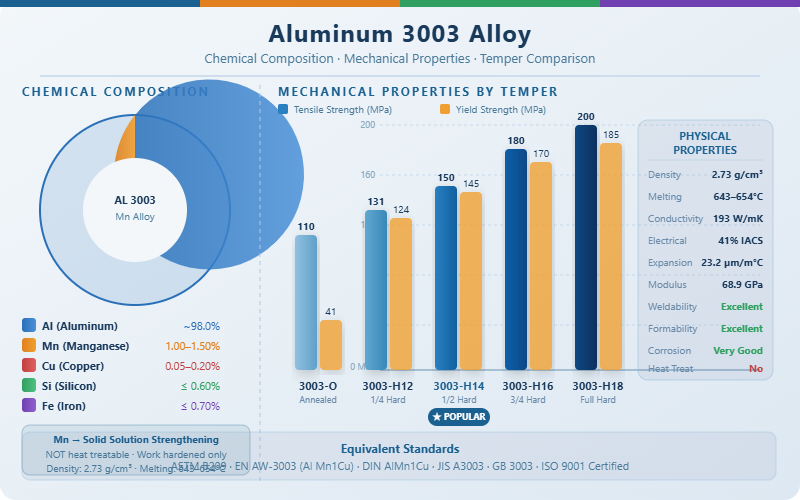
Understanding the aluminium alloy 3003 chemical composition is the first step in evaluating this material.
Chemical Composition of Aluminum 3003
| Element | Content (%) |
|---|---|
| Aluminum (Al) | Balance (~98%) |
| Manganese (Mn) | 1.00 – 1.50 |
| Copper (Cu) | 0.05 – 0.20 |
| Silicon (Si) | ≤ 0.60 |
| Iron (Fe) | ≤ 0.70 |
| Zinc (Zn) | ≤ 0.10 |
| Other elements | ≤ 0.05 each |
Key Composition Notes
Manganese — The Core Alloying Element
Manganese is what defines aluminum 3003 alloy. At 1.0–1.5%, Mn strengthens the aluminum matrix through solid solution strengthening. It also improves resistance to corrosion and helps maintain good formability.
Copper — Minor Strength Addition
The small copper content (0.05–0.20%) adds a slight strength increase. It also improves machinability without significantly affecting corrosion resistance.
Low Impurity Levels
The controlled levels of Si, Fe, and Zn keep the alloy clean and consistent. This ensures predictable performance across production batches.
Not Heat Treatable
Unlike 6061, aluminum 3003 cannot be strengthened by heat treatment. It is strengthened only through work hardening (cold rolling). This is why temper designations like H14 and H18 are important for this alloy.
AL 3003 Material Properties
Aluminium 3003 Mechanical Properties
The aluminium 3003 mechanical properties vary significantly depending on the temper condition.
| Property | 3003-O | 3003-H12 | 3003-H14 | 3003-H16 | 3003-H18 |
|---|---|---|---|---|---|
| Tensile Strength (MPa) | 110 | 131 | 150 | 180 | 200 |
| Yield Strength (MPa) | 41 | 124 | 145 | 170 | 185 |
| Elongation (%) | 25 | 10 | 8 | 5 | 4 |
| Hardness (Brinell HB) | 28 | 35 | 40 | 47 | 55 |
| Shear Strength (MPa) | 76 | 83 | 97 | 110 | 110 |
Aluminum 3003 Tensile Strength
Aluminum 3003 tensile strength ranges from 110 MPa (O temper, annealed) to 200 MPa (H18, fully hardened). For most general applications, 3003-H14 with a tensile strength of 150 MPa is the standard choice. It offers a good balance of strength and formability.
3003 Aluminum Yield Strength
3003 aluminum yield strength ranges from 41 MPa in O temper to 185 MPa in H18 temper. For structural applications that need dimensional stability, 3003-H14 with a yield strength of 145 MPa is recommended.
Physical Properties of Aluminum Alloy 3003
| Property | Value |
|---|---|
| Aluminum alloy 3003 density | 2.73 g/cm³ |
| Melting Range | 643 – 654°C |
| Thermal Conductivity | 193 W/(m·K) |
| Electrical Conductivity | 41% IACS |
| Coefficient of Thermal Expansion | 23.2 µm/m·°C |
| Elastic Modulus | 68.9 GPa |
| Specific Heat Capacity | 893 J/(kg·K) |
Aluminum Alloy 3003 H14 Properties
Aluminum alloy 3003 H14 is the most commonly ordered temper for this alloy. Here is why:
What Does H14 Mean?
The temper designation H14 means:
- H = Strain hardened (work hardened by cold rolling)
- 1 = Strain hardened only (no annealing after cold work)
- 4 = Half-hard condition (halfway between annealed and fully hard)
3003-H14 Mechanical Properties
| Property | Value |
|---|---|
| Tensile Strength | 150 MPa (22 ksi) |
| Yield Strength | 145 MPa (21 ksi) |
| Elongation | 8% |
| Hardness | 40 HB |
| Shear Strength | 97 MPa |
Why H14 Is Popular
3003-H14 hits the sweet spot between strength and workability:
- Strong enough for most sheet metal applications
- Still formable enough for bending and light drawing
- Good surface finish for painting and coating
- Widely stocked and readily available worldwide
- Competitively priced
Aluminum Alloy 3003-O (Annealed)
Aluminum alloy 3003-O is the fully annealed (soft) condition. It has the lowest strength but the best formability. Choose 3003-O when:
- Deep drawing is required (cookware, pressure vessel bodies)
- Complex forming operations are needed
- Maximum ductility is the priority
- Cracking during forming must be avoided
What Is 3003 Aluminum Alloy Used For?
3003 aluminum alloy is one of the most versatile general-purpose aluminum alloys. Here are its most important applications:
Cookware and Kitchen Products
Is 3003 aluminum good for cooking? Yes — absolutely. Aluminum 3003 is one of the top choices for cookware manufacturing. Here is why:
- Food safe: The alloy contains no harmful elements at usage levels
- Excellent thermal conductivity: Heat spreads evenly across the cooking surface
- Good formability: Easy to deep draw into pots, pans, and lids
- Corrosion resistant: Does not react with most foods
- Lightweight: Cookware is easy to handle
Common cookware products made from 3003 aluminum alloy:
- Frying pans and sauce pans
- Pressure cooker bodies and lids
- Woks and stock pots
- Baking trays and pizza pans
- Rice cooker components
3003-O temper is preferred for deep-drawn cookware. 3003-H14 is used for flat baking trays and lids.
Storage Tanks and Pressure Vessels
The excellent corrosion resistance and good strength of AL 3003 make it ideal for:
- Chemical storage tanks
- Fuel tanks (aviation and automotive)
- Water storage containers
- Food and beverage processing tanks
- Cryogenic vessels
Roofing and Building Panels
In construction, aluminum alloy 3003 is widely used for:
- Roofing sheets and panels
- Wall cladding and facades
- Ceiling tiles and panels
- Gutters and downpipes
- Architectural trim and flashings
3003-H14 is the standard temper for roofing and cladding applications. It offers enough stiffness to resist wind loads and foot traffic while remaining easy to install.
Heat Exchangers
The high thermal conductivity of 3003 aluminum makes it perfect for heat exchanger applications:
- Automotive radiators and coolers
- HVAC systems
- Refrigeration equipment
- Industrial heat exchangers
- Air-cooled condensers
Signage and Nameplates
3003 aluminum sheet provides an excellent base for signs and nameplates:
- Road signs and traffic signs
- Commercial and retail signage
- Industrial nameplates
- Outdoor advertising panels
Chemical Equipment
3003 resists attack from many chemicals. It is used in:
- Chemical processing equipment
- Piping and ducting
- Filter housings
- Reaction vessel components
Other Applications
- Mail boxes and postal equipment
- Garage doors and panels
- Trailer siding and flooring
- Grain silos and agricultural storage
- Marine fittings and boat components
What Is the Difference Between 3003 and 6061 Aluminum?
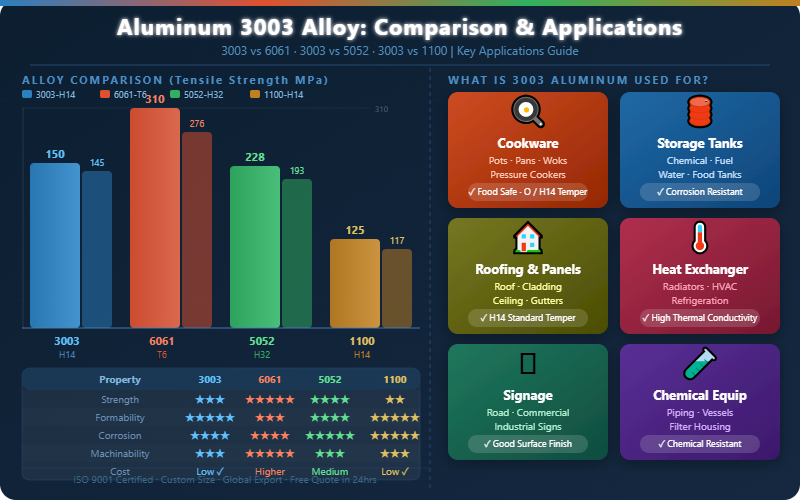
This is one of the most common questions buyers ask. Here is a clear comparison:
3003 vs 6061: Composition
| Feature | 3003 Aluminum | 6061 Aluminum |
|---|---|---|
| Series | 3xxx (Mn alloy) | 6xxx (Mg+Si alloy) |
| Main alloying element | Manganese (Mn) | Magnesium + Silicon |
| Heat treatable | No | Yes |
| Typical temper | H14, H18, O | T6, T651 |
3003 vs 6061: Mechanical Properties
| Property | 3003-H14 | 6061-T6 |
|---|---|---|
| Tensile Strength | 150 MPa | 310 MPa |
| Yield Strength | 145 MPa | 276 MPa |
| Elongation | 8% | 12% |
| Hardness | 40 HB | 95 HB |
| Density | 2.73 g/cm³ | 2.70 g/cm³ |
3003 vs 6061: Key Differences
Strength
6061-T6 is more than twice as strong as 3003-H14. If you need high structural strength, choose 6061.
Formability
3003 is much more formable than 6061. For deep drawing, bending, and spinning, 3003 is the better choice.
Machinability
6061 machines much better than 3003. For precision CNC machining, 6061 is preferred.
Weldability
Both alloys weld well. 3003 has a slight edge in weldability.
Corrosion Resistance
Both alloys have good corrosion resistance. 3003 has a slight advantage due to its simpler composition.
Cost
3003 is generally less expensive than 6061. It is a simpler alloy with lower raw material costs.
Heat Treatment
6061 can be heat treated to dramatically increase strength. 3003 cannot be heat treated — it relies on work hardening only.
When to Choose 3003 vs 6061
Choose 3003 when:
- Formability and deep drawing are needed
- Cost efficiency is important
- Corrosion resistance in mild environments is required
- Welding is a primary joining method
- Applications include cookware, tanks, roofing, signs
Choose 6061 when:
- High strength is the priority
- Precision machining is required
- Aerospace or structural applications
- Heat treatment capability is needed
- Applications include structural parts, machine components, aerospace fittings
Which Aluminum Is Stronger, 3003 or 5052?
Many buyers compare aluminum alloy 3003 vs 5052. Here is the full comparison:
3003 vs 5052: Composition
| Feature | 3003 Aluminum | 5052 Aluminum |
|---|---|---|
| Series | 3xxx (Mn alloy) | 5xxx (Mg alloy) |
| Main alloying element | Manganese (Mn 1.0–1.5%) | Magnesium (Mg 2.2–2.8%) |
| Heat treatable | No | No |
3003 vs 5052: Mechanical Properties
| Property | 3003-H14 | 5052-H32 |
|---|---|---|
| Tensile Strength | 150 MPa | 228 MPa |
| Yield Strength | 145 MPa | 193 MPa |
| Elongation | 8% | 12% |
| Hardness | 40 HB | 60 HB |
| Fatigue Strength | 55 MPa | 117 MPa |
Answer: 5052 is stronger than 3003. 5052-H32 has about 52% higher tensile strength than 3003-H14. The higher magnesium content in 5052 gives it significantly better strength.
3003 vs 5052: Other Properties
| Property | 3003 | 5052 |
|---|---|---|
| Corrosion resistance | Good | Excellent (especially marine) |
| Formability | Excellent | Very good |
| Weldability | Excellent | Excellent |
| Machinability | Fair | Fair |
| Cost | Lower | Higher |
| Marine suitability | Moderate | Excellent |
When to Choose 3003 vs 5052
Choose 3003 when:
- Maximum formability is needed
- Cost is the main concern
- Mild environment, no saltwater exposure
- Cookware, roofing, general sheet metal work
Choose 5052 when:
- Higher strength is needed
- Marine or saltwater environment
- Pressure vessels or fuel tanks
- Better fatigue resistance is required
Aluminum Alloy 1100 vs 3003
Another common comparison is aluminum alloy 1100 vs 3003.
1100 vs 3003: Overview
| Feature | 1100 Aluminum | 3003 Aluminum |
|---|---|---|
| Series | 1xxx (pure Al) | 3xxx (Mn alloy) |
| Al content | ≥ 99.0% | ~98% |
| Main alloy element | None | Manganese |
| Heat treatable | No | No |
1100 vs 3003: Mechanical Properties
| Property | 1100-H14 | 3003-H14 |
|---|---|---|
| Tensile Strength | 125 MPa | 150 MPa |
| Yield Strength | 117 MPa | 145 MPa |
| Elongation | 9% | 8% |
| Hardness | 32 HB | 40 HB |
Key Differences
Strength: 3003 is about 20% stronger than 1100 in the same temper.
Purity: 1100 has higher aluminum purity (≥99%). This gives slightly better corrosion resistance and electrical conductivity.
Formability: Both alloys are very formable. 1100 has a slight edge in deep drawing.
Cost: 1100 and 3003 are similar in price. 1100 may be slightly cheaper in some markets.
Applications: Both are used for cookware, signs, and general fabrication. 3003 is preferred when more strength is needed. 1100 is preferred when the highest purity or conductivity is required.
Aluminium 3003 Equivalent Grades
Buyers in different countries use different standard systems. Here are the aluminium 3003 equivalent grades in major international standards:
| Standard | Designation |
|---|---|
| USA (AA / ASTM) | 3003 |
| Europe (EN) | EN AW-3003 / Al Mn1Cu |
| Germany (DIN) | AlMn1Cu |
| UK (BS) | N3 |
| Japan (JIS) | A3003 |
| China (GB) | 3003 |
| ISO | AlMn1Cu |
| Russia (GOST) | AMts |
When sourcing aluminum 3003 alloy internationally, always verify the chemical composition against the standard you are using. The composition is consistent across standards, but designation names vary.
Aluminium 3003 Temper Guide
Choosing the right temper is as important as choosing the right alloy. Here is a full temper guide for aluminum 3003:
| Temper | Process | Strength | Formability | Best Application |
|---|---|---|---|---|
| 3003-O | Annealed (fully soft) | Lowest | Best | Deep drawing, cookware, complex forms |
| 3003-H12 | Strain hardened (1/4 hard) | Low-Medium | Very Good | Light forming, general sheet |
| 3003-H14 | Strain hardened (1/2 hard) | Medium | Good | Roofing, panels, signs, general use |
| 3003-H16 | Strain hardened (3/4 hard) | Medium-High | Fair | Stiffer panels, structural sheet |
| 3003-H18 | Strain hardened (full hard) | Highest | Low | Maximum strength, minimal forming |
| 3003-H22 | Strain hardened + partial anneal | Low-Medium | Very Good | Balance of strength and ductility |
| 3003-H24 | Strain hardened + partial anneal | Medium | Good | Good surface finish, moderate forming |
3003 Aluminum Alloy Product Forms and Specifications
We supply aluminum 3003 alloy in multiple product forms:
Sheet and Plate
- Thickness: 0.2mm – 200mm
- Width: up to 2650mm
- Length: up to 8000mm (or cut to size)
- Surface: mill finish, bright, painted, anodized
Coil
- Thickness: 0.2mm – 6.0mm
- Width: 100mm – 2650mm
- Inner diameter: 150mm, 300mm, 505mm
- Outer diameter: up to 1800mm
Circle / Disc
- Diameter: 80mm – 1500mm
- Thickness: 0.3mm – 6.0mm
- Surface: mill, polished, anodized
- Temper: O, H12, H14
Strip
- Width: 10mm – 600mm
- Thickness: 0.1mm – 3.0mm
- Custom slit widths available
Why Choose Us for Aluminum 3003 Alloy?
We are a professional manufacturer and global exporter of aluminum 3003 alloy products. Here is what makes us the right partner:
Complete Product Range
We supply aluminum alloy 3003 in all tempers, product forms, and sizes. Whether you need coil, sheet, plate, circle, or strip, we have it in stock or can produce it to your specification.
Strict Quality Control
Every batch is tested and certified:
- Chemical composition (OES spectrometer)
- Mechanical properties (tensile test, hardness)
- Dimensional inspection
- Surface quality check
- Full mill test certificate provided
Meets International Standards
Our aluminum 3003 products comply with:
- ASTM B209 (sheet and plate)
- EN 573 / EN 485 (European standard)
- GB/T 3880 (Chinese standard)
- ISO 9001:2015 certified
Competitive Factory Pricing
Direct manufacturer supply means no middlemen and no markup. You get factory-direct pricing with full quality assurance.
Global Export Experience
We export aluminum 3003 alloy to the USA, Germany, Australia, Canada, UAE, South Korea, Southeast Asia, and over 60 countries worldwide.
Fast Delivery
- Standard sizes: 7–15 days
- Custom orders: 20–30 days
- Sample orders: available on request
Frequently Asked Questions
What is 3003 aluminum alloy used for?
3003 aluminum alloy is used for cookware, storage tanks, roofing panels, heat exchangers, chemical equipment, signage, and general sheet metal fabrication. Its combination of good formability, corrosion resistance, and moderate strength makes it one of the most versatile general-purpose aluminum alloys.
What is the difference between 3003 and 6061 aluminum?
3003 is a manganese alloy with moderate strength (150 MPa in H14). It is not heat treatable and excels in formability and weldability. 6061 is a magnesium-silicon alloy with high strength (310 MPa in T6). It is heat treatable and excels in machinability and structural performance. Choose 3003 for forming and corrosion resistance. Choose 6061 for strength and machining.
Is 3003 aluminum good for cooking?
Yes. 3003 aluminum is an excellent material for cookware. It is food safe, conducts heat evenly, resists corrosion from food contact, and is easy to form into cookware shapes. Most aluminum pots and pans use 3003 or 1050/1060 aluminum as the base material.
Which aluminum is stronger, 3003 or 5052?
5052 is stronger than 3003. In H32 temper, 5052 has a tensile strength of 228 MPa compared to 150 MPa for 3003-H14. However, 3003 is more formable and less expensive. Choose 5052 when higher strength or marine corrosion resistance is needed.
What is the density of aluminum alloy 3003?
The aluminum alloy 3003 density is 2.73 g/cm³. This is very close to other aluminum alloys and significantly lighter than steel (7.85 g/cm³) or copper (8.96 g/cm³).
What is the aluminium 3003 equivalent in European standards?
The aluminium 3003 equivalent in European EN standards is EN AW-3003 or Al Mn1Cu. In German DIN standard, it is listed as AlMn1Cu. In Japanese JIS standard, it is A3003.
Can 3003 aluminum be anodized?
Yes. 3003 aluminum anodizes well. The anodized surface provides excellent corrosion protection and can be colored for decorative applications. However, the anodized finish on 3003 may not be as clear or uniform as on higher-purity alloys like 1050 or 1060.
What is the difference between 3003-O and 3003-H14?
3003-O is fully annealed (soft). It has low strength (110 MPa) but maximum formability. It is used for deep drawing operations like cookware. 3003-H14 is half-hard. It has higher strength (150 MPa) and less formability. It is used for roofing, panels, and general sheet applications.
Conclusion
Aluminum 3003 alloy is a reliable, versatile, and cost-effective material trusted by manufacturers worldwide. Its manganese-based composition gives it better strength than pure aluminum alloys while maintaining excellent formability, corrosion resistance, and weldability.
Whether you need 3003-O for deep-drawn cookware, 3003-H14 for roofing panels, or custom tempers for specialized applications, we supply the full range with certified quality and competitive pricing.
Contact us today for a free quote. Provide your required temper, thickness, width, and quantity. We respond within 24 hours with pricing and full technical support.