
What Is AA1060 Aluminum Sheet?
AA1060 aluminum sheet is a commercially pure aluminum product. The “AA” stands for Aluminum Association — the international body that designates aluminum alloy grades. The number “1060” identifies the specific grade within the 1000 series pure aluminum family.
AA1060 aluminum contains a minimum of 99.6% aluminum. The remaining 0.4% consists of small amounts of iron, silicon, copper, and other trace elements. This very high purity gives 1060 aluminum its characteristic properties — excellent electrical conductivity, outstanding corrosion resistance, and superior formability.
Aluminum 1060 sheet is one of the most widely produced aluminum products in the world. Its combination of low cost, easy processing, and reliable performance makes it the standard choice for electrical applications, food equipment, chemical processing, and general-purpose sheet metal work.
1060 aluminum sheets come in a wide range of thicknesses, widths, and tempers. From ultra-thin foil gauge material to thick plates, the 1060 alloy covers many different industrial needs.
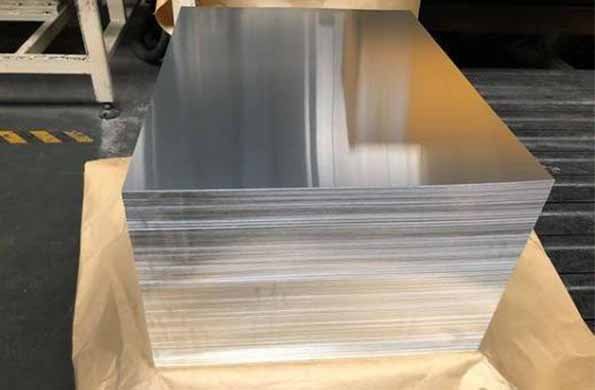
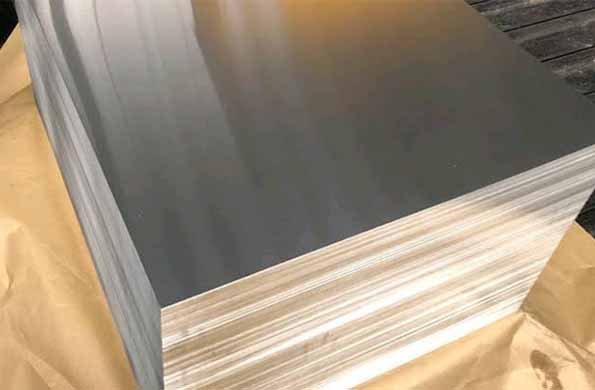
What Is 1060 Grade Aluminium Alloy?
1060 grade aluminium alloy belongs to the 1000 series. The 1000 series covers commercially pure aluminum — alloys with aluminum content of 99.0% or higher.
Within the 1000 series, the last two digits indicate the minimum aluminum percentage above 99%:
| Alloy | Minimum Al Content |
|---|---|
| 1050 | 99.50% |
| 1060 | 99.60% |
| 1070 | 99.70% |
| 1100 | 99.00% |
| 1235 | 99.35% |
AA1060 sits between 1050 and 1070 in terms of purity. It offers a practical balance — higher purity than 1100 for better conductivity and corrosion resistance, while remaining more cost-effective than 1070 or 1080.
Key Characteristics of 1060 Grade Aluminium
- Very high purity — 99.6% minimum aluminum content
- Non-heat-treatable — Strength comes only from work hardening
- Excellent electrical conductivity — 61% IACS minimum
- Superior corrosion resistance — Excellent in most environments
- Outstanding formability — Soft and easily worked in O temper
- Good thermal conductivity — Efficient heat transfer
- Food and chemical safe — Inert to most food acids and chemicals
- Fully recyclable — 100% recyclable with no quality loss
AA1060 Aluminum Chemical Composition
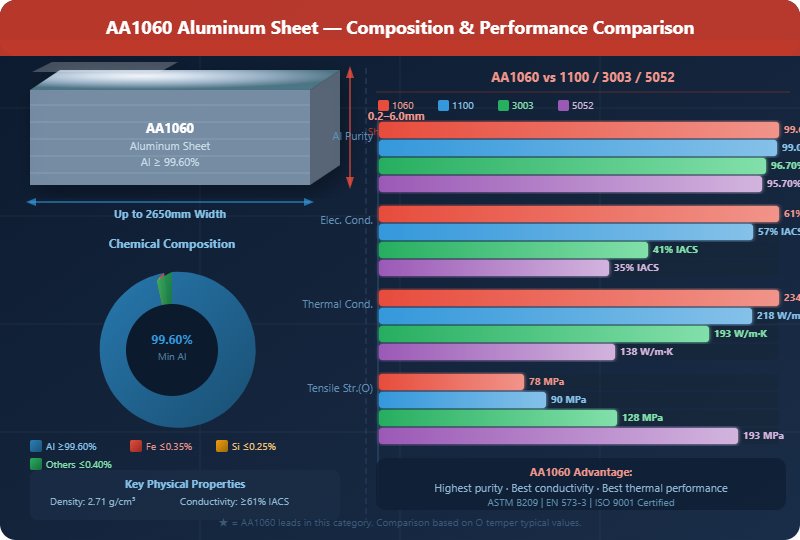
The chemical composition of AA1060 aluminum follows strict international standards.
Chemical Composition Table
| Element | Symbol | Maximum Content (%) |
|---|---|---|
| Aluminum | Al | ≥ 99.60% (balance) |
| Silicon | Si | 0.25 max |
| Iron | Fe | 0.35 max |
| Copper | Cu | 0.05 max |
| Manganese | Mn | 0.03 max |
| Magnesium | Mg | 0.03 max |
| Zinc | Zn | 0.05 max |
| Titanium | Ti | 0.03 max |
| Vanadium | V | 0.05 max |
| Other (each) | — | 0.03 max |
| Other (total) | — | 0.10 max |
Why High Purity Matters
The high aluminum content of aa1060 directly determines its key performance characteristics:
Electrical Conductivity
Each alloying element reduces electrical conductivity. The fewer impurities, the better the conductivity. AA1060 achieves 61% IACS — suitable for electrical bus bars, transformer windings, and cable applications.
Corrosion Resistance
Pure aluminum forms a strong natural oxide layer. Alloying elements can disrupt this layer and reduce protection. The high purity of 1060 gives it excellent corrosion resistance in outdoor, marine, and chemical environments.
Formability
Pure aluminum is inherently soft and ductile. The low impurity levels in 1060 maintain maximum formability in O temper — elongation reaches 23–28%.
AA1060 Aluminum Sheet Properties
Physical Properties
| Property | Value |
|---|---|
| Density | 2.71 g/cm³ |
| Melting Range | 646 – 657°C |
| Thermal Conductivity | 234 W/m·K |
| Electrical Conductivity | ≥ 61% IACS |
| Coefficient of Thermal Expansion | 23.6 µm/m·°C |
| Elastic Modulus | 69 GPa |
| Reflectivity | 80 – 85% |
Mechanical Properties by Temper
| Temper | Tensile Str. (MPa) | Yield Str. (MPa) | Elongation (%) | Hardness (HB) |
|---|---|---|---|---|
| O | 60 – 95 | 15 – 40 | 23 – 28 | 19 – 26 |
| H12 | 80 – 115 | 65 – 95 | 8 – 12 | 23 – 30 |
| H14 | 95 – 130 | 80 – 110 | 5 – 8 | 26 – 34 |
| H16 | 110 – 145 | 95 – 125 | 4 – 6 | 30 – 38 |
| H18 | 125 – 160 | 115 – 145 | 3 – 5 | 34 – 42 |
| H22 | 80 – 115 | 55 – 85 | 10 – 14 | 21 – 28 |
| H24 | 95 – 130 | 75 – 105 | 6 – 10 | 24 – 32 |
Key Property Highlights
Outstanding Thermal Conductivity (234 W/m·K)
This is significantly higher than 3003 (193 W/m·K) or 5052 (138 W/m·K). High thermal conductivity makes 1060 ideal for heat exchangers, cooling equipment, and thermal management applications.
Excellent Electrical Conductivity (≥61% IACS)
This is the highest among common aluminum sheet alloys. Only 1350 series electrical conductor grade aluminum exceeds this level. 1060 is widely used for electrical bus bars and transformer windings.
Superior Reflectivity (80–85%)
The high purity surface of 1060 reflects light efficiently. Lighting reflectors, solar reflectors, and decorative mirror applications use this property.
Low Density (2.71 g/cm³)
Like all aluminum, 1060 is approximately one-third the weight of steel. This low density makes it valuable wherever weight reduction matters.
What Is Aluminum 1060 Used For?
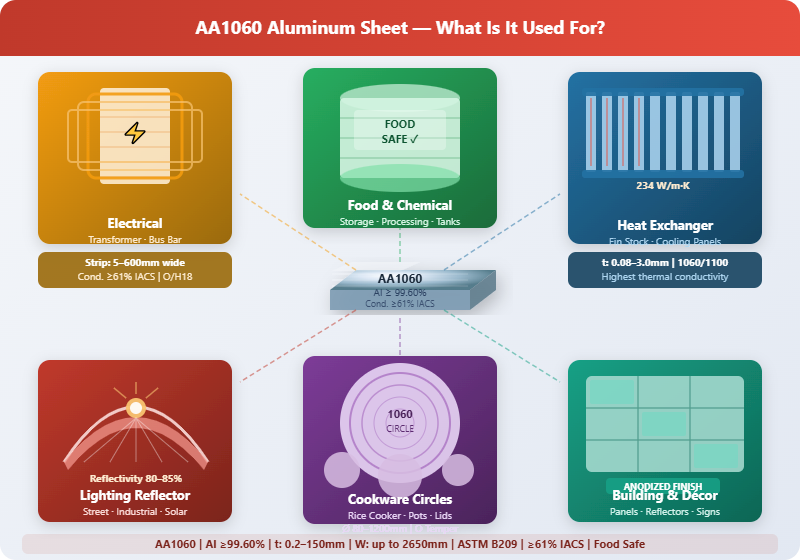
What is aluminum 1060 used for? The answer covers a wide range of industries. Here is a detailed breakdown.
Electrical Applications
This is one of the most important markets for aa1060 aluminum.
Transformer Windings
Aluminum transformer coils use 1060 strip for the winding conductor. The high electrical conductivity reduces energy losses. The soft O temper allows the strip to wind without cracking. Aluminum transformer windings replace copper in many medium and large power transformers worldwide.
Bus Bars
Electrical bus bars carry large currents in switchgear, power distribution panels, and substations. 1060 aluminum bus bar stock offers good conductivity at low cost compared to copper.
Cable and Wire Applications
1060 aluminum strip wraps around cable cores for shielding and armoring. The high conductivity and corrosion resistance suit underground and outdoor cable applications.
Capacitor Foil
Very thin 1060 foil forms the electrode plates in aluminum electrolytic capacitors. The high purity is essential for consistent capacitor performance.
Food Processing and Storage
aa1060 aluminum sheet is widely used in food industry equipment.
Food Processing Equipment
Mixing bowls, food trays, storage containers, and processing equipment use 1060 sheet for its food safety and corrosion resistance. The alloy does not react with most food acids or alkalis.
Grain Storage Silos
Large agricultural grain storage silos use 1060 aluminum panels. The excellent corrosion resistance eliminates rust problems. The lightweight panels are easy to transport and assemble in remote locations.
Food Packaging
Thin 1060 foil and sheet forms food containers, lidding, and flexible packaging. Food safety certification confirms its suitability for direct food contact.
Chemical and Industrial Equipment
Chemical Storage Tanks
1060 aluminum resists attack from many chemicals including dilute acids, alkalis, and organic solvents. Chemical storage tanks, pipes, and fittings use 1060 sheet for corrosion-resistant construction.
Heat Exchangers
The combination of high thermal conductivity, good formability, and corrosion resistance makes 1060 ideal for heat exchanger applications. Plate heat exchangers, shell and tube exchangers, and radiator components all use 1060 aluminum.
Laboratory Equipment
Chemical laboratory equipment uses 1060 aluminum where corrosion resistance and cleanliness are important.
Cookware and Kitchen Products
Aluminum Circles for Cookware
1060 aluminum circles serve as blanks for stamping rice cooker inner pots, small saucepans, and lightweight cookware. The high elongation in O temper allows clean deep drawing operations.
Kitchen Utensils
Spatulas, ladles, colanders, and other kitchen tools use 1060 aluminum for its lightweight and food-safe properties.
Lighting and Reflector Applications
Lighting Reflectors
The high reflectivity of 1060 aluminum (80–85%) makes it ideal for light reflector applications. Street lighting, industrial lighting, and decorative lighting fixtures use 1060 reflector sheet.
Solar Reflectors
Concentrated solar power systems use aluminum reflectors to focus sunlight. The high reflectivity and corrosion resistance of 1060 suit outdoor solar applications.
Building and Architecture
Decorative Panels
Anodized 1060 aluminum sheet provides decorative wall panels, ceiling tiles, and architectural trim with excellent corrosion resistance.
Roofing in Corrosive Environments
Where high corrosion resistance is the priority over strength, 1060 aluminum roofing outperforms lower-purity alloys.
Nameplates and Labels
The smooth, bright surface of 1060 sheet accepts printing and engraving well.
Automotive and Transportation
Heat Shields
Engine compartment heat shields use 1060 aluminum for its combination of thermal properties and light weight.
Decorative Trim
Bright-finish 1060 sheet forms decorative trim panels and accents in vehicles.
1060 Aluminum Plate
1060 aluminum plate refers to 1060 material in thicker gauges — typically 6mm and above. Plate differs from sheet in its greater thickness and typically lower temper (O or H12).
Common Uses for 1060 Aluminum Plate
| Application | Typical Thickness | Temper |
|---|---|---|
| Chemical storage vessels | 8–20mm | O, H12 |
| Heat exchanger plates | 6–12mm | O, H14 |
| Tooling and mold bases | 10–50mm | H14 |
| Electrical bus bar | 6–25mm | H12, H14 |
| Structural tanks | 8–30mm | O, H12 |
1060 Plate vs 1060 Sheet
| Feature | 1060 Sheet | 1060 Plate |
|---|---|---|
| Thickness | 0.2mm – 6.0mm | 6.0mm – 150mm |
| Form | Coil or flat sheet | Flat only |
| Temper | O through H18 | O, H12, H14 |
| Main Use | Formed parts, foil | Machined parts, tanks |
1060 Aluminum Strip
1060 aluminum strip is 1060 material in narrow coil form. Slitting lines cut wide 1060 coils into narrow strips for specific applications.
Key Uses for 1060 Aluminum Strip
Transformer Winding Strip
This is the largest market. Electrical grade 1060 strip winds into transformer coils. Width matches the transformer core height. Thickness determines the current capacity.
Fin Stock Strip
Very narrow, thin 1060 strip forms heat exchanger fins in HVAC and refrigeration equipment.
Cable Wrapping Strip
Narrow 1060 strip wraps helically around cable cores for protection and shielding.
Venetian Blind Slats
1060 strip in 25mm–50mm width forms the horizontal slats in venetian blind systems.
1060 Aluminum Strip Specifications
| Parameter | Range |
|---|---|
| Width | 5mm – 600mm |
| Thickness | 0.10mm – 3.0mm |
| Temper | O, H14, H18, H22, H24 |
| Width tolerance | ±0.1mm – ±0.3mm |
| Edge | Mill edge or slit edge |
| Coil inner diameter | 150mm – 610mm |
AA1060 Aluminum Sheet Specifications
Standard Sheet Specifications
| Parameter | Range |
|---|---|
| Thickness | 0.2mm – 6.0mm |
| Width | 100mm – 2650mm |
| Length | 500mm – 8000mm |
| Coil inner diameter | 505mm or 610mm |
| Coil outer diameter | Up to 1800mm |
| Coil weight | Up to 8,000 kg |
Surface Finish Options
| Finish | Description | Application |
|---|---|---|
| Mill finish | Standard as-rolled | General use |
| Bright finish | Polished, reflective | Reflectors, decorative |
| Embossed | Textured pattern | Anti-slip, decorative |
| Anodized | Hard oxide layer | Architectural, decorative |
| Painted | Color coating | Decorative panels |
Dimensional Tolerances
| Parameter | Tolerance |
|---|---|
| Thickness | ±4% – ±6% of nominal |
| Width (sheet) | ±1mm – ±3mm |
| Length | +6mm / 0mm |
| Flatness | Max 3mm per 1000mm |
Aluminum 1060 Cost
Aluminum 1060 cost is among the lowest of all aluminum alloys. Several factors keep the cost competitive.
Why 1060 Is Cost-Effective
Simple Composition
1060 requires only minimal alloying additions. The raw material cost is essentially the cost of primary aluminum plus minimal processing additions. No expensive alloying elements like magnesium, copper, or zinc are needed.
Well-Established Production
1060 is one of the oldest and most widely produced aluminum alloys. Production processes are fully optimized. Equipment utilization rates are high. This drives down per-unit cost.
High Market Volume
Large production volumes spread fixed costs across more units. This further reduces the per-kg cost compared to specialty alloys.
Factors That Affect Aluminum 1060 Cost
LME Aluminum Price
The base cost of all aluminum products follows London Metal Exchange prices. LME aluminum prices change daily with global supply and demand.
Processing Method
- Cold rolled sheet costs more than hot rolled
- Annealed (O temper) adds annealing cost
- Slit strip adds slitting cost
- Surface treatments add coating or polishing cost
Thickness
Very thin gauges (below 0.5mm) cost more per kg due to additional rolling passes. Very thick plate (above 20mm) costs more due to saw cutting and handling.
Width and Length
Non-standard widths require slitting. Non-standard lengths require cutting. Both add processing cost.
Order Quantity
Larger orders receive lower per-kg pricing. Minimum order quantities vary by product form.
Certification Requirements
Certified material (ASTM, EN standards with full documentation) costs slightly more than uncertified material.
Indicative Price Range
| Product | Approximate Price Range |
|---|---|
| 1060 sheet (mill finish, O temper) | $2.2 – $3.5 per kg |
| 1060 sheet (bright finish) | $2.6 – $4.0 per kg |
| 1060 strip (transformer grade) | $2.8 – $4.2 per kg |
| 1060 plate (standard) | $2.4 – $3.8 per kg |
Prices change with LME aluminum market. Contact us for current pricing.
AA1060 vs Other Aluminum Alloys
AA1060 vs 1100 Aluminum
| Property | AA1060 | 1100 |
|---|---|---|
| Min Al Content | 99.60% | 99.00% |
| Tensile Str. (O) | 60–95 MPa | 75–105 MPa |
| Elongation (O) | 23–28% | 25–35% |
| Electrical Cond. | ≥61% IACS | ~57% IACS |
| Corrosion Res. | Excellent | Very Good |
| Cost | Lower | Similar |
| Main Difference | Higher purity, better conductivity | Slightly stronger |
Choose 1060 when electrical conductivity and corrosion resistance are priorities.
Choose 1100 when slightly more strength is needed at similar purity levels.
AA1060 vs 3003 Aluminum
| Property | AA1060 | 3003 |
|---|---|---|
| Min Al Content | 99.60% | ~96.7% |
| Tensile Str. (O) | 60–95 MPa | 110–145 MPa |
| Elongation (O) | 23–28% | 25–30% |
| Electrical Cond. | ≥61% IACS | ~41% IACS |
| Corrosion Res. | Excellent | Excellent |
| Cost | Lower | Medium |
Choose 1060 for electrical, chemical, and high-corrosion applications.
Choose 3003 when more strength is needed — cookware, pressure cookers, structural panels.
AA1060 vs 5052 Aluminum
| Property | AA1060 | 5052 |
|---|---|---|
| Tensile Str. | 60–95 MPa | 170–215 MPa |
| Electrical Cond. | ≥61% IACS | ~35% IACS |
| Marine Resistance | Good | Superior |
| Formability (O) | Excellent | Very Good |
| Cost | Lower | Higher |
Choose 1060 for electrical and general-purpose applications.
Choose 5052 for marine environments or applications requiring high strength.
Quality Standards for AA1060 Aluminum Sheet
International Standards
| Standard | Region | Scope |
|---|---|---|
| ASTM B209 | USA | Aluminum sheet and plate |
| ASTM B373 | USA | Aluminum foil |
| EN 573-3 | Europe | Chemical composition |
| EN 485 | Europe | Mechanical properties |
| GB/T 3880 | China | Aluminum sheet standard |
| JIS H4000 | Japan | Aluminum sheet |
| IEC 60317 | International | Electrical conductor aluminum |
Quality Inspection Points
Chemical Composition
Spectrometer analysis confirms aluminum content meets 99.60% minimum. Iron and silicon levels must stay within limits to maintain conductivity and corrosion resistance.
Electrical Conductivity Testing
For electrical grade 1060, conductivity testing confirms minimum 61% IACS. This is especially important for transformer winding and bus bar applications.
Mechanical Properties
Tensile strength, yield strength, and elongation must meet temper specifications. O temper elongation below 23% indicates insufficient annealing.
Dimensional Accuracy
Thickness uniformity across the full width is critical. Variations in thickness cause problems in both electrical winding and sheet forming operations.
Surface Quality
No scratches, oxidation, oil stains, or roll marks. Bright finish material requires additional surface quality inspection.
Packaging and Shipping
Standard Packaging
Sheet packaging:
- Flat stacked on wooden pallets
- Protective paper between sheets
- Waterproof outer wrapping
- Steel strapping
- Corner and edge protection
Coil packaging:
- Waterproof kraft paper wrapping
- Inner and outer diameter protection rings
- Placed on coil saddle pallets
- Steel strapping bands
Shipping Options
| Method | Transit Time | Best For |
|---|---|---|
| Sea freight (FCL) | 15–40 days | Large orders |
| Sea freight (LCL) | 20–50 days | Medium orders |
| Air freight | 3–7 days | Samples, urgent orders |
| Rail (Eurasia) | 15–25 days | Europe-bound |
Why Buy AA1060 Aluminum Sheet from Us?
Consistent High Purity
We verify aluminum content of 99.60% minimum on every batch using optical emission spectrometry. Conductivity testing confirms electrical grade specification for transformer and bus bar applications.
Full Product Range
We supply aa1060 aluminum in:
- Sheet: 0.2mm – 6.0mm thickness
- Plate: 6.0mm – 150mm thickness
- Strip: 5mm – 600mm width
- Circles: 80mm – 1200mm diameter
- Tempers: O, H12, H14, H16, H18, H22, H24
- Surface: Mill, bright, embossed, anodized
Electrical Grade Capability
Our transformer winding strip meets IEC 60317 requirements for aluminum conductor material. Conductivity certificates accompany every electrical grade shipment.
Complete Documentation
Every shipment includes:
- Mill Test Certificate with full composition and mechanical data
- Electrical conductivity report (for electrical grade)
- ASTM B209 or EN 485 compliance statement
- Certificate of origin
- SGS or third-party inspection available
Global Supply Experience
We supply aluminum 1060 sheet and strip to customers in:
| Region | Key Markets |
|---|---|
| Asia Pacific | Vietnam, Thailand, Indonesia, India |
| Middle East | Turkey, Iran, Saudi Arabia, UAE |
| Africa | Nigeria, Egypt, Ethiopia, Kenya |
| Europe | Germany, Poland, Italy, Netherlands |
| Americas | Brazil, Mexico, Colombia |
Frequently Asked Questions
What is aluminum 1060 used for?
Aluminum 1060 is used for electrical applications (transformer windings, bus bars, capacitor foil), food processing equipment, chemical storage tanks, heat exchangers, lighting reflectors, and general-purpose sheet metal work. Its high purity gives it excellent electrical conductivity and corrosion resistance.
What is 1060 grade aluminium alloy?
1060 grade aluminium is a commercially pure aluminum alloy containing minimum 99.60% aluminum. It belongs to the 1000 series pure aluminum family. It is non-heat-treatable, with strength coming only from work hardening. Key properties include excellent electrical conductivity (≥61% IACS), outstanding corrosion resistance, and good formability.
What is the difference between AA1060 and 1100 aluminum?
AA1060 has higher aluminum purity (99.60% vs 99.00% minimum) and better electrical conductivity. 1100 is slightly stronger in O temper and has marginally better formability at very thin gauges. Both are excellent for general purpose and food-safe applications. Choose 1060 when conductivity is the priority.
How much does aluminum 1060 cost?
Aluminum 1060 sheet costs approximately $2.2–$3.5 per kg for standard mill finish material. Bright finish, special tempers, and certified material cost more. Prices change with LME aluminum market rates. Contact us for current pricing based on your specific requirements.
What thickness is available for AA1060 aluminum sheet?
Standard sheet thickness ranges from 0.2mm to 6.0mm. Plate is available from 6.0mm to 150mm. Ultra-thin foil gauge from 0.006mm is also available. Strip widths from 5mm to 600mm are available in coil form.
Is AA1060 aluminum food safe?
Yes. AA1060 aluminum meets FDA and EU food contact regulations. Its high purity means minimal impurities that could react with food. It is used widely in food processing equipment, storage containers, and food packaging.
Can AA1060 be welded?
Yes. 1060 aluminum welds well using TIG and MIG processes. Use 1100 or 4043 filler wire. Post-weld strength in the heat-affected zone is lower than the base metal, which is normal for non-heat-treatable alloys.
Product Summary and Quote Request
Quick Specification Reference
| Parameter | Details |
|---|---|
| Alloy | AA1060 (A1060) |
| Min Al Content | 99.60% |
| Temper | O, H12, H14, H16, H18, H22, H24 |
| Sheet thickness | 0.2mm – 6.0mm |
| Plate thickness | 6.0mm – 150mm |
| Strip width | 5mm – 600mm |
| Sheet width | Up to 2650mm |
| Surface | Mill / Bright / Embossed / Anodized |
| Conductivity | ≥ 61% IACS |
| Standard | ASTM B209, EN 573-3, EN 485 |
| Certifications | ISO 9001, SGS, MTC |
| MOQ | 2 – 5 tons |
| Lead Time | 15 – 25 days |
Request Your Free Quote
Contact our sales team today. We respond within 24 hours.
Please include:
- Thickness and width required
- Temper needed
- Surface finish
- Quantity (kg or tons)
- Application (helps us recommend optimal specs)
- Destination country
- Certification requirements