
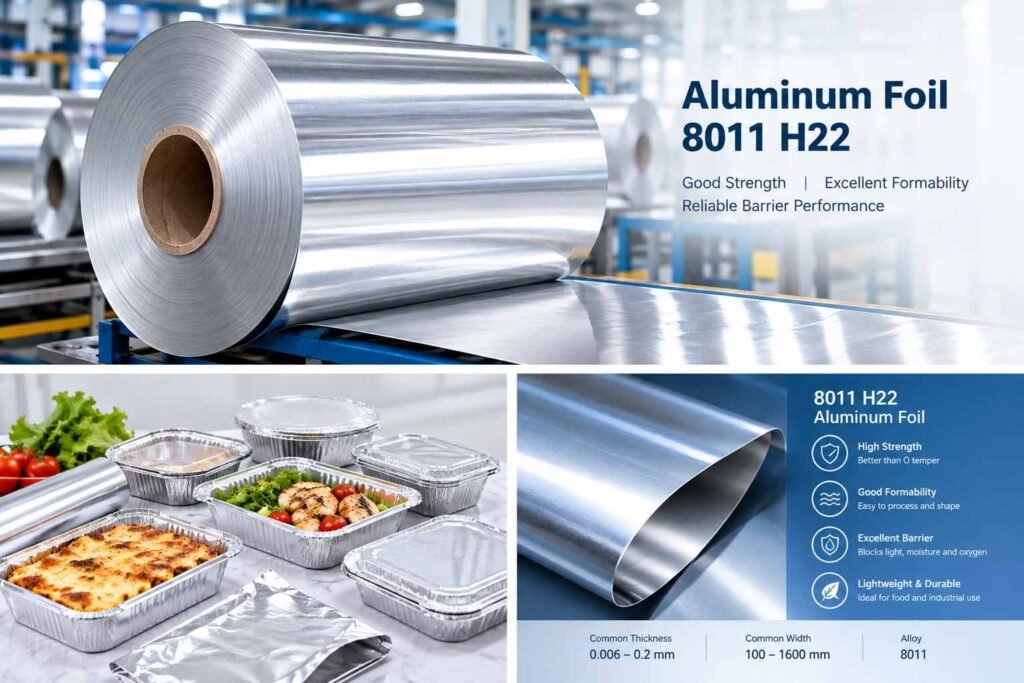
Aluminum foil 8011 H22 is a widely used aluminum foil material for food containers, packaging, lids, household foil, and other forming applications. It combines the useful properties of 8011 aluminum alloy with the H22 temper, providing a practical balance of strength, ductility, and formability.
For buyers, manufacturers, and packaging companies, understanding the alloy, temper, thickness, dimensions, and applicable HS code is important when selecting aluminum foil 8011 H22.
This guide explains the key characteristics, applications, specifications, and purchasing considerations of 8011 aluminum foil.
What Is 8011 Aluminum Foil?
8011 aluminum foil is an aluminum alloy foil belonging to the 8xxx series. Iron and silicon are the main alloying elements. These additions help improve the strength and processing performance of thin aluminum foil while maintaining good formability.
8011 aluminum foil is commonly used for:
- Food packaging
- Aluminum food containers
- Takeaway trays
- Aluminum foil lids
- Pharmaceutical packaging
- Household foil
- Bottle cap and closure applications
- Heat exchanger and insulation applications
The combination of good formability, barrier performance, light weight, and corrosion resistance makes 8011 aluminum foil suitable for many packaging applications.
For food and pharmaceutical applications, the final product should also meet the relevant food-contact, pharmaceutical, coating, and hygiene requirements for the target market.
What Is H22 Aluminum Foil?
H22 is a temper designation for aluminum alloy.
The H indicates that the aluminum has been strain hardened through cold working. The second digit indicates the type of processing. H2 means the material has been strain hardened and then partially annealed.
Therefore, 8011 H22 aluminum foil has been cold worked and partially annealed to obtain a balance between strength and ductility.
Compared with fully soft O temper foil, H22 aluminum foil has higher strength. At the same time, it retains enough ductility for forming and other manufacturing processes.
This balance makes 8011 H22 aluminum foil useful for semi-rigid packaging products, food containers, trays, lids, and similar applications.
8011 H22 vs. 8011 O
| Feature | 8011 H22 | 8011 O |
|---|---|---|
| Temper | Partially annealed | Fully annealed |
| Strength | Higher | Lower |
| Ductility | Good | Excellent |
| Formability | Good | Very high |
| Typical applications | Containers, trays, lids | Flexible packaging, deep forming, soft foil |
| Material condition | 1/4 hard | Soft |
The correct temper depends on the forming method and final product requirements.
What Are the Different Types of Aluminum Foil?
Aluminum foil can be classified according to alloy, temper, thickness, surface condition, and end use.
Common aluminum foil alloys include 8011, 3003, 3004, 8006, and 1235. Different alloys are selected according to the required strength, ductility, forming performance, and application. The U.S. International Trade Commission identifies 3003, 3004, 8006, and 8011 among the common alloys used for food container foil.
For 8011 aluminum foil, common tempers include:
- 8011 O
- 8011 H22
- 8011 H24
- 8011 H26
- Other customized tempers according to application
8011 H22 Aluminum Foil
8011 H22 is suitable when the customer needs a combination of strength and forming performance.
8011 O Aluminum Foil
8011 O is softer and more ductile. It is often selected for applications requiring high flexibility and forming performance.
Coated 8011 Aluminum Foil
8011 foil can also be coated, laminated, lacquered, or printed. The surface treatment depends on the final application.
For example, packaging foil may receive a coating or lacquer to improve sealing, printing, or compatibility with other packaging materials.
What Is the Chemical Composition of Aluminum Alloy 8011?
The main alloying elements in 8011 aluminum foil are iron and silicon. A typical composition range is shown below. Exact limits should be confirmed according to the applicable material standard and customer specification.
| Element | Typical Composition (%) |
|---|---|
| Aluminum (Al) | Balance |
| Iron (Fe) | 0.60–1.00 |
| Silicon (Si) | 0.50–0.90 |
| Copper (Cu) | ≤0.10 |
| Manganese (Mn) | ≤0.20 |
| Magnesium (Mg) | ≤0.05–0.10 |
| Zinc (Zn) | ≤0.10 |
| Titanium (Ti) | ≤0.08 |
| Others | According to applicable standard |
The controlled Fe and Si content contributes to the strength and processing characteristics needed for thin foil products.
For a production order, the chemical composition should be checked against the requested standard, such as the relevant ASTM, EN, JIS, or other customer-specified requirements.
What Are the Applications of 8011 Aluminum Foil?
The main advantage of aluminum foil 8011 is its versatility.
Food Packaging
8011 aluminum foil can be used for food packaging where a lightweight and effective barrier material is required.
Typical products include:
- Food containers
- Takeaway trays
- Baking trays
- Food lids
- Household foil
- Packaging liners
Aluminum foil can provide a barrier against moisture, light, and oxygen, helping protect packaged products.
Pharmaceutical Packaging
8011 aluminum foil is also used in pharmaceutical packaging, including certain lidding and blister packaging applications.
The appropriate foil grade, temper, thickness, coating, and surface quality should be selected according to the pharmaceutical packaging process.
Household Aluminum Foil
Thin 8011 foil can be processed into household aluminum foil rolls or sheets. Its light weight and flexibility make it convenient for wrapping and covering food.
Aluminum Containers and Trays
8011 H22 aluminum foil can be suitable for container foil where a balance between formability and strength is required.
The typical thickness range for food container foil can vary substantially depending on the product. The USITC notes common container foil gauges from about 0.03 mm to 0.20 mm.
What Is the HS Code for Aluminum Foil Packaging?
The HS code for aluminum foil depends on the actual product, thickness, backing, processing, and destination country’s tariff classification.
At the international HS heading level, 7607 covers aluminum foil, including foil that is printed or backed with paper, paperboard, plastics, or similar materials, with the classification depending on thickness and whether it is backed.
For example, in the United States, aluminum foil products can fall under different HTSUS subheadings within 7607. The exact code should therefore be confirmed based on the product specification rather than simply using “8011” as the tariff code.
What About Aluminum Foil Pans HS Code?
This is an important distinction.
Aluminum foil and finished aluminum foil pans may not have the same tariff classification.
For example, U.S. customs classification can treat finished aluminum kitchen and household articles differently from aluminum foil in roll or sheet form. A U.S. Customs ruling classified certain aluminum foil containers, including carry-out containers and pizza pans, under heading 7615 rather than heading 7607.
Therefore, when searching for an aluminum foil pans HS code, buyers should provide the customs broker or classification specialist with the finished product’s:
- Material
- Alloy
- Thickness
- Shape
- Manufacturing process
- Intended use
- Whether it is a finished container or raw foil
The final HS/HTS code should be confirmed for the importing country before customs declaration.
What Is Aluminum Foil 8×8?
Aluminum foil 8×8 usually refers to aluminum foil sheets measuring 8 × 8 inches, or approximately 203 × 203 mm.
This size can be supplied as pre-cut foil sheets rather than foil rolls.
8×8 aluminum foil sheets can be used for:
- Food wrapping
- Bakery packaging
- Restaurant packaging
- Takeaway food
- Small food containers
- Household applications
- Catering
When ordering 8011 foil 8×8, the size alone is not enough to define the product. Buyers should also specify:
- Alloy: 8011
- Temper: H22, O, or another temper
- Thickness
- Sheet size: 8 × 8 inches
- Surface: bright or matte
- Quantity
- Packaging requirements
- Application
This information helps the manufacturer provide the correct aluminum foil.
Aluminum Foil 8011 H22 Specifications
The specification of aluminum foil 8011 H22 can be customized according to the customer’s application and production requirements.
A typical specification structure is shown below:
| Item | 8011 H22 Aluminum Foil |
|---|---|
| Alloy | 8011 |
| Temper | H22 |
| Material | Aluminum alloy |
| Product form | Foil roll or sheet |
| Thickness | Customized |
| Width | Customized |
| Length | Customized |
| Surface | Bright / Matte |
| Edge | Mill edge / Slit edge |
| Application | Food packaging, containers, lids, industrial applications |
| Packaging | Export seaworthy packaging |
| Inspection | According to agreed standard |
For mass production, thickness and width tolerances should be confirmed before the order. Surface quality is also important for foil applications because oil stains, wrinkles, corrosion, excessive pinholes, and poor flatness can affect subsequent processing.
Why Choose 8011 H22 Aluminum Foil?
There are several reasons why buyers choose 8011 H22 aluminum foil.
Good Strength-to-Weight Ratio
Aluminum is lightweight, while the H22 temper provides more strength than a fully annealed O temper.
Good Formability
8011 H22 maintains useful ductility after partial annealing. This makes it suitable for forming operations where both strength and workability are required.
Good Barrier Performance
Aluminum foil provides an effective barrier against light, moisture, and oxygen, which is valuable in packaging applications.
Good Surface Quality
High-quality foil can provide a clean and smooth surface suitable for printing, coating, laminating, or forming.
Wide Application Range
From food packaging to pharmaceutical packaging and industrial applications, 8011 foil can be manufactured in different thicknesses, widths, tempers, and surface conditions.
How to Choose the Right 8011 Foil?
Choosing the correct 8011 aluminium foil starts with the final application.
If the product requires deep forming, a softer temper may be more suitable. If the application needs better stiffness and strength, 8011 H22 or another H temper can be considered.
Before placing an order, buyers should confirm:
- Alloy – 8011
- Temper – H22 or another required temper
- Thickness – based on forming and packaging requirements
- Width – according to the converting or forming equipment
- Length or coil weight – according to production requirements
- Surface condition – bright, matte, coated, or laminated
- Edge condition – mill edge or slit edge
- Pinhole requirements – especially for packaging applications
- Mechanical properties – according to the applicable standard
- Packaging – suitable for storage and international transportation
Clear specifications can reduce production errors and make it easier for the manufacturer to provide a consistent product.
8011 Aluminum Foil vs. Other Aluminum Foil Alloys
Different aluminum foil alloys have different advantages.
| Alloy | Typical Characteristics | Common Applications |
|---|---|---|
| 8011 | Good formability and strength | Food packaging, lids, containers, pharmaceutical packaging |
| 3003 | Good strength and corrosion resistance | Food containers, trays, heat exchangers |
| 3004 | Higher strength than 3003 in many applications | Containers and packaging |
| 8006 | High strength and good forming performance | Food containers and trays |
| 1235 | High aluminum purity and excellent ductility | Flexible packaging and foil products |
The best alloy depends on the forming process, required strength, thickness, final product, and applicable standard.
How to Buy Aluminum Foil 8011 H22 from a Manufacturer?
When sourcing aluminum foil 8011 H22, it is better to provide a complete product specification instead of only sending the alloy number.
For example:
8011 H22 aluminum foil, 0.08 mm thickness × 500 mm width, bright surface, suitable for food container production.
For pre-cut products, the specification can be written as:
8011 H22 aluminum foil sheets, 0.08 mm × 8 × 8 inches, bright surface, customized packing.
A professional aluminum manufacturer can then confirm the production feasibility, tolerance, minimum order quantity, packaging, and delivery schedule.