What Is PVDF Coated Aluminum Coil?
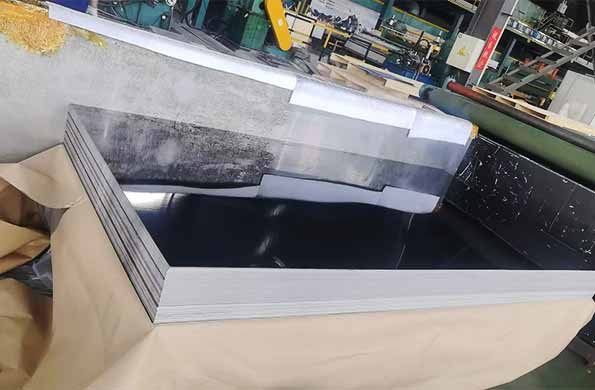
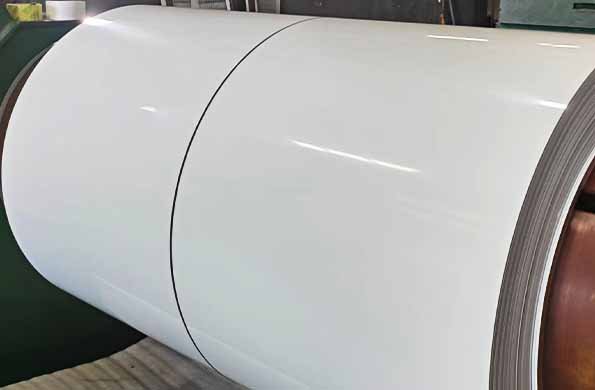
PVDF coated aluminum coil is an aluminum coil with a PVDF-based paint system applied to its surface. PVDF stands for Polyvinylidene Fluoride. It is a high-performance fluoropolymer resin used in premium architectural and industrial coatings.
The coating bonds tightly to the aluminum surface. It creates a hard, smooth, and highly durable finish. Manufacturers apply it through a continuous coil coating process. This ensures consistent thickness and color across the entire coil.
PVDF coated aluminum coil is the material of choice for high-end building facades, curtain walls, roofing panels, and ceilings. Architects and construction companies worldwide specify it for projects that demand long-lasting color and weather resistance.
If you need an aluminum coil that holds its color and gloss for 20+ years outdoors, PVDF coating is the answer.
What Is PVDF Coating on Aluminium?
Many buyers ask: what is PVDF coating on aluminium?
PVDF coating is a liquid paint system where the primary resin is Polyvinylidene Fluoride (PVDF). The most widely used PVDF resin in the coating industry is Kynar 500® (by Arkema) and Hylar 5000® (by Solvay).
Industry standards require that a true PVDF coating contain at least 70% PVDF resin by weight in the binder. The remaining 30% is typically acrylic resin, which improves adhesion and gloss.
What Makes PVDF Special?
PVDF is a fluoropolymer. Fluoropolymers contain very strong carbon-fluorine (C-F) bonds. These bonds are among the strongest in organic chemistry. They resist:
- Ultraviolet (UV) radiation
- Heat and temperature extremes
- Acid rain and chemical exposure
- Salt spray and humidity
- Pollution and industrial gases
This is why PVDF coating on aluminium lasts far longer than conventional coatings. The color stays stable. The gloss does not fade. The surface does not crack or peel.
PVDF Coating Structure on Aluminum Coil
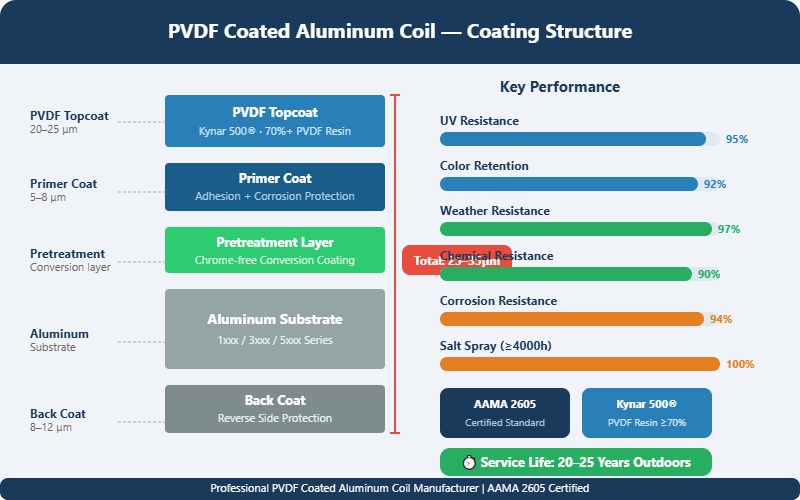
A standard PVDF coated aluminium coil has multiple layers:
| Layer | Function |
|---|---|
| Aluminum substrate | Base material (1xxx, 3xxx, 5xxx series) |
| Pretreatment layer | Chromate or chrome-free conversion coating – improves adhesion |
| Primer coat | 5–8 μm – improves adhesion and corrosion resistance |
| PVDF topcoat | 20–25 μm – main decorative and protective layer |
| Back coat (optional) | 8–12 μm – protects the reverse side |
Total dry film thickness typically ranges from 25 to 35 μm.
How Is PVDF Coil Coating Applied?
PVDF coil coatings are applied through a highly efficient industrial process called continuous coil coating (also called “coil-to-coil coating” or “strip coating”).
The Coil Coating Process — Step by Step
Step 1: Uncoiling
The aluminum coil unwinds at the entry of the coil coating line.
Step 2: Cleaning and Degreasing
The aluminum strip passes through chemical cleaning tanks. This removes oil, dirt, and surface oxides.
Step 3: Pretreatment
The strip receives a chemical conversion coating. This step creates a strong bond between the aluminum and the primer. Chrome-free pretreatment systems are now widely used for environmental compliance.
Step 4: Primer Application
A roller coater applies the primer coat evenly. The strip then passes through an oven for curing.
Step 5: PVDF Topcoat Application
Another roller coater applies the PVDF coating. The coat is uniform and consistent across the full width of the strip.
Step 6: Curing Oven
The coated strip passes through a high-temperature oven (typically 220–260°C). The PVDF coating cures and forms a hard, durable film.
Step 7: Cooling and Inspection
The strip cools quickly. Quality inspectors check color, gloss, thickness, and adhesion.
Step 8: Recoiling
The finished PVDF coated aluminum coil rewinds for shipping or further processing.
This continuous process is fast, consistent, and environmentally efficient. It produces less waste than spray painting.
Key Properties of PVDF Coated Aluminum Coil
PVDF coated aluminum coil combines the strength of aluminum with the superior surface performance of PVDF. Here are its key properties.
Outstanding UV Resistance
PVDF resists UV degradation better than almost any other coating. Colors retain their original appearance for 20–25 years in outdoor environments. This is the #1 reason architects specify PVDF for building exteriors.
Excellent Weather Resistance
PVDF coated aluminium coil withstands extreme weather:
- High temperature: up to 150°C
- Low temperature: down to -40°C
- Heavy rain, snow, and humidity
- Coastal salt spray environments
Superior Color Retention
The color fade rate of PVDF coatings is extremely low. Even after years of sun exposure, the color change (ΔE) stays below 5 units. In high-quality systems, ΔE stays below 3 units.
Strong Chemical Resistance
PVDF coatings resist acids, alkalis, solvents, and industrial pollutants. This makes PVDF coated aluminum coil ideal for industrial buildings and coastal projects.
Good Formability
Even with the coating applied, PVDF coated aluminum coil bends and forms without cracking. The coating is flexible enough to handle standard architectural forming operations.
Low Maintenance
The smooth PVDF surface is hydrophobic. Dirt and pollutants do not stick easily. Rainwater cleans the surface naturally. Maintenance costs are very low over the building’s lifespan.
Performance Summary Table
| Property | Performance |
|---|---|
| UV Resistance | Excellent (20–25 years) |
| Color Retention | ΔE < 5 (AAMA 2605 standard) |
| Gloss Retention | ≥ 50% after 10 years |
| Chalk Resistance | Rating 8 (ASTM D4214) |
| Salt Spray Resistance | ≥ 4000 hours |
| Adhesion | 0 (best rating, ASTM D3359) |
| Flexibility | T-bend: 0T–2T without cracking |
PVDF Coated Aluminum Coil Specifications
We supply PVDF coated aluminum coil in a wide range of specifications to suit different applications.
Alloy Options
| Alloy | Features | Best Use |
|---|---|---|
| 1100 | High purity, good formability | Simple architectural panels |
| 3003 | Good corrosion resistance | Roofing, cladding |
| 3004 | Higher strength than 3003 | Structural panels |
| 3105 | Good forming properties | Wall panels, roofing |
| 5005 | Good anodizing quality, strong | High-end facades |
| 5052 | High strength, marine grade | Coastal projects |
Thickness Range
- 0.2 mm to 4.0 mm
- Most common: 0.5 mm, 0.7 mm, 0.8 mm, 1.0 mm, 1.2 mm, 1.5 mm, 2.0 mm
Width Range
- 600 mm to 2000 mm
- Custom widths available
Coil Weight
- Standard: 2–5 MT per coil
- Heavy coils: up to 10 MT
Color Options
- RAL color system: all RAL colors available
- Pantone color system: available on request
- Standard colors: white, silver, grey, champagne, bronze, black, blue, red, green
- Custom colors: available with minimum order quantity
PVDF Coating Thickness
- Topcoat: 20–25 μm
- Total system (primer + topcoat): 25–35 μm
Gloss Level Options
- Low gloss: 10–20 GU
- Medium gloss: 30–50 GU
- High gloss: 60–80 GU
Standards Compliance
- AAMA 2605 (highest American standard for PVDF coatings)
- EN 13523 (European coil coating standard)
- ASTM D522, D3359, D4214
- GB/T 17748 (Chinese national standard)
PVDF Coating vs Anodizing: Which Is Better?
This is a common question for architects and buyers. Both PVDF coating and anodizing are premium surface treatments for aluminum. They have different strengths.
What Is Anodizing?
Anodizing is an electrochemical process. It converts the aluminum surface into a hard oxide layer. The oxide layer is part of the aluminum itself — not an applied coating.
Side-by-Side Comparison
| Feature | PVDF Coating | Anodizing |
|---|---|---|
| Color Range | Unlimited (any RAL/Pantone) | Limited (clear, bronze, black, gold) |
| UV Resistance | Excellent | Good |
| Color Consistency | Excellent (batch to batch) | Moderate (slight variation) |
| Corrosion Resistance | Excellent | Excellent |
| Surface Hardness | Moderate | Very high |
| Scratch Resistance | Moderate | High |
| Repairability | Yes (touchup paint) | Difficult |
| Cost | Moderate | Higher |
| Environmental Impact | Low (chrome-free options) | Moderate (chemical waste) |
| Thickness | 25–35 μm (applied) | 10–25 μm (integral) |
| Best For | Exterior facades, roofing, cladding | High-traffic interiors, premium facades |
When to Choose PVDF Coating
- You need a specific color (especially whites, greys, custom colors)
- The project is a large building exterior
- Budget is a consideration
- You need consistent color across many panels
When to Choose Anodizing
- You want a metallic or natural aluminum appearance
- The surface will face heavy physical abrasion
- The project requires a very hard surface
- Interior high-traffic applications
For most exterior architectural applications, PVDF coated aluminum coil is the better choice. It offers more color options, lower cost, and excellent long-term weather performance.
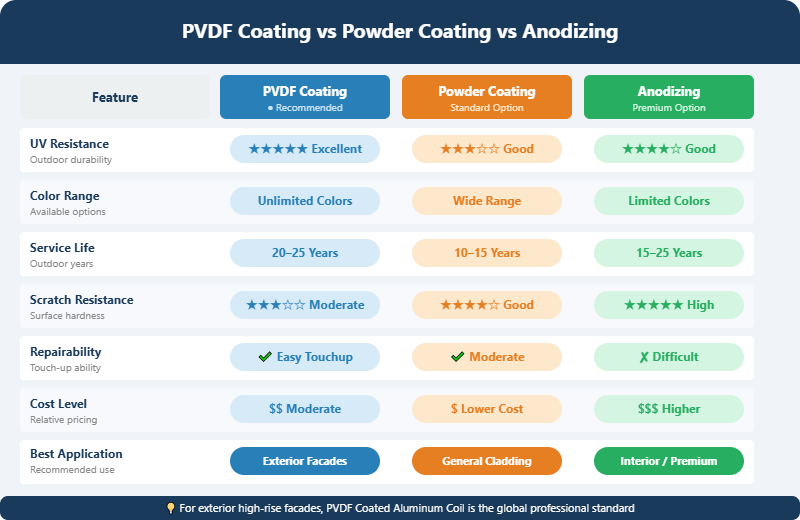
What Is the Difference Between PVDF and Powder Coating?
Buyers often compare PVDF vs powder coating. Both are popular aluminum surface treatments, but they are very different.
What Is Powder Coating?
Powder coating is a dry finishing process. Electrostatically charged dry powder particles are sprayed onto the aluminum surface. The coated part then goes into an oven. The powder melts and flows to form a smooth film.
Key Differences: PVDF vs Powder Coating
| Feature | PVDF Coating | Powder Coating |
|---|---|---|
| Resin Type | Polyvinylidene Fluoride (fluoropolymer) | Polyester, epoxy, or polyurethane |
| Application Method | Liquid coil coating (roller) | Electrostatic spray (dry powder) |
| UV Resistance | Excellent (20–25 years) | Good (10–15 years) |
| Color Retention | Superior | Moderate |
| Chalking Resistance | Excellent | Moderate |
| Gloss Retention | Superior | Moderate |
| Chemical Resistance | Excellent | Good |
| Film Thickness | 25–35 μm | 60–80 μm |
| Cost | Higher | Lower |
| Standard | AAMA 2605 | AAMA 2604 |
| Best For | High-end exterior facades | General architectural use |
The Simple Answer
PVDF coating lasts longer and performs better outdoors. It costs more, but it saves money over the building’s lifetime through lower maintenance and longer service life.
Powder coating costs less upfront and works well for standard architectural projects. But it shows more fading and chalking after 10–15 years of outdoor exposure.
For premium projects — especially tall buildings, coastal locations, and landmark structures — PVDF coated aluminum coil is always the professional choice.
PVDF Coated Aluminum Coil Applications
PVDF coated aluminum coil is used across many industries and building types. Here are the main application areas.
1. Curtain Wall Systems
Curtain walls are the outer skin of modern high-rise buildings. They must look beautiful for decades and resist all weather conditions. PVDF coated aluminum coil is the standard material for curtain wall panels worldwide.
2. Aluminum Composite Panels (ACP)
ACP manufacturers laminate PVDF coated aluminum coil onto both faces of a polyethylene or mineral core. The result is a lightweight, rigid panel used for building facades, signage, and interior decoration.
3. Roofing and Wall Cladding
PVDF coated aluminium coil is roll-formed into roofing panels and wall cladding profiles. It works for:
- Commercial buildings
- Industrial warehouses
- Sports stadiums
- Airport terminals
4. Aluminum Ceiling Systems
Architects use PVDF coated aluminum for suspended ceiling systems in airports, shopping malls, and public buildings. The coating keeps the ceiling looking fresh for many years.
5. Sunshade Louvers and Fins
Building sunshade systems use PVDF coated aluminum profiles. They block direct sunlight while maintaining a clean exterior appearance.
6. Door and Window Frames
High-end door and window manufacturers use PVDF coated aluminum coil for frame components. The coating offers better UV resistance than standard powder coating.
7. Signage and Advertising Boards
Large outdoor advertising boards and building signage use PVDF coated aluminum for long-term color stability.
8. Industrial Applications
Some industrial sectors use PVDF coated aluminum coil for:
- Chemical plant panels
- Food processing equipment panels
- Clean room wall systems
PVDF Coating Price: What Affects the Cost?
Many buyers ask about PVDF coating price. The cost of PVDF coated aluminum coil depends on several factors.
1. Aluminum Alloy and Thickness
Thicker aluminum and higher-grade alloys (like 5052) cost more than thin, basic alloys (like 3003). The aluminum substrate is the biggest part of the total cost.
2. PVDF Coating System Quality
There are different quality levels of PVDF coatings:
- Standard PVDF: 70% PVDF resin content – meets AAMA 2605
- Premium PVDF: Higher resin content, special pigments, enhanced performance
- Kynar 500® or Hylar 5000® certified: Licensed brand resin – commands a premium price
3. Color and Finish
- Standard colors (white, grey, silver) are less expensive
- Custom colors (special RAL or Pantone matching) cost more
- Special finishes (metallic, wood grain, stone pattern) cost more than solid colors
4. Coating Thickness
Thicker coatings require more material and more oven time. This increases the cost.
5. Order Quantity
Larger orders receive better unit pricing. Minimum order quantities (MOQ) typically start at 3–5 metric tons per color per specification.
6. Market Aluminum Price
The London Metal Exchange (LME) aluminum price changes daily. It directly affects the base cost of PVDF coated aluminum coil.
Approximate Price Range
General reference: PVDF coated aluminum coil typically costs $2,500 – $4,500 per metric ton depending on specifications and market conditions.
Contact us for a current, accurate quotation based on your exact specifications.
Why Choose Us as Your PVDF Coated Aluminum Coil Supplier
We are a professional manufacturer and exporter of PVDF coated aluminum coil with over 15 years of experience. Here is why global customers trust us.
✅ Genuine PVDF Coating — AAMA 2605 Certified
We use Kynar 500® certified PVDF resin. Our coatings meet AAMA 2605, the highest American standard. We provide full test reports with every order.
✅ Wide Range of Colors and Finishes
We offer over 500 standard colors and unlimited custom colors. Solid colors, metallic finishes, wood grain, and stone patterns are all available.
✅ Strict Quality Control
Every coil goes through:
- Color and gloss measurement
- Coating thickness check
- Adhesion and flexibility testing
- Salt spray testing
- Visual surface inspection
✅ Competitive Factory Pricing
As a direct manufacturer, we cut out middlemen. You get factory-direct PVDF coating prices with better margins for your business.
✅ Fast Lead Time
Standard colors: 15–20 business days
Custom colors: 20–30 business days
✅ Flexible MOQ
We accept orders from 3 metric tons per specification. We can discuss smaller trial orders for new customers.
✅ Strong Export Experience
We export PVDF coated aluminium coil to over 40 countries including the USA, UK, Australia, UAE, Saudi Arabia, South Korea, and across Southeast Asia and Europe.
✅ Full Technical Support
Our technical team helps you choose the right alloy, temper, coating system, and thickness for your project. We provide free samples on request.
Frequently Asked Questions (FAQ)
Q: What is the lifespan of PVDF coating on aluminum?
A: A quality PVDF coated aluminum coil lasts 20–25 years outdoors without significant color fading or gloss loss when maintained properly.
Q: What standard should I specify for PVDF coated aluminum?
A: Specify AAMA 2605 for premium exterior applications. This is the most demanding American standard for PVDF coil coatings.
Q: Can PVDF coated aluminum coil be further processed?
A: Yes. It can be cut, roll-formed, bent, and fabricated. Use proper tooling to avoid coating damage during forming.
Q: Do you offer chrome-free pretreatment?
A: Yes. We offer both chromate and chrome-free (Cr-free) pretreatment systems. Chrome-free is recommended for RoHS-compliant projects.
Q: Can I get a custom color matched to my RAL or Pantone specification?
A: Yes. We match any RAL or Pantone color. Provide us with the color code and we will produce a sample for your approval.
Q: What is the minimum order quantity?
A: Our standard MOQ is 3 metric tons per color per specification.
Q: Do you provide material test certificates?
A: Yes. We provide full mill test certificates, coating test reports, and AAMA 2605 compliance documentation.
Conclusion
PVDF coated aluminum coil is the premium choice for architects, contractors, and manufacturers who demand long-lasting beauty and performance. Its superior UV resistance, color retention, and weather durability make it the global standard for high-end building exteriors.
Whether you are comparing PVDF coating vs anodizing, understanding the difference between PVDF and powder coating, or ready to request a price, we are here to help.
Contact us today for free samples, technical specifications, and a competitive quote. Our team responds within 24 hours.