
What Is Aluminum Coil?
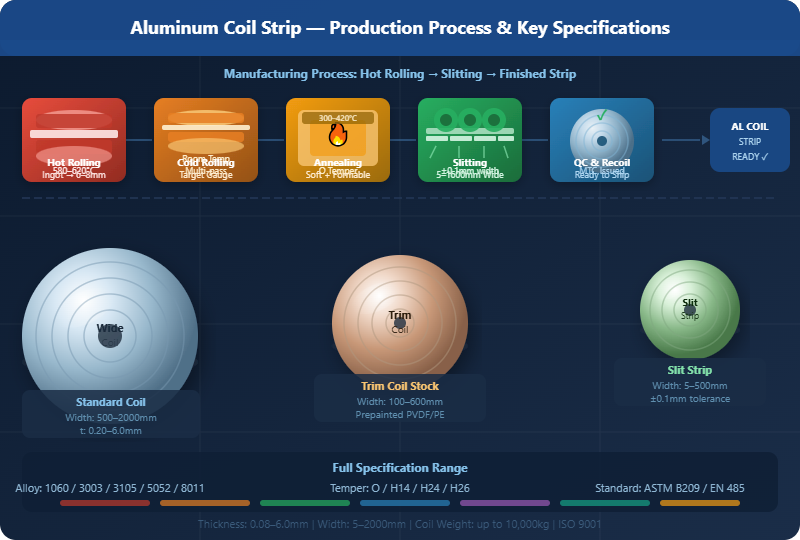
Aluminum coil is aluminum sheet that has been rolled into a continuous coil form during production. The rolling process starts with large aluminum ingots. These ingots pass through hot rolling mills and then cold rolling mills. The result is a long, thin sheet of aluminum wound tightly around a steel mandrel or core.
Aluminum coils come in many widths, thicknesses, alloys, and tempers. They serve as the primary raw material form for many downstream industries. Manufacturers feed aluminum coil directly into stamping presses, roll-forming machines, coating lines, and fabrication equipment.
Aluminum coil strip is a narrower form of aluminum coil. Wide coils are slit into narrow strips on slitting lines. These strips range from a few millimeters to several hundred millimeters wide. The narrow width suits specific applications like heat exchanger fins, electrical components, and decorative trim.
Understanding the difference between aluminum coil, aluminum coil stock, and aluminum coil strips helps buyers order the right product for their needs.


What Is Aluminum Coil Stock?
Aluminum coil stock refers to aluminum coil held in inventory and available for immediate delivery. Suppliers maintain coil stock in the most popular alloys, tempers, widths, and thicknesses. Buyers can order from stock without waiting for custom production runs.
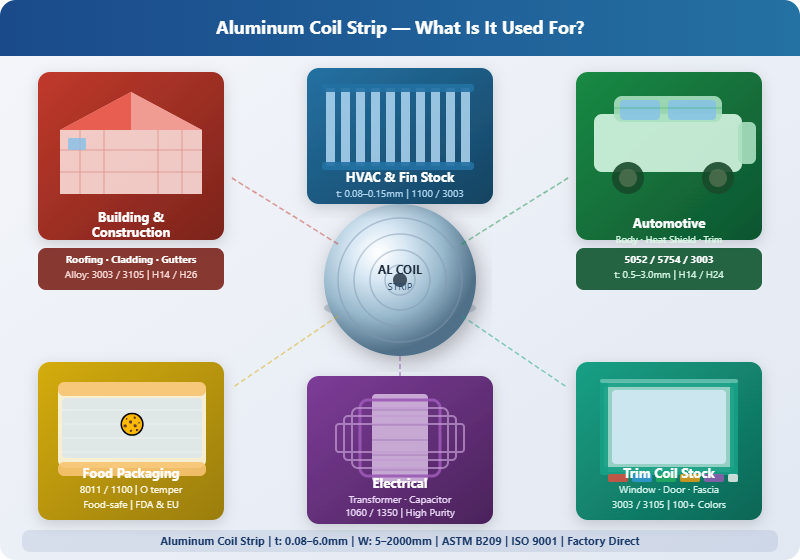
What is aluminum coil stock used for? The answer covers many industries:
- Building and construction products
- Roofing and wall cladding panels
- Gutters and downspouts
- HVAC components
- Automotive trim and parts
- Food packaging
- Electrical components
Aluminium coil stock is the standard supply form for most sheet metal fabrication businesses. Having coil stock on hand allows quick response to customer orders and production schedules.
Standard Aluminum Coil Stock Sizes
Aluminum coil stock sizes vary by supplier and market. Here are the most common dimensions:
Thickness Range
| Category | Thickness |
|---|---|
| Foil gauge | 0.006mm – 0.20mm |
| Light gauge | 0.20mm – 0.80mm |
| Standard gauge | 0.80mm – 3.0mm |
| Heavy gauge | 3.0mm – 6.0mm |
| Plate | Above 6.0mm |
Width Range
| Product Type | Width Range |
|---|---|
| Narrow strip | 5mm – 100mm |
| Medium strip | 100mm – 500mm |
| Standard coil | 500mm – 1650mm |
| Wide coil | 1650mm – 2650mm |
Coil Dimensions
| Parameter | Typical Range |
|---|---|
| Inner diameter | 505mm or 610mm |
| Outer diameter | 800mm – 2000mm |
| Coil weight | 500 kg – 10,000 kg |
What Is Aluminum Coil Used For?
What is aluminum coil used for? The answer spans dozens of industries. Here is a comprehensive breakdown.
Building and Construction
This is the largest market for aluminum coils. Building products include:
Roofing Systems
Standing seam roofing, corrugated panels, and tile-profile roofing all start as aluminum coil. Roll-forming machines convert flat coil into finished roof panel profiles at high speed.
Wall Cladding and Facades
Commercial and residential building facades use aluminum coil as the base material. The coil feeds into forming equipment that creates flat panels, cassette panels, and profiled cladding.
Gutters and Downspouts
Gutter manufacturers run aluminum coil through continuous roll-forming machines. The coil feeds in one end and finished gutters come out the other. Common gutter alloys are 3003 and 3105.
Soffit and Fascia
Residential soffit and fascia panels for roof overhangs use aluminum coil in 0.019″ to 0.024″ thickness. These panels protect roof structures from weather and pests.
Window and Door Frames
Extruded aluminum window frames start as billet, but sheet metal components like flashings and trim pieces use coil stock.
HVAC and Refrigeration
Aluminum coil strip is critical for HVAC equipment:
Fin Stock
Heat exchanger fins are the primary use. Very thin aluminum strip (0.08mm–0.15mm) feeds into fin-stamping machines at high speed. The fins increase heat transfer surface area in air conditioning condensers, evaporators, and refrigerators.
Tube Stock
Flat-rolled aluminum strip forms into round or rectangular tubes for refrigerant circuits.
Duct Components
Flexible duct connectors and rigid ductwork use aluminum coil for lightweight, corrosion-resistant performance.
Automotive Industry
Aluminum coils serve many automotive applications:
- Body panels (hoods, doors, fenders)
- Heat shields and thermal barriers
- Decorative trim and moldings
- Fuel tank components
- Radiator fin stock
- Air conditioning components
Automotive grade coils must meet strict surface quality and dimensional tolerance requirements.
Food Packaging
Thin-gauge aluminum coil produces food packaging:
- Flexible packaging laminate layers
- Container lids and closures
- Semi-rigid food trays
- Lidding foil for dairy products
- Pharmaceutical blister pack backing
Food contact applications require food-safe alloys and clean surfaces free from contamination.
Electrical and Electronics
Aluminum coil strips serve electrical applications:
- Transformer winding (electrical grade coil)
- Motor windings and components
- Capacitor foil
- EMI shielding strips
- Bus bar stock
- Cable wrapping and armoring
Signage and Displays
Flat aluminum coil stock cuts and forms into:
- Outdoor signs and billboards
- Retail display components
- Traffic and road signs
- Nameplates and labels
Consumer Products
Many everyday products start as aluminum coil:
- Aluminum foil household rolls
- Beverage can bodies and lids
- Cosmetic packaging components
- Sporting goods components
What Is Aluminum Trim Coil Used For?
What is aluminum trim coil used for? This is a specific question from the building products industry.
Aluminum trim coil is a prepainted or coated aluminum coil in narrow widths. Building contractors and siding installers use it to fabricate custom trim pieces on the job site.
Key Uses of Aluminum Trim Coil
Window and Door Capping
Trim coil wraps around window frames, door frames, and fascia boards. It protects wood framing from moisture and gives a clean, finished appearance.
Fascia Capping
Aluminum trim coil bends over existing wood fascia boards. This protects the wood and eliminates the need for repainting.
Custom Flashing
Roofers and installers bend trim coil into custom flashing shapes using hand brakes or portable bending tools. Drip edges, step flashing, and counter flashing all use trim coil.
Soffit Edging
Trim coil forms the J-channel, F-channel, and other edging profiles used in soffit installation.
Siding Accessories
Custom corner posts, J-channels, and transition pieces use trim coil cut and bent on site.
Aluminum Trim Coil Specifications
| Parameter | Typical Range |
|---|---|
| Thickness | 0.019″ – 0.032″ (0.48mm – 0.81mm) |
| Width | 12″ – 24″ (305mm – 610mm) |
| Coil weight | 50 lbs – 150 lbs (23kg – 68kg) |
| Alloy | 3003, 3105 |
| Temper | H14, H16 |
| Finish | Prepainted (many colors) |
Trim coil comes in a wide range of colors to match siding, fascia, and architectural trim requirements.
Slit Coil Aluminum Strip
Slit coil aluminum strip is produced by running wide aluminum coil through a slitting line. Rotary knives cut the wide coil into multiple narrow strips simultaneously. Each strip rewinds into its own coil.
The Slitting Process
Step 1: Uncoiling
A wide master coil feeds onto an uncoiler. The coil unwinds and feeds into the slitting line.
Step 2: Straightening
The aluminum strip passes through a leveler or straightener. This removes coil set and ensures flat entry into the slitter.
Step 3: Slitting
Rotary upper and lower knives cut the strip to specified widths. Multiple knife sets cut simultaneously, producing many strips from one master coil.
Step 4: Separation
Separator rings between the knives keep individual strips apart. Loop pits or tensioning systems control strip tension.
Step 5: Recoiling
Individual strips wind onto separate mandrels. Each finished strip coil meets specified inner and outer diameter requirements.
Step 6: Edge Conditioning (Optional)
Some applications require edge deburring or rounding after slitting.
Slit Coil Aluminum Strip Specifications
| Parameter | Range |
|---|---|
| Width | 5mm – 1600mm |
| Thickness | 0.10mm – 6.0mm |
| Width tolerance | ±0.1mm – ±0.3mm |
| Edge condition | Mill edge or slit edge |
| Coil weight | As specified |
| Inner diameter | 150mm – 610mm |
Common Uses for Slit Coil Aluminum Strip
| Application | Width Range | Alloy |
|---|---|---|
| Heat exchanger fins | 8mm – 25mm | 1100, 3003 |
| Electrical windings | 20mm – 200mm | 1350, 1060 |
| Cable armoring | 15mm – 80mm | 1060, 1100 |
| Venetian blinds | 25mm – 50mm | 3003, 5052 |
| Zipper tape | 5mm – 15mm | 5052 |
| Automotive trim | 20mm – 150mm | 3003, 5052 |
| Capacitor foil | 10mm – 100mm | 1060, 1070 |
Common Aluminum Alloys for Coil and Strip
Different applications need different alloys. Here is a guide to the most common aluminum coil alloys.
1000 Series — Pure Aluminum
| Alloy | Key Properties | Main Use |
|---|---|---|
| 1060 | High purity, excellent conductivity | Electrical windings, transformer coil |
| 1100 | Good formability, food safe | Food packaging, heat exchanger fins |
| 1235 | Very high purity | Pharmaceutical foil, capacitors |
3000 Series — Manganese Alloys
| Alloy | Key Properties | Main Use |
|---|---|---|
| 3003 | Good strength, formability | Gutters, cookware, fin stock |
| 3105 | Better strength, good paintability | Roofing, siding, trim coil |
| 3004 | Higher strength than 3003 | Beverage cans, storage tanks |
5000 Series — Magnesium Alloys
| Alloy | Key Properties | Main Use |
|---|---|---|
| 5052 | High strength, marine grade | Marine, automotive, pressure vessels |
| 5754 | Good weldability | Automotive body panels |
| 5083 | Highest strength 5xxx | Marine, cryogenic applications |
8000 Series — Iron-Silicon Alloys
| Alloy | Key Properties | Main Use |
|---|---|---|
| 8011 | Excellent formability | Food packaging foil, pan lid circles |
| 8079 | Premium surface quality | Pharmaceutical foil, lithium battery |
| 8021 | High iron content | Medical packaging foil |
Aluminum Coil Tempers Explained
The temper affects the strength, hardness, and formability of aluminum coil stock.
H Temper Series (Strain Hardened)
| Temper | Description | Typical Application |
|---|---|---|
| H12 | Quarter hard | Light forming |
| H14 | Half hard | General fabrication |
| H16 | Three-quarter hard | Stiffer panels |
| H18 | Full hard | Minimal forming |
| H22 | Quarter hard + partial anneal | Good formability |
| H24 | Half hard + partial anneal | Roll forming |
| H26 | Three-quarter hard + partial anneal | Roofing, cladding |
O Temper (Annealed)
Fully softened condition. Maximum formability. Used for deep drawing circles, cookware production, and complex forming operations.
T Temper (Heat Treated)
Applies to heat-treatable alloys like 6061 and 2024. T6 is the most common — solution heat treated and artificially aged for maximum strength.
Surface Finish Options for Aluminum Coil
Mill Finish
The standard as-rolled surface. No additional treatment. Suitable for most industrial applications.
Bright Finish
Polished surface with high reflectivity. Used for decorative and visible applications.
Prepainted / Color Coated
Paint applied on continuous coil coating lines. Options include:
- Polyester (PE) — cost-effective
- Silicon modified polyester (SMP) — better weathering
- PVDF — premium, 20+ year color life
- Epoxy — corrosion-resistant primer
Anodized
Electrochemical oxide layer for hardness and corrosion resistance.
Embossed
Textured patterns pressed into the surface. Common patterns: diamond, stucco, orange peel.
Brushed
Satin or hairline finish for decorative applications.
Aluminum Coil Quality Standards
International Standards
| Standard | Region | Scope |
|---|---|---|
| ASTM B209 | USA | Aluminum sheet and plate |
| ASTM B479 | USA | Aluminum foil |
| EN 485 | Europe | Sheet, strip, and plate |
| EN 546 | Europe | Aluminum foil |
| GB/T 3880 | China | Aluminum sheet and strip |
| JIS H4000 | Japan | Aluminum sheet |
Quality Control Points
Chemical Composition
Spectrometer analysis confirms alloy content meets specification. Done on every cast or heat.
Mechanical Properties
Tensile strength, yield strength, and elongation tested per batch. Must meet standard minimum values for the specified alloy and temper.
Dimensional Accuracy
- Thickness: ±4% to ±6% of nominal (tighter tolerances available)
- Width: ±1mm to ±3mm for slit strip
- Flatness: Measured as I-unit or wave height
Surface Quality
Visual inspection for scratches, oxidation, oil stains, roll marks, and surface defects.
Coil Geometry
- Telescoping (coil sides not aligned): Maximum specified
- Camber (strip curvature): Maximum per 1000mm
- Edge condition: Burr-free for slit coil
How to Order Aluminum Coil Strip
Providing complete specifications ensures accurate pricing and on-time delivery.
Required Specifications
1. Alloy
Specify the alloy number (e.g., 3003, 1060, 8011, 5052).
2. Temper
Specify the temper condition (e.g., H14, H24, O temper).
3. Thickness
Specify in mm or inches with required tolerance.
4. Width
Specify in mm or inches. For slit strip, specify with tolerance.
5. Coil Weight or Length
Specify maximum coil weight or length per coil.
6. Inner Diameter
Specify inner core diameter (common: 150mm, 305mm, 505mm, 610mm).
7. Surface Finish
Mill finish, bright finish, prepainted, or other treatment.
8. Edge Condition
Mill edge (rolled edge from original coil) or slit edge (cut edge from slitting).
9. Quantity
In kg, tons, or square meters.
10. Standards and Certifications
ASTM B209, EN 485, or other applicable standards.
Packaging and Shipping of Aluminum Coil
Coil Packaging Options
Standard packaging:
- Coil wrapped in waterproof kraft paper
- Inner diameter protection rings (plastic or cardboard)
- Outer diameter protection rings
- Steel strapping bands
- Placed on wooden or steel cradles
Export packaging:
- Additional moisture-resistant wrapping
- Desiccant bags inside packaging
- Wooden cases for sensitive surfaces
- Sea-worthy crating for long voyages
Shipping Methods
| Method | Suitable For | Transit Time |
|---|---|---|
| Sea freight (FCL) | Large orders (10+ tons) | 15–45 days |
| Sea freight (LCL) | Medium orders (1–10 tons) | 20–50 days |
| Air freight | Samples, urgent small orders | 3–7 days |
| Rail | Europe and Central Asia routes | 15–25 days |
Container Loading
| Container | Aluminum Coil Capacity |
|---|---|
| 20-foot | 18–22 tons |
| 40-foot | 24–26 tons |
| 40-foot HC | Up to 28 tons |
Coils load standing upright (eye to sky) or horizontally (eye to wall) depending on coil dimensions and container configuration.
Why Choose Us for Aluminum Coil Strip?
Full Production Chain
We control the complete production process:
- Aluminum casting and ingot production
- Hot rolling
- Cold rolling
- Annealing
- Slitting and cut-to-length
- Surface treatment and coating
This integration ensures consistent quality and competitive pricing.
Wide Product Range
We supply aluminum coil strips in:
- Alloys: 1060, 1100, 3003, 3105, 5052, 8011, and more
- Tempers: O, H12, H14, H16, H18, H22, H24, H26
- Thickness: 0.08mm – 6.0mm
- Width: 5mm – 2000mm
- Surface: Mill, bright, prepainted, anodized, embossed
Tight Dimensional Tolerances
Our slitting equipment maintains width tolerances of ±0.1mm for precision strip applications. Thickness uniformity across the full coil width is verified on every order.
Complete Documentation
Every shipment includes:
- Mill Test Certificate (MTC)
- Chemical composition report
- Mechanical property test results
- Third-party inspection reports (SGS, BV, TUV available)
- Certificate of origin
- Food safety compliance (where applicable)
Global Export Experience
We supply aluminum coil stock and aluminum coil strips to customers in:
| Region | Markets |
|---|---|
| North America | USA, Canada, Mexico |
| Europe | Germany, UK, France, Italy, Poland |
| Middle East | Turkey, UAE, Saudi Arabia, Israel |
| Southeast Asia | Vietnam, Thailand, Indonesia, Malaysia |
| South Asia | India, Bangladesh, Pakistan |
| Africa | Nigeria, Egypt, South Africa, Kenya |
| Oceania | Australia, New Zealand |
Frequently Asked Questions
What is aluminum coil?
Aluminum coil is a continuous length of aluminum sheet wound into a roll around a central core. It is the primary supply form for aluminum sheet products. Manufacturers feed coil into stamping, forming, coating, and cutting equipment for high-speed production.
What is aluminum coil used for?
Aluminum coil is used for building products (roofing, siding, gutters), HVAC equipment (fin stock, ducting), automotive parts, food packaging, electrical components, and many other applications. It is the starting material for most aluminum sheet fabrication.
What is aluminum coil stock?
Aluminum coil stock refers to coil held in inventory for immediate delivery. Suppliers stock common alloys, tempers, and sizes. Buyers order from stock for fast delivery without waiting for production.
What is aluminum trim coil used for?
Aluminum trim coil is prepainted narrow-width coil used by building contractors. They bend it on site into custom trim pieces for wrapping window frames, door frames, fascia boards, and other architectural details. It protects wood framing from moisture and gives a finished appearance.
What are standard aluminum coil stock sizes?
Common thicknesses range from 0.20mm to 6.0mm. Common widths range from 100mm to 1650mm for standard coil and from 5mm to 500mm for slit strip. Coil weights typically range from 500kg to 8000kg per coil.
What is slit coil aluminum strip?
Slit coil aluminum strip is produced by cutting wide master coils into narrow strips using rotary slitting knives. The strips rewind into individual coils. Widths range from 5mm to several hundred millimeters. Heat exchanger fins, electrical windings, and decorative trim are common applications.
What alloy is best for aluminum trim coil?
3003 and 3105 are the most common alloys for aluminum trim coil. 3105 H14 or H16 is the standard specification for prepainted building trim coil. It offers good formability for on-site bending with enough stiffness for structural trim applications.
Can you supply custom widths and thicknesses?
Yes. We produce aluminum coil strip in custom widths from 5mm to 2000mm and custom thicknesses from 0.08mm to 6.0mm. Contact us with your specifications for a quote.
Request a Quote
We supply aluminum coil strip and aluminum coil stock to manufacturers and distributors worldwide.
Product Summary
| Parameter | Details |
|---|---|
| Product | Aluminum coil strip / aluminum coil stock |
| Alloys | 1060, 1100, 3003, 3105, 5052, 8011 + more |
| Tempers | O, H12, H14, H16, H18, H22, H24, H26 |
| Thickness | 0.08mm – 6.0mm |
| Width | 5mm – 2000mm |
| Surface | Mill / Bright / Prepainted / Anodized |
| Standards | ASTM B209, EN 485, GB/T 3880 |
| Certifications | ISO 9001, SGS, MTC |
| MOQ | 2 – 5 tons per specification |
| Lead Time | 15 – 25 days |
| Packaging | Wrapped coils on cradles |
Get Your Free Quote in 24 Hours
Please provide:
- Alloy and temper
- Thickness and width
- Coil weight per coil (or total quantity)
- Surface finish required
- Edge condition (mill edge or slit edge)
- Destination country
- Certification requirements
Our sales team responds within 24 hours with competitive pricing and technical confirmation.